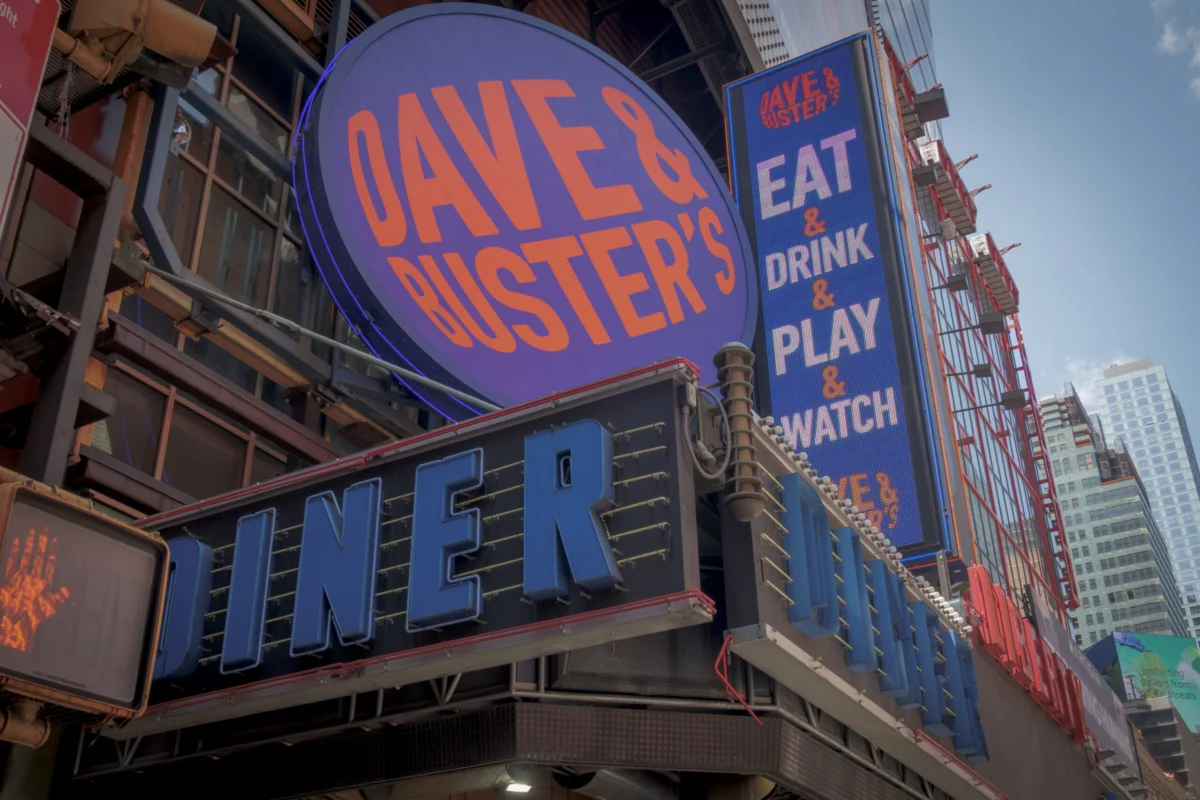
NEW YORK — In a decisive maneuver to arrest a prolonged financial slump, entertainment and dining giant Dave & Buster’s has officially shaken up its roster of marketing partners. Following 13 consecutive quarters of declining sales, the 45-year-old brand has appointed independent creative powerhouse Gut as its creative agency of record (AOR) and global independent media agency Mediaplus as its media AOR.
The dual agency appointments follow a highly competitive, multi-agency pitch process that included the brand’s incumbent partners. Previously, Deloitte Digital held the creative account, while Dentsu X managed media buying and planning.
As Dave & Buster’s approaches a milestone half-century in business, the leadership team is betting that fresh creative thinking and modern media strategies can reconnect the legacy brand with a rapidly evolving consumer base. However, company executives are quick to clarify that this partnership does not entail a traditional brand overhaul. With brand awareness sitting at an enviable 90%, the challenge is not about introducing consumers to who Dave & Buster’s is, but rather giving them a compelling reason to walk through the doors.
Main Facts
The overarching narrative of this agency review centers on a legacy brand grappling with shifting consumer habits in the post-pandemic entertainment landscape.
- The New Roster: Gut has been named the creative agency of record, and Mediaplus has been named the media agency of record. Both agencies won their respective accounts following a comprehensive review that pitted them against incumbent agencies.
- The Incumbents: Deloitte Digital previously served as Dave & Buster’s creative AOR, while Dentsu X managed media operations.
- The Catalyst: The leadership shakeup comes on the heels of 13 consecutive quarters of falling sales, highlighting an urgent need to revitalize top-line growth and foot traffic.
- Brand Health: Despite sliding sales, Dave & Buster’s maintains robust brand equity. According to Chief Marketing Officer Jeremy Tucker, consumer brand awareness for the 45-year-old chain hovers around 90%.
- Strategic Direction: Despite the new agency appointments, the company is explicitly avoiding a ground-up brand refresh. The focus will instead be on driving relevance, modernizing engagement, and converting high awareness into active store visits.
Chronology of a Turnaround: The Path to the Agency Review
To understand how Dave & Buster’s arrived at this pivotal marketing pivot, it is necessary to examine the timeline of operational headwinds, leadership transitions, and strategic evaluations that preceded the Gut and Mediaplus appointments.
The Pandemic and Post-Lockdown Reality
When widespread lockdowns hit the hospitality and entertainment sectors in 2020, experiential dining chains were hit harder than almost any other vertical. Dave & Buster’s, which relies heavily on high-density social gatherings, massive arcades, and large-screen sports viewing environments, saw its business model upended overnight.
While the brand experienced a temporary post-pandemic surge as consumers rushed to resume out-of-home social activities, that pent-up demand eventually plateaued. By 2021 and 2022, inflationary pressures began squeezing discretionary spending among the chain’s core demographic: families, young adults, and Gen Z consumers looking for weekend entertainment.
The 13-Quarter Sludge
Beginning in late 2021 and extending through 2024 and into 2025, Dave & Buster’s found itself grappling with a persistent downward trend. Quarter after quarter, financial earnings reports revealed falling comparable store sales and shrinking foot traffic.
During this stretch, the company attempted various tactical adjustments—including menu overhauls, loyalty program enhancements, and targeted value promotions—yet these efforts failed to reverse the broader trajectory. The mounting pressure signaled to Wall Street and company stakeholders that a deeper, structural evolution in how the brand communicated with its audience was desperately needed.
The Decision to Pitch
Recognizing that its current marketing approach was no longer yielding the desired results, Dave & Buster’s executive leadership initiated a formal, comprehensive agency review in late 2024/early 2025.
The review was designed to test fresh perspectives against the established strategies of incumbents Deloitte Digital and Dentsu X. Over several months, agencies participated in rigorous pitch phases, presenting strategic frameworks, creative concepts, and media models tailored to the modern entertainment landscape.
The Selection of Gut and Mediaplus
By selecting Gut—an agency renowned for disruptive, culturally resonant, and PR-friendly creative work—and Mediaplus—known for data-driven, holistic media planning—Dave & Buster’s signaled a departure from safe, traditional advertising. The announcement in early 2025 marks the official starting line for this new partnership, with the first major integrated campaigns expected to roll out later in the year.
Supporting Data & Market Context
To fully grasp the magnitude of Dave & Buster’s current situation, one must look closely at the quantitative data driving the brand’s business decisions, as well as the broader macroeconomic forces shaping the "eatertainment" sector.
The 90% Awareness Paradox
In marketing, brand awareness is typically treated as the holy grail. For Dave & Buster’s, however, a 90% awareness rate presents a unique paradox.
+-------------------------------------------------------------+
               DAVE & BUSTER'S BRAND METRICS
+-------------------------------------------------------------+
| Brand Age                 | 45 Years                        |
| Consumer Awareness        | ~90%                            |
| Consecutive Sales Slump   | 13 Quarters                     |
| Core Challenge            | Relevance & Conversion          |
+-------------------------------------------------------------+
As CMO Jeremy Tucker pointed out, nearly nine out of ten consumers know what Dave & Buster’s is. They associate the name with massive arcades, oversized cocktails, sports bars, and birthday parties.
The problem is no longer discovery; it is relevance. When consumers make a weekend decision about where to spend their discretionary entertainment dollars, Dave & Buster’s is increasingly losing out to alternative experiences—ranging from boutique bowling alleys and competitive social venues (like Topgolf or Puttery) to home entertainment ecosystems and streaming services. The task for Gut and Mediaplus is not to explain what Dave & Buster’s does, but to inject cultural urgency into the brand so that "knowing" the brand translates into an immediate desire to visit.
The "Eatertainment" Landscape
Dave & Buster’s operates in the competitive "eatertainment" sector—a category that exploded in popularity over the past decade. While market projections indicate long-term growth for experiential dining, the competitive intensity has skyrocketed.
- Demographic Shifts: Gen Z and Millennials increasingly prioritize experiential spending over material goods, but their tastes are fickle. They demand seamless digital integration, high-quality culinary options (moving past standard bar food), and Instagrammable or TikTok-friendly environments.
- Economic Pressures: Persistent inflation and economic uncertainty have made consumers more selective. When dining out or seeking entertainment, patrons expect higher value, making promotional strategies and perceived return on investment crucial.
Official Responses and Strategic Vision
Leadership at Dave & Buster’s, alongside executives from Gut and Mediaplus, have shared early insights into what this partnership aims to achieve and why the timing is critical for the 45-year-old brand.
Jeremy Tucker on the Pivot Point
In an exclusive interview with ADWEEK, Dave & Buster’s Chief Marketing Officer Jeremy Tucker emphasized that the agency appointments coincide with a critical inflection point for the company.
"The agencies are teaming up with the brand at a pivotal moment," Tucker stated.
Rather than signaling a complete identity overhaul, Tucker stressed that the brand’s high awareness gives them a solid foundation to build upon. The objective is to leverage Gut’s creative fearlessness and Mediaplus’s sophisticated media architecture to re-engage lapsed customers and capture the attention of younger demographics who view entertainment through a digital-first lens.
The Creative Philosophy: Gut’s Mandate
Gut, an agency celebrated for its bold, unconventional creative campaigns that frequently capture global headlines, enters the relationship with a clear mandate: shake up the messaging.
While specific creative campaigns have yet to launch publicly, Gut’s track record suggests an approach rooted in cultural relevance, provocative storytelling, and interactive consumer experiences. For a brand like Dave & Buster’s, which relies heavily on the joy of play and social competition, Gut’s creative style is expected to lean heavily into the emotional highs of gaming, winning, and socializing.
The Media Strategy: Mediaplus’s Approach
On the media front, Mediaplus brings a human-centric, data-driven methodology. In an era where media fragmentation makes reaching target audiences increasingly difficult—spanning linear television, connected TV (CTV), social media platforms, programmatic display, and out-of-home advertising—Mediaplus will be tasked with optimizing every advertising dollar.
The agency’s role will involve ensuring that Dave & Buster’s media investments are deployed with surgical precision, meeting consumers where they spend their digital and physical time, and driving measurable foot traffic back to local stores.
Broader Implications for the Industry
The partnership between Dave & Buster’s, Gut, and Mediaplus carries significant implications not just for the brand itself, but for the broader advertising and hospitality industries.
1. The Death of the "Rebrand" for Legacy Giants
Dave & Buster’s explicit decision to bypass a traditional brand refresh despite multi-quarter sales declines offers a valuable lesson in brand stewardship. Many legacy companies panic during downturns, throwing out their logos, changing their brand voice, and alienating loyal customers in an attempt to chase trends.
By recognizing that its 90% awareness is an asset rather than a liability, Dave & Buster’s is choosing to evolve its relevance rather than its identity. This strategy may serve as a blueprint for other 20th-century brands struggling to connect with 21st-century consumers.
2. The Rise of Independent Agencies in Major Retail Reviews
The selection of Gut and Mediaplus—both prominent independent entities—underscores a broader industry trend. Major legacy brands are increasingly looking past holding-company conglomerates in favor of independent agencies that offer agility, specialized creative risk-taking, and transparent media operations. This shift continues to reshape the competitive dynamics of agency pitches across retail, hospitality, and entertainment.
3. Turning Awareness Into Action
Ultimately, the success or failure of this new agency roster will be judged by a single metric: whether those 13 consecutive quarters of falling sales can finally be transformed into positive growth.
If Gut and Mediaplus can successfully convert Dave & Buster’s massive brand awareness into active, recurring foot traffic, it will validate the power of culturally driven creative and precision media planning in turning around legacy brick-and-mortar experiences. As the brand prepares for its upcoming initiatives in Midtown and beyond, the entire marketing and hospitality industry will be watching closely to see if the games can begin anew.