NEW YORK — On the crisp, clear morning of September 11, 2001, the world as New York knew it fractured. Standing on Hudson Street, eyes locked on the unimaginable, witnesses watched in horror as the first tower of the World Trade Center fell. That single, catastrophic morning seared an indelible image into the collective consciousness of a generation.
In the immediate aftermath, the future of Lower Manhattan’s historic Financial District appeared fundamentally bleak. Economic forecasters and urban planners whispered a grim consensus: nobody would ever want to return. The physical wound was too deep, the psychological trauma too profound, and the economic lifeblood drained from downtown in a matter of hours.
Yet, more than two decades later, the skyline tells a vastly different story. Lower Manhattan has completed one of the most remarkable urban transformations in modern history. Far from remaining a graveyard of corporate ambition, the Financial District has evolved into a vibrant, multi-dimensional ecosystem where commerce, culture, media, and residential life intersect. At the heart of this rebirth lies an unlikely catalyst: the advertising, media, and creative industries.
Main Facts: The Resurgence of a Global Financial and Creative Hub
The transformation of Lower Manhattan is no longer a hopeful projection; it is a hard, quantifiable reality. Once viewed as a ghost town after the closing bell at 5:00 PM, the Financial District now pulses with life around the clock.
According to data compiled by the New York State Comptroller, Lower Manhattan’s residential population has more than doubled since 2000. What was once exclusively a nine-to-five enclave of banking executives and traders is now a bustling neighborhood boasting stroller-lined sidewalks, dog parks, elite culinary hotspots, and a booming millennial and Gen Z demographic. Real estate metrics further underline this seismic shift: in 2025, StreetEasy data revealed that the Financial District recorded the highest surge in apartment searches of any neighborhood across all five boroughs.
At the vanguard of this neighborhood evolution were media and tech giants. When traditional corporate titans hesitated to commit to the rebuilding zone, creative conglomerates stepped into the void. Companies like Condé Nast, Spotify, and Fast Company planted their flags downtown, transforming Lower Manhattan from a monocultural banking district into a diversified hub of global commerce, media, and innovation.
Chronology: From the 16-Acre Void to a Skyward Skyline
To understand the magnitude of today’s Lower Manhattan, one must retrace the agonizingly slow, deliberate steps of its physical and spiritual reconstruction.
The Immediate Aftermath (2001–2006)
In the months following the attacks, the site of the World Trade Center remained an open, smoking scar in the middle of the city—a 16-acre void universally referred to simply as "the pit." Spanned by temporary pedestrian bridges, the site felt frozen in time. For a long time, the prevailing sentiment was that nothing could ever successfully rise from the rubble. The emotional toll matched the economic stagnation.
The Rise of the Steel (2006–2013)
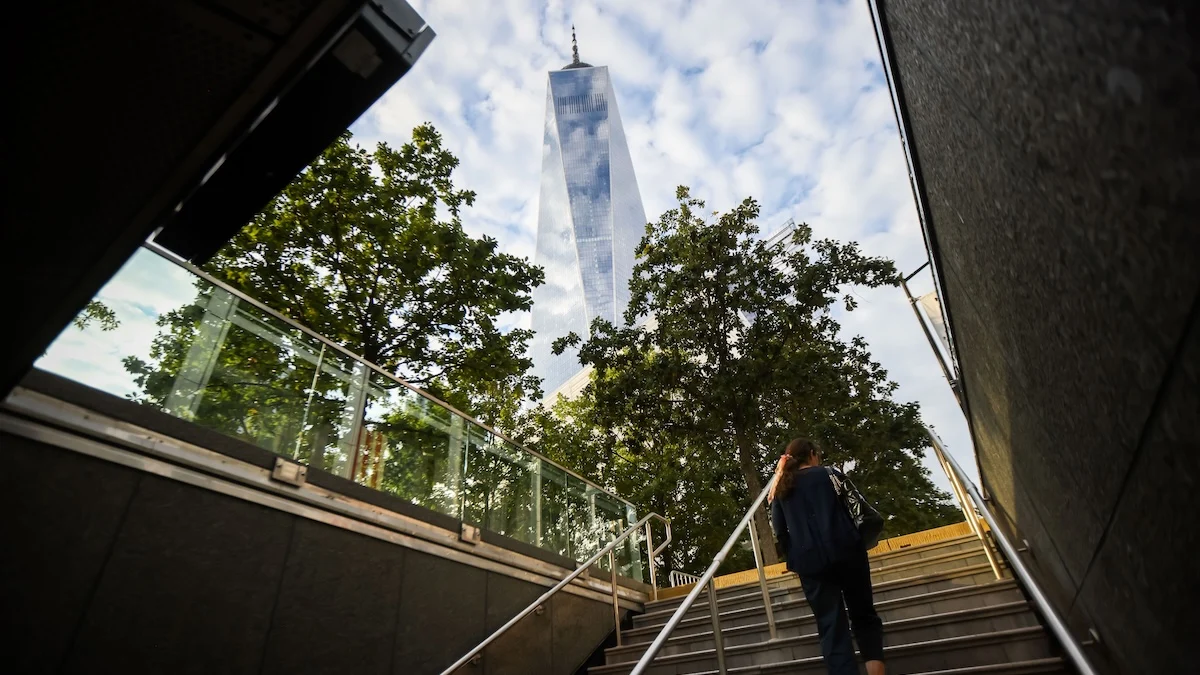
Slowly, painstakingly, the structural blueprints took shape. Steel began to climb. One World Trade Center broke street level and slowly inched its way upward, reclaiming and ultimately redefining the New York City skyline. Over the course of a decade, the city did what it has historically done best: it moved forward without ever forgetting.
The Corporate Gamble (2013)
The turning point for commercial revitalization arrived in 2013, requiring immense corporate courage. WPP, the global advertising and media giant, took a massive calculated risk. Its global media collective, GroupM (now operating as WPP Media), signed one of the very first long-term leases at 3 World Trade Center. At the time, it stood as the largest new office commitment in a World Trade Center building.
This monumental lease was a direct vote of confidence in a vision championed by developer Larry Silverstein, who spearheaded the complex’s redevelopment, and then-Mayor Michael Bloomberg. Their unwavering determination to see downtown restored laid the foundation for the influx of creative agencies and tech enterprises that followed.
Supporting Data: Numbers Behind the Downtown Renaissance
The anecdotal sense of a bustling downtown is thoroughly backed by demographic, economic, and real estate data collected over the past two decades.
- Population Growth: The residential population of Lower Manhattan has surged by over 100% since the turn of the millennium, shifting the neighborhood from a transient business district to a permanent residential community.
- Real Estate Demand: Real estate platform StreetEasy noted that in 2025, the Financial District outpaced every other neighborhood across New York City’s five boroughs in terms of year-over-year growth for apartment search volume.
- Commercial Shifts: The tenant profile of downtown has undergone a complete overhaul. Prior to 2001, the financial services sector occupied the vast majority of Class-A office space. Today, technology, advertising, media, and information (TAMI) companies occupy millions of square feet across the World Trade Center complex and surrounding blocks.
- Infrastructure and Culture: Billions of dollars have been poured into transportation and public spaces, highlighted by the architectural marvel of the Oculus transit hub, alongside expanded waterfront esplanades, schools, and cultural institutions like the Perelman Performing Arts Center.
Official Responses and Stakeholder Perspectives
The rebuilding of Lower Manhattan was never merely an engineering project; it was a profound exercise in civic leadership and psychological recovery.
Developer Larry Silverstein, whose tenacity kept the rebuilding project alive through years of political gridlock, insurance battles, and economic downturns, often emphasized that the project was a moral obligation to the city and the nation. "We had to build back better, stronger, and taller," Silverstein frequently noted, viewing the towers not just as real estate assets, but as symbols of American resilience.
Former Mayor Michael Bloomberg championed the diversification of downtown from the outset. Recognizing that relying solely on the financial sector left the city vulnerable, Bloomberg’s administration aggressively courted tech startups, media conglomerates, and educational institutions to establish roots south of Chambers Street.
For the executives and employees who walk through the World Trade Center campus every day, the environment carries a unique, quiet gravity. Passing the shimmering memorial pools each morning—where the footprints of the twin towers once stood—serves as a daily, sobering ritual. Families, tourists, and corporate executives share the same plaza in quiet reflection.
From office windows overlooking the skeletal, cathedral-like ribs of the Oculus, workers are constantly reminded of the duality of their workspace. It is a place anchored by solemn remembrance, yet fully charged with the daily hum of modern commerce. In high-pressure industries like advertising and media—where deadlines, pitches, and corporate stress often dominate the daily routine—the weighted history of the location provides an intrinsic grounding effect, a daily reminder not to take a single day for granted.
Implications: Creativity as the Ultimate Act of Optimism
What does it mean for the global creative economy to headquarter itself atop the very soil where destruction once reigned?
The revitalization of Lower Manhattan offers a profound lesson on the intersection of urban planning, human psychology, and commercial enterprise. Architects, urban designers, and city planners faced an unprecedented challenge: how to honor the immense loss of life while simultaneously empowering a traumatized community to look toward the future with hope.
The answer lay in creativity.
Urban development experts often argue that creativity is the ultimate act of optimism. Imagination, collaboration, and visionary design are, at their core, gestures toward tomorrow. By inviting the advertising, media, and tech sectors into the Financial District, Lower Manhattan did not merely rebuild its physical infrastructure; it updated its cultural operating system.
Today, Lower Manhattan stands as a living, breathing tribute to endurance. It is a neighborhood where people wake up, raise families, innovate, and build global brands every single day. It proves that even the deepest wounds can be met with structural and creative ingenuity.
For the thousands of advertising executives, media planners, and tech pioneers walking its plazas, the message is clear: Lower Manhattan is a place forever anchored by remembrance, yet surrounded—and propelled—by boundless hope.