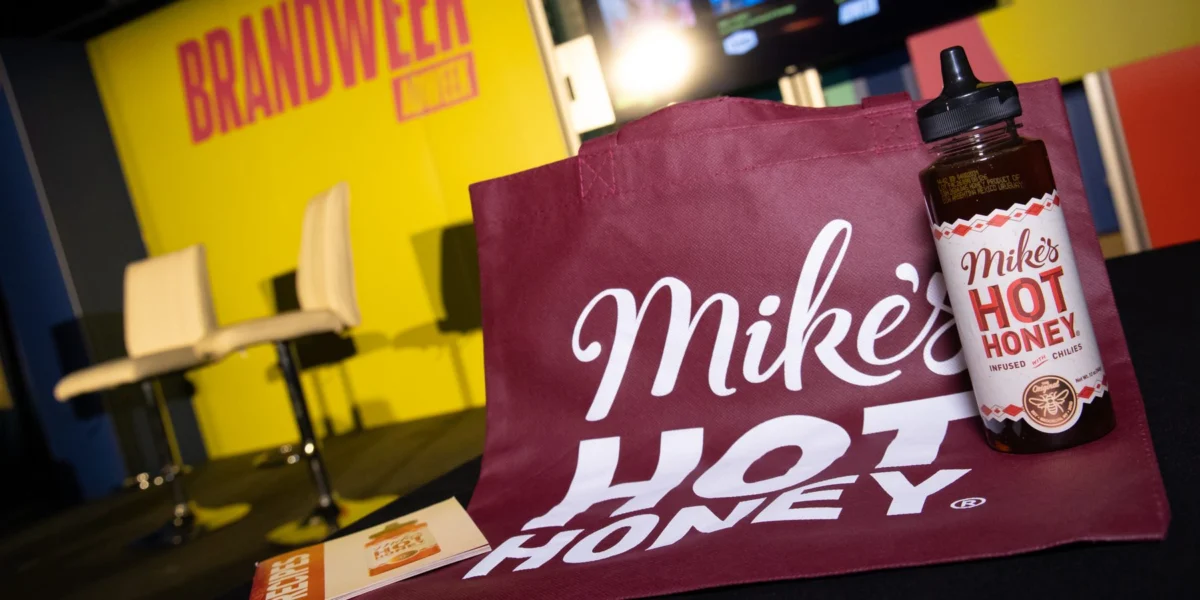
NEW YORK — In the culinary landscape, few products manage to single-handedly carve out an entirely new category. For generations, honey was viewed primarily as a sweetener—a natural addition to morning tea, a drizzle over yogurt, or a baking ingredient. Today, thanks to a fiery concoction born in a Brooklyn kitchen, honey has crossed over into uncharted territory as a savory, heat-packing condiment.
Mike’s Hot Honey has fundamentally shifted consumer perceptions regarding how, when, and where honey can be consumed. Achieving this status, however, required a playbook that was anything but traditional.
At a recent Brandweek "Brands Doing Cool Sht Experience" session, industry leaders gathered to dissect the meteoric rise of the brand. Bill Bradley, deputy TV, media, and sports editor at Adweek*, sat down with Catherine Krueger, senior integrated marketing manager at Mike’s Hot Honey, and Mike Cassell, co-founder and head of strategy at Another Thing. The panel explored the strategic maneuvers, grassroots origins, and cultural resonance that transformed a localized single-product startup into an undeniable consumer packaged goods (CPG) heavyweight.
Main Facts: The Anatomy of a Disruptor
The core of Mike’s Hot Honey’s business model is deceptively simple: pure honey infused with chili peppers. Yet, this minimalist ingredient list birthed a complex brand ecosystem that now dominates supermarket shelves, restaurant tabletops, and social media feeds alike.
- The Product: A high-margin, scalable blend of sweet and heat that appeals to a diverse demographic of culinary adventurousness.
- The Market Impact: By pioneering the "hot honey" subcategory, the brand paved the way for a wave of competitors while retaining market leadership through authentic branding and cultural agility.
- The Growth Engine: Eschewing massive upfront capital expenditures or traditional high-budget advertising campaigns, the brand scaled through organic culinary partnerships, localized grassroots marketing, and word-of-mouth advocacy.
- The Leadership Insights: As revealed during the Brandweek panel, the brand’s sustained momentum relies heavily on maintaining a distinct voice, treating the product as an experience rather than a mere commodity, and leveraging modern marketing frameworks to stay relevant in a crowded grocery aisle.
Chronology: From Pizzeria Experiment to National Staple
The journey of Mike’s Hot Honey is a masterclass in organic business evolution. Unlike corporate-backed incubators that launch with millions of dollars in venture capital and exhaustive focus groups, Mike’s Hot Honey grew out of experimentation, serendipity, and neighborhood hustle.
2010: The Brooklyn Genesis
The story began in the vibrant culinary ecosystem of Brooklyn, New York. Founder Mike Kurtz was working in a pizzeria when he began experimenting with infusing honey with chili peppers. Inspired by a pizzeria he had visited in Brazil that served honey with pepper flakes on top, Kurtz developed his own proprietary recipe.
Initially, the infused honey was made in small batches and drizzled over pizzas at the restaurant where he worked. Customers immediately took notice. The contrast of the sweet, floral notes of the honey paired with the sharp, lingering burn of the chilies against savory cheese, tomato sauce, and charred crust proved irresistible. Diners began asking if they could buy bottles to take home.
2011–2015: Word-of-Mouth and the Local Pizzeria Circuit
During its formative years, the brand did not rely on traditional retail distribution. Instead, it grew through a hyper-local, grassroots distribution model. Kurtz delivered bottles by hand to independent pizzerias and specialty food shops across Brooklyn and Manhattan.
This strategy achieved two crucial objectives:
- It established unshakeable culinary credibility by associating the product with artisanal pizza culture.
- It built a passionate base of early adopters who advocated for the product simply because they loved how it tasted on their food.
Slowly, the honey began appearing on tables across New York City, turning everyday diners into brand ambassadors.
2016–2019: Retail Expansion and Category Creation
As demand spilled over from restaurants into households, the brand transitioned from a local secret to a wider retail presence. Mike’s Hot Honey secured placement in high-end specialty grocery stores, followed by regional supermarket chains.
Crucially, the brand was operating in a category of its own. While hot sauces had enjoyed decades of cult status and mainstream growth, "hot honey" was an entirely novel concept for the average grocery shopper. Consumer education happened organically through visual merchandising—showcasing the vibrant amber and red-tinted liquid—and through strategic culinary partnerships.
2020–Present: The Cultural Phenomenon
The 2020s marked a period of exponential scaling. Propelled by the home-cooking boom of the pandemic era and the virality of food content on platforms like TikTok and Instagram, Mike’s Hot Honey transformed into a cultural touchstone. Major fast-food chains began incorporating hot honey into limited-time offerings (LTOs), validate-testing the flavor profile for mass audiences.
Today, the brand is a fixture in mainstream supermarkets nationwide, sitting comfortably alongside legacy condiments like ketchup, mustard, and hot sauce.
Supporting Data and Market Insights
The success of Mike’s Hot Honey is not merely a matter of good taste; it reflects broader shifts in consumer behavior, flavor preferences, and marketing efficacy.
The Rise of Flavor Adventurousness
Market research consistently shows that modern consumers—particularly Millennials and Gen Z—crave bold, complex flavor profiles that combine contrasting sensations. The "swicy" (sweet and spicy) trend has become one of the dominant forces in the food and beverage industry. According to food industry data analysts, searches and menu mentions for hot honey grew by triple digits over a five-year span leading up to the mid-2020s.
The Power of Nontraditional Marketing
During the Brandweek session, Catherine Krueger and Mike Cassell emphasized that scaling a niche product into a household name requires abandoning the conventional CPG playbook. Key data points regarding the brand’s marketing philosophy include:
- Organic Reach Over Paid Display: A significant percentage of the brand’s early growth and sustained cultural relevance stems from earned media, user-generated content, and organic culinary advocacy rather than heavy programmatic ad spending.
- B2B-to-B2C Synergy: By maintaining a strong presence in foodservice (restaurants, pizzerias, and fast-casual chains), the brand utilizes dining establishments as physical showrooms. When consumers experience the product on a restaurant menu, they are primed to purchase a bottle at retail.
Official Responses: Insights from the Brandweek Stage
The conversation between Bill Bradley, Catherine Krueger, and Mike Cassell offered a rare behind-the-scenes look at the strategic machinery powering Mike’s Hot Honey.
The Strategy of Staying Authentic
Catherine Krueger addressed the challenges of scaling a brand rooted in artisanal authenticity without losing its soul. "When you start in Brooklyn pizza shops, your credibility is baked into the product," Krueger noted. "As you grow into national retailers, the challenge isn’t just about distribution logistics—it’s about ensuring that every consumer touchpoint still feels authentic to that original discovery moment."
Krueger stressed that modern marketing must treat the consumer as an active participant rather than a passive target. By leaning into the unexpected ways people use the product—whether on pizza, fried chicken, roasted vegetables, cocktails, or ice cream—the brand encourages organic experimentation.
Building a Cultural Footprint
Mike Cassell expanded on the cultural dimension of the brand’s success, highlighting how Another Thing approaches strategy for modern challengers. "Mike’s Hot Honey didn’t just introduce a new SKU; they shifted a cultural habit," Cassell explained during the session.
According to Cassell, challenger brands succeed by identifying white space in stagnant legacy categories. While major food conglomerates often rely on line extensions of existing products (e.g., a slightly spicier version of standard ketchup), true disruptors introduce entirely new paradigms.
"The goal was never just to sell honey," Cassell noted. "The goal was to make people question why they had never put heat in their sweet before. Once you change that baseline assumption, the entire culinary world opens up."
Implications: What Mike’s Hot Honey Means for the Future of CPG
The trajectory of Mike’s Hot Honey offers valuable lessons for marketers, entrepreneurs, and established food corporations alike. As consumer loyalty shifts away from faceless corporate conglomerates toward brands with distinct personalities and authentic origin stories, the Mike’s Hot Honey model serves as a blueprint for modern brand building.
1. The Death of the Traditional Ad Funnel
The brand’s reliance on grassroots foodservice adoption proves that experiential trial remains one of the most powerful conversion tools in existence. For new CPG brands, securing placement where consumers are already gathered to enjoy food—such as restaurants and food festivals—yields higher long-term brand equity than digital banner ads.
2. Category Creation Requires Persistence
Pioneering a new category is fraught with risk. Retail buyers are often hesitant to allocate shelf space to products that do not fit neatly into existing category definitions. Mike’s Hot Honey succeeded by proving market demand from the bottom up: consumers demanded it from restaurants, restaurants demanded it from distributors, and eventually, supermarkets had no choice but to create space for it.
3. Agility in the Age of Social Media
In an era where food trends explode overnight on social media platforms, brands must be nimble enough to capitalize on viral moments. Mike’s Hot Honey’s willingness to embrace quirky consumer recipes and unconventional pairings has kept the brand fresh, engaging, and culturally relevant.
Conclusion
From a solitary experiment in a Brooklyn pizzeria to a multi-channel culinary powerhouse, Mike’s Hot Honey has permanently altered the condiment landscape. As industry professionals look toward the future, the brand stands as a testament to the fact that with a superior product, authentic roots, and a willingness to challenge convention, even the most traditional pantry staple can be reinvented.