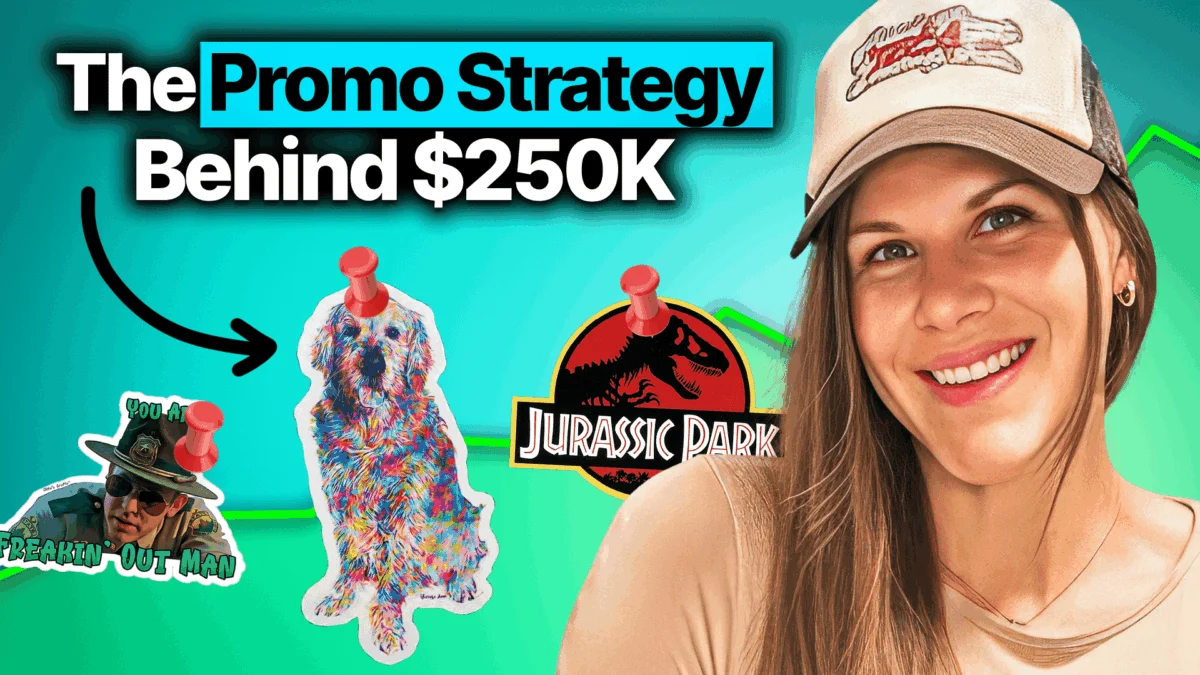
In the digital age, the barrier to entry for e-commerce has never been lower, but the challenge of achieving sustainable, long-term profitability remains significant. Many entrepreneurs start with grand visions of complex software or high-end retail, but Therese Waechter, the founder of the thriving sticker brand Otto’s Grotto, took a different path. By focusing on a singular, humble product—the sticker—and mastering the intricacies of multi-platform distribution, she has scaled a grassroots project into a $250,000-per-year enterprise.
This article explores the trajectory of Otto’s Grotto, detailing how Waechter navigated the treacherous waters of platform dependency, in-house manufacturing, and the modern "vibe coding" revolution to build a resilient e-commerce machine.
The Chronology: From Accidental Design to E-Commerce Dominance
The story of Otto’s Grotto did not begin with a detailed business plan or venture capital. Instead, it was born out of the common e-commerce grind. Waechter was initially exploring Amazon FBA (Fulfillment by Amazon) flips and various merchandising avenues. During this period of experimentation, one particular design resonated with her audience.
The Pivot Point
Initially, Waechter bundled stickers with t-shirts as a value-add. However, the data told a different story: the stickers were the real draw. When a sudden, unexplained shutdown of her Facebook storefront threatened her livelihood, Waechter was forced to evaluate her strategy. Rather than viewing the closure as a terminal failure, she treated it as a catalyst for diversification. She began investing heavily in more stable, search-intent-driven platforms like Etsy and Amazon, effectively insulating her brand from the volatility of social media algorithms.
In-House Evolution
As demand increased, Waechter faced the classic entrepreneur’s dilemma: outsource and lose margins, or keep it in-house and lose time? She chose the latter, investing in high-quality printers, laminators, and cutting machinery. This period was characterized by "growing pains," as she learned the nuances of sticker production. By bringing manufacturing in-house, she gained unprecedented control over quality and fulfillment speed—a critical competitive advantage on platforms where shipping times are a primary ranking factor.
Supporting Data: The Multi-Platform Ecosystem
Waechter’s success is built upon a four-pillar distribution strategy. She treats each platform not as a carbon copy of the others, but as a specialized tool designed to capture a specific type of customer intent.
The Four-Platform Strategy
- Etsy: Serving as the brand’s creative hub, Etsy is used to test new designs and engage with a community that values the "handmade" aesthetic.
- Amazon: Utilized for high-volume, keyword-driven sales. Waechter treats Amazon as a search engine, optimizing listings for high-intent shoppers who want fast delivery.
- Faire: This is the engine of her wholesale business. By listing on Faire, she reaches independent boutique owners across the country, providing a steady stream of B2B revenue.
- Shopify: Her independent storefront, which acts as the "home base." Crucially, she uses her website to capture direct wholesale leads, bypassing the 15% commission fees associated with third-party wholesale platforms.
The Shift to Automation
Recently, Waechter has transitioned toward a hybrid model. She is currently outsourcing core production to a vetted trade printer. This move represents a strategic shift from "small business operator" to "brand manager." By offloading the physical labor of printing and cutting, she is focusing on the higher-level tasks that drive growth: SEO, media relations, and design innovation.
The Role of "Vibe Coding" and AI
One of the most intriguing aspects of Waechter’s recent growth is her integration of Artificial Intelligence. In a widely discussed feature in Business Insider, she was highlighted for her practice of "vibe coding"—a colloquial term for using tools like ChatGPT to write code or build website features that would otherwise require a professional developer.
While Waechter admits that AI can sometimes lead to "side quests"—distractions that pull her away from core revenue-generating activities—it has fundamentally changed her workflow. She uses AI to:
- Draft compelling, SEO-rich product descriptions for thousands of SKUs.
- Automate customer service responses to common queries.
- Rapidly prototype design concepts before moving to final production.
This tech-forward approach allows her to maintain a lean operation while outputting the volume of a much larger corporation.
Implications for Modern E-Commerce
The success of Otto’s Grotto offers a roadmap for aspiring entrepreneurs. Waechter’s journey highlights several immutable truths about the current e-commerce landscape.
1. The Power of Search Intent
Unlike the "viral" model, which relies on fleeting social media trends, Waechter built her business on search intent. People search for stickers on Amazon and Etsy because they have a specific need or desire. By meeting that demand with high-quality, optimized content, she ensures a consistent flow of traffic that doesn’t require constant social media maintenance.
2. Diversification as Risk Mitigation
If there is one lesson to be learned from her early Facebook crisis, it is that platform dependency is the death of many small businesses. By spreading her presence across four distinct channels, Waechter has created a business that can survive even if one channel falters.
3. The "Earned Media" Strategy
Waechter does not rely solely on paid advertising. She is an active practitioner of "earned media." By utilizing platforms like Qwoted and participating in PR communities, she secures features in publications that bolster her brand’s authority. This serves a dual purpose: it builds trust with customers and creates high-quality backlinks that improve her search engine rankings.
Strategic Advice for Sellers
During her appearance on the Niche Pursuits Podcast, Waechter provided actionable advice for those looking to replicate her success:
- For Amazon Sellers: Don’t just list a product. Study the algorithm. Use high-volume keywords in your titles and ensure your images are optimized for the mobile shopping experience.
- For Etsy Sellers: Consistency is key. Treat Etsy as a long-term SEO project. Update your listings frequently and engage with the community to keep your shop relevant in the eyes of the algorithm.
- For Faire/Wholesale: Understand that B2B is a relationship game. Offer attractive terms to retailers and always look for ways to transition your most loyal wholesale clients to your direct Shopify site to maximize margins.
Final Thoughts: The Future of the Sticker Business
Therese Waechter’s journey is a testament to the fact that there is no "too small" category in business. By applying rigorous professional standards to a niche product, she has created a scalable, semi-passive income stream that affords her both financial freedom and creative autonomy.
Her story serves as a reminder that the path to a six-figure business is rarely a straight line. It is a series of pivots, from accidental beginnings to the adoption of advanced AI tools. For those currently building their own niche site or e-commerce brand, the takeaway is clear: focus on your platform, optimize for search, and never stop looking for ways to streamline your operation.
Whether you are printing stickers in your living room or building a global brand, the principles remain the same: identify a need, own your distribution, and never stop learning.