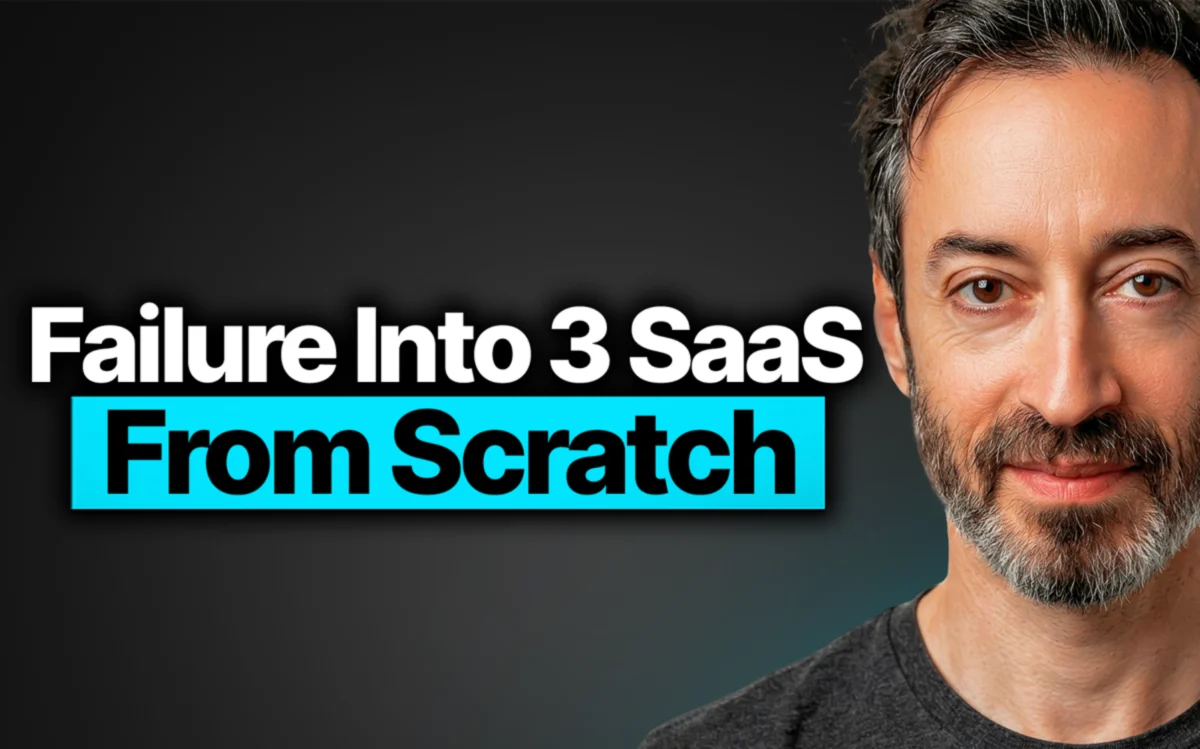
SAN FRANCISCO — The modern trajectory of tech entrepreneurship is rarely a straight line, but few founders have traversed a path as diverse as Bernard Huang. In a recent, wide-ranging appearance on the Niche Pursuits podcast, Huang unpacked an eclectic career spanning college poker circuits, a failed restaurant franchise, seven foundational years in Silicon Valley, high-level SEO consulting, and the bootstrap scaling of Clearscope to mid-seven-figure revenues.
Beyond recounting his operational journey, Huang offered a sobering look at the shifting economics of online publishing and the structural disruptions introduced by generative artificial intelligence. His experiences offer a masterclass in probabilistic decision-making, systems engineering, and adapting to technological tides.
Main Facts: The Anatomy of an Unorthodox Entrepreneur
Huang’s career is defined by rapid adaptation across entirely different industries. Key milestones from his professional evolution include:
- Early Success: Huang generated over $100,000 in online poker winnings while still an undergraduate student, using the game to hone his mental models for risk management and expected value.
- Brick-and-Mortar Realities: Following college, he invested his poker earnings into a physical restaurant franchise (Dickey’s Barbecue Pit), an operation that folded after 13 months due to crushing labor and management challenges.
- The Silicon Valley Catalyst: Relocating to the tech hub, Huang spent seven years embedded in the ecosystem, including a stint at the Y Combinator-backed commercial real estate marketplace 42Floors.
- The Software Pivot: Leveraging deep organic search expertise gained from his consulting days, Huang co-founded Clearscope around 2016, bootstrapping the entity-optimization software company to a mid-seven-figure peak over a nearly ten-year run.
- The AI Disruption: Most recently, Huang has been experimenting with automated social video workflows—generating tens of millions of views at a fraction of traditional production costs—while warning that generative AI is fundamentally breaking legacy online publishing economics.
Chronology: A Decade-by-Decade Evolution
To understand how Huang arrived at the forefront of content optimization, it is necessary to examine the chronological stepping stones that shaped his business philosophy.
Phase 1: The Poker Table and the Mathematics of Risk
Huang’s entry into business began unexpectedly during his high school years when he watched a classmate clear six figures playing online poker. Intrigued, Huang dedicated himself to studying the mathematics of the game. By the time he reached college, he was consistently pulling in six figures at the virtual tables.
More importantly, poker instilled in Huang a foundational mental model: the separation of decision quality from outcome. A player can make the statistically optimal move and still lose because probabilities do not guarantee single-instance results. Conversely, bad decisions can occasionally yield lucky wins.
When applied to business, this philosophy changed how Huang viewed failure. Struggling entrepreneurs often internalize losses as a personal indictment of their talent. Huang realized that failing marketing campaigns, poor product launches, or sluggish sales are rarely moral or intellectual failings; rather, they are symptoms of a flawed underlying system. By treating failures as systemic bottlenecks rather than personal defects, entrepreneurs can objectively study, adjust, and optimize their operations.
Phase 2: The 13-Month Restaurant Experiment
Armed with his poker earnings, Huang and a group of friends dived headfirst into the physical world by acquiring a Dickey’s Barbecue Pit franchise. Reality proved harsh. The business lasted a mere 13 months before the founders pulled the plug.
The venture exposed the crushing operational weight of brick-and-mortar businesses, where labor, inventory management, daily food preparation, and fluctuating customer demand must align flawlessly every single day. For Huang, who was in his early twenties at the time, labor management proved to be the insurmountable hurdle. High employee turnover, general manager burnout, and the awkward dynamics of a 20-year-old attempting to manage significantly older, experienced hospitality workers combined to break the business model.
Rather than dismissing physical commerce entirely, Huang walked away with a nuanced takeaway: founders must possess the self-awareness to identify their operational blind spots, define roles with absolute clarity, and hire personnel whose hard-earned expertise directly complements the founder’s weaknesses.
Phase 3: The Silicon Valley Crucible
Seeking an escape from physical retail, Huang taught himself to code and spent several years ideating online startups before landing in Silicon Valley. From approximately 2013 through 2020, he immersed himself in the tech ecosystem, notably joining 42Floors.
Surrounded by hyper-ambitious engineers, venture capitalists, and battle-tested operators working on complex technical challenges, Huang experienced the transformative power of geographic and intellectual proximity. Being embedded in Silicon Valley meant that influential investors, seasoned mentors, and potential co-founders were never more than an introduction or two away. This network would later form the seedbed for his consulting career.
Phase 4: From High-End Consulting to Clearscope
At 42Floors, Huang spearheaded growth initiatives and mastered the nuances of organic search, helping the company rank aggressively for high-value commercial real estate terms in major metropolitan markets like San Francisco and New York.
After departing, Huang and a partner briefly explored an esports coaching marketplace connecting League of Legends players. When low transaction values stalled that concept, they pivoted to SEO consulting, riding referrals from their Y Combinator network. Soon, they were managing six-figure contracts for enterprise clients with massive, sprawling websites.
Through these intensive client audits, Huang’s team uncovered a critical insight: SEO success wasn’t merely a byproduct of technical checklists, backlink volume, and repetitive keyword stuffing. Instead, page quality, user intent, and comprehensive topic coverage dictated organic performance.

This realization prompted rigorous testing using natural language processing (NLP) to map out related semantic entities found across top-ranking search results. When client sites systematically integrated these entities, they recorded organic traffic gains ranging from 50% to 150% within 30 days. These repeatable results validated a transition from custom agency consulting to productized software: Clearscope was born.
Supporting Data & Operational Insights
Huang’s path with Clearscope highlights several distinct operational and growth strategies that set bootstrapped SaaS companies apart from venture-backed behemoths.
Customer Success as the Primary Growth Engine
When Clearscope launched around 2016, it introduced a novel category. Content optimization software was not yet a standard line item in marketing budgets. Consequently, outbound cold outreach routinely failed; enterprise SEOs, inundated with automated pitches warning of technical site errors, reflexively treated cold emails as spam.
To overcome this, Huang leaned heavily into a high-touch customer success model. For instance, when an early prospect at Optimizely signed up but underutilized the tool, Huang personally optimized their content in exchange for a case study if traffic improved. The rewritten page subsequently saw a traffic surge exceeding 100%.
These proof-of-concept victories established vital trust. Because elite SEO practitioners often treat proprietary tactics as competitive advantages, growth rarely happened through public shouting matches. Instead, word-of-mouth recommendations traveled quietly through private professional circles.
The Decadel-Long Bootstrap Strategy
While Huang had deep roots in the venture capital community, he and his co-founder deliberately chose to bootstrap Clearscope for nearly a decade.
- Autonomy Over Scale: Avoiding traditional VC funding allowed the founders to sidestep the hyper-growth treadmill that traps many tech startups. They were not pressured to achieve "unicorn-or-bust" valuations that often force premature scaling or unnatural corporate pivots.
- Sustainable Cash Flow: By focusing on unit economics and reliable profitability, Clearscope scaled to mid-seven figures in annual recurring revenue.
- The Trade-Off: Huang openly acknowledges the downsides of bootstrapping—primarily missing out on institutional mentorship, aggressive hiring pipelines, and rapid capital injections during market contractions—yet maintains that the absolute control over product vision justified the path.
Implications: The Looming Shadow of Generative AI
As Huang looks beyond the decade-long build of Clearscope, he identifies a profound structural shift underway in the digital economy: the rapid collapse of traditional online publishing economics.
The Death of Traditional Content Economics
For decades, the implicit social contract of the internet rewarded creators and publishers: invest capital and time into producing valuable, informative content, and search engines or social algorithms will reward you with traffic, advertising revenue, and paying customers.
Generative AI has fundamentally fractured this pipeline. When AI-powered search engines and answer engines synthesize and deliver information directly to users, the incentive for consumers to click through to original publisher websites evaporates. Small publishers can no longer justify heavy investments in deep editorial work when the upstream traffic is intercepted.
Simultaneously, the cost of media production has hit structural floors. Huang shared personal tests with automated social video workflows—utilizing AI video generation models and automated scheduling tools—that successfully amassed roughly 20 million views at a fraction of traditional production costs. When an automated workflow can produce engaging media for pennies, human-led productions face severe economic pressure.
The New Rules of Software and Audience Ownership
In an environment where generating code, content, or media is frictionless, production alone ceases to be a competitive moat. Anyone can spin up a product or publish an article, leading to a saturated digital marketplace.
Huang points to two critical survival strategies for modern entrepreneurs:
- Endurance as an Advantage: While thousands can launch a product or channel over a weekend, very few maintain operational consistency across three, six, or twelve months. Persistence remains a rare commodity.
- The New Pricing Anchor: With powerhouse AI subscriptions like Claude Max and ChatGPT Pro anchoring consumer expectations around $200 per month, software pricing models face downward pressure. Founders must adapt by offering broad utility or shifting monetization away from the software tool itself toward attention and community.
Ultimately, Huang advises modern creators to bypass fragile intermediary platforms—such as search engines and social algorithms prone to overnight policy shifts—and cultivate direct, owned relationships with audiences via newsletters, specialized communities, and direct customer channels.
Official Responses and Industry Outlook
While industry analysts debate the long-term impact of autonomous agents on software-as-a-service (SaaS) multiples, founders like Huang view the current era as a period of unprecedented experimentation.
The barriers between a conceptual idea and a finished product have effectively vanished. For entrepreneurs willing to embrace probabilistic thinking, abandon emotional attachments to failed systems, and pivot dynamically when metrics dictate, the post-AI landscape offers vast opportunities—provided they own their audiences and build businesses anchored in true operational resilience.