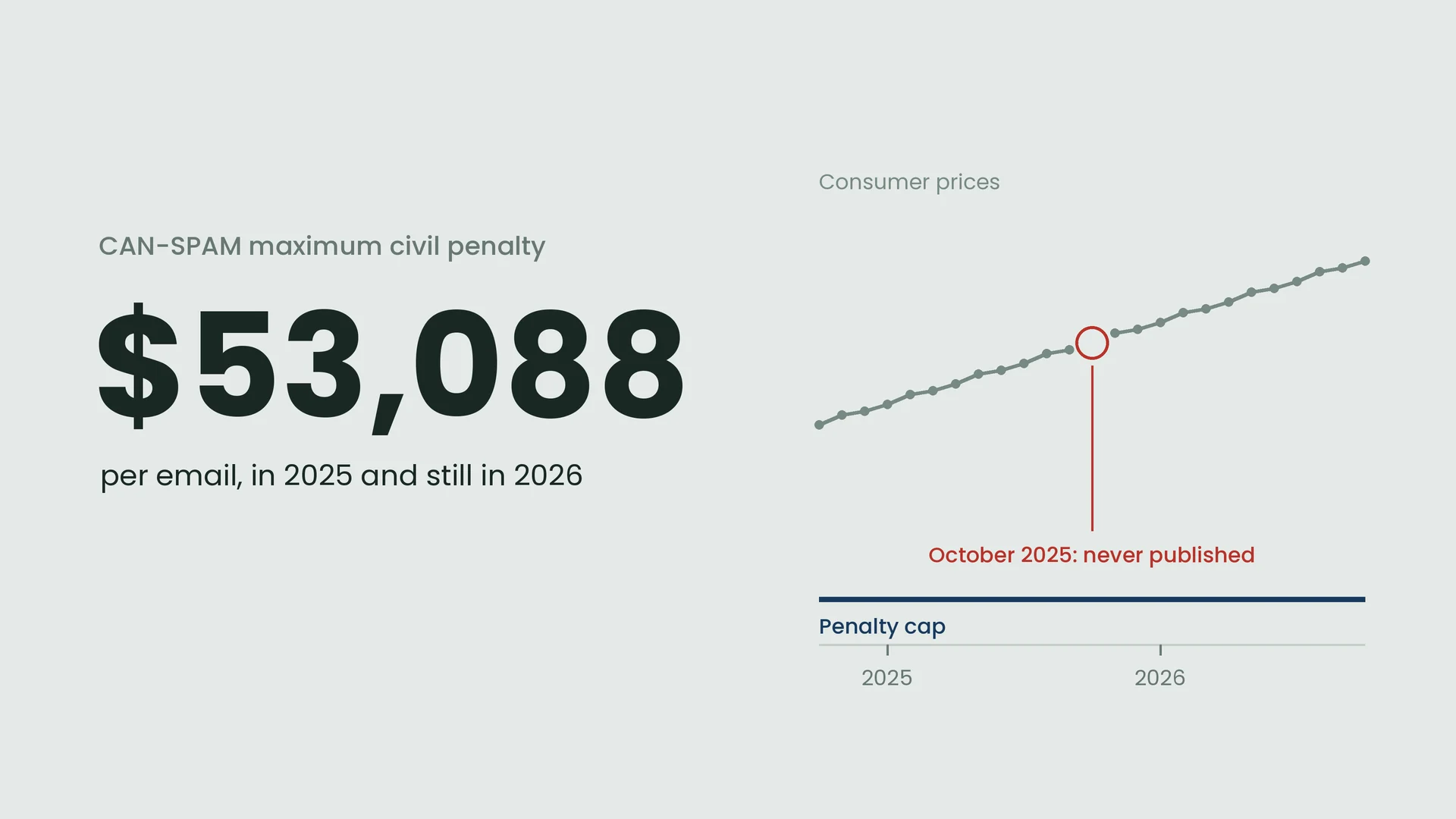
WASHINGTON — In a regulatory decision that offers a momentary financial reprieve to high-volume commercial emailers, the Federal Trade Commission (FTC) confirmed in the Federal Register on September 15 that the maximum civil penalty for a violation of the Controlling the Assault of Non-Solicited Pornography and Marketing (CAN-SPAM) Act will remain capped at $53,088 per email for the remainder of 2026.
The ruling cements the continuation of 2025’s penalty thresholds, halting the customary annual inflationary escalations mandated by federal law. The freeze is a direct consequence of last autumn’s federal government shutdown, which disrupted vital economic data collection by the Bureau of Labor Statistics (BLS) and forced the Office of Management and Budget (OMB) to cancel annual adjustments across the executive branch.
While marketing departments and compliance officers breathe a temporary sigh of relief, legal experts emphasize that the penalty structure remains formidable. A single email campaign falling foul of federal guidelines still exposes senders to astronomical theoretical liabilities, even as state-level statutory damages move in the opposite direction.
Main Facts
The foundational mechanics of federal civil penalties rest on statutory inflation adjustments. However, the FTC’s recent confirmation in the Federal Register establishes several critical baseline facts for the digital marketing and compliance sectors through December 31, 2026:
- The Penalty Cap: The maximum civil penalty for a single CAN-SPAM violation remains steady at $53,088 per email.
- Regulatory Authority: Under federal enforcement frameworks, CAN-SPAM violations are prosecuted as unfair or deceptive acts or practices under Section 5 of the FTC Act, meaning the statutory cap applies to every individual non-compliant message sent.
- The Governing Code: Current penalty amounts are codified under 16 CFR § 1.98, which has remained untouched since January 2025.
- The Root Cause: The freeze stems from data omissions caused by the autumn 2025 federal government shutdown, preventing the calculation of the Consumer Price Index (CPI) metrics required for statutory updates.
- Future Outlook: The freeze is strictly temporary. Unless Congress passes intervening legislation, the 2027 adjustment will absorb a cumulative two-year inflation cycle, likely resulting in a substantial jump in baseline penalties next year.
Chronology of a Regulatory Freeze
To understand how the federal government arrived at a mid-September confirmation regarding 2026 penalties, it is necessary to examine the chain of events that unfolded across the nation’s capital over the past twelve months.
Autumn 2025: The Government Shutdown
Every federal agency is bound by the Federal Civil Penalties Inflation Adjustment Act Improvements Act of 2015, which requires annual adjustments to civil monetary penalties. The calculation relies heavily on comparing the Consumer Price Index for all Urban Consumers (CPI-U) for October of the current year with the CPI-U for October of the preceding year.
However, last autumn, a protracted federal government shutdown severely disrupted operations across multiple departments. The BLS was unable to conduct or finalize essential economic surveys and data tabulations. Consequently, the crucial October 2025 Consumer Price Index figure—the mathematical linchpin for the 2026 penalty adjustments—was never officially produced.
April 17, 2026: OMB Issues Memo M-26-11
With the baseline October data missing, executive agencies faced a legal and administrative vacuum regarding how to implement the statutory mandate for January 2026 adjustments. To resolve the impasse, the OMB issued Memorandum M-26-11 on April 17, 2026.
The directive officially cancelled the 2026 civil penalty inflation adjustments for every federal agency, instructing them to maintain their existing penalty schedules—those established in January 2025—for the remainder of the calendar year.
September 15, 2026: Formal FTC Confirmation
Although the OMB memo set the policy in April, federal agencies were required to formally update their respective regulatory records to reflect the status quo. On September 15, 2026, the FTC published its formal notice in the Federal Register (RIN 3084-ABXX / Docket No. FTC-2026-18853), confirming that it would not alter its civil penalty amounts for 2026 and would continue applying the 2025 baseline figures through the end of the year.
Supporting Data and Comparative Analysis
While a $53,088 per-email penalty is a theoretical ceiling for most infractions, the math behind large-scale commercial email campaigns can quickly spiral into figures that dwarf corporate balance sheets.
The Scale of Federal Exposure
In commercial email marketing, lists often number in the hundreds of thousands, if not millions, of subscribers. If an enterprise launches a campaign that violates core tenets of the CAN-SPAM Act—such as using deceptive header information, failing to provide a functioning opt-out mechanism, or omitting a valid physical postal address—the theoretical exposure scales rapidly:
- 10 non-compliant emails: Up to $530,880
- 100 non-compliant emails: Up to $5,308,800
- 1,000 non-compliant emails: Up to $53,088,000
While the FTC rarely extracts the absolute maximum statutory penalty for every single message in a mass-marketing campaign—often settling for fractions of the total exposure or negotiating civil penalties based on ill-gotten gains and corporate ability to pay—the $53,088 figure serves as the primary anchor during settlement negotiations and judicial proceedings.
Federal vs. State Damages: Washington CEMA Contrast
The weight of federal penalties stands in stark contrast to recent adjustments seen at the state level. A prime example is Washington State’s newly amended Commercial Electronic Mail Act (CEMA).
Washington’s CEMA historically featured steep statutory damages designed to deter spam. However, under recent legislative updates highlighted by industry analysts, the state cut its statutory damages from $500 down to $100 per email for cases filed on or after June 11.
The disparity is staggering:
- A single federal CAN-SPAM penalty ($53,088) is equivalent to the statutory damages of more than 500 individual emails under Washington’s revised CEMA framework.
- This divergence highlights the shifting enforcement burden in the United States. While state legislatures ease local statutory damages to balance litigation risks for businesses, federal regulators maintain an uncompromising stance on deceptive or non-compliant digital messaging.
Official Responses and Industry Reactions
The regulatory freeze has elicited mixed reactions from legal professionals, email deliverability consultants, and compliance advocates.
Industry trade groups expressed relief that the OMB and FTC recognized the administrative impossibility of implementing inflation adjustments without the necessary BLS data. Speaking on condition of anonymity, a compliance director for a major e-commerce platform noted:
"The freeze prevents an unnecessary compounding administrative headache during a year already marked by economic uncertainty. However, our compliance posture has not shifted by a single degree. Whether the penalty is $53,088 or projected to hit $55,000 next year, the baseline rule remains: compliance is non-negotiable."
Legal scholars, meanwhile, have pointed out the unique nature of the OMB memo. Federal mandates for annual inflation adjustments are rarely skipped entirely; typically, agencies implement retroactive catch-up adjustments. The decision to completely forgo the 2026 adjustment cycle reflects the acute disruption caused by the 2025 government shutdown.
Furthermore, consumer protection advocates have downplayed the significance of the freeze, arguing that the $53,088 penalty cap remains more than sufficient to deter bad actors when combined with the FTC’s broader enforcement tools, which include consumer redress, injunctions, and mandatory data-reporting requirements.
Implications for Marketers and Compliance Officers
As the calendar turns toward the final quarter of 2026, legal and marketing professionals must look beyond the immediate freeze and prepare for what lies ahead.
1. The 2027 Double-Adjustment Shock
Because the 2026 inflation adjustment was cancelled rather than permanently forgiven, the regulatory mechanism will resume in January 2027. Under standard statutory formulas, the 2027 adjustment will be calculated by comparing the Consumer Price Index of October 2026 against the pre-shutdown baseline.
Without legislative intervention to alter the formula, the 2027 figure will effectively bake in a cumulative two-year inflation adjustment. Compliance officers should anticipate a notable jump in the per-email penalty cap when the FTC publishes its updated rules in early 2027, making proactive risk mitigation even more urgent.
2. Ongoing CAN-SPAM Fundamentals
The penalty freeze does not alter the underlying rules of the CAN-SPAM Act, which celebrated its twentieth anniversary in recent years. Marketers must continue to strictly enforce compliance across seven core pillars:
- No False or Misleading Header Information: Source, destination, and routing information must be accurate and identify the person or business who initiated the message.
- No Deceptive Subject Lines: The subject line must not mislead the recipient about the contents or subject matter of the message.
- Identification as an Advertisement: The message must clearly and conspicuously disclose that it is an advertisement or solicitation.
- Valid Physical Postal Address: The email must include the sender’s valid current physical postal address.
- Clear and Conspicuous Opt-Out Mechanism: Every email must include a clear, easy-to-use method to opt out of receiving future emails. The mechanism must remain operational for at least 30 days after the email is sent.
- Timely Opt-Out Processing: Senders must honor opt-out requests within 10 business days. Senders cannot charge a fee, require personal information other than an email address, or make the recipient take any step other than sending a reply email or visiting a single web page.
- Vendor Accountability: Businesses hiring third-party marketing affiliates remain legally responsible for ensuring those affiliates comply with CAN-SPAM standards. The FTC has repeatedly demonstrated that outsourcing email campaigns does not shield a brand from federal liability.
3. Comprehensive Risk Management
In light of federal penalties hovering above $53,000 per message, automated compliance checks are no longer optional. Enterprises are increasingly adopting multi-layered verification protocols:
- Real-Time Suppression List Synchronization: Ensuring that opt-out requests propagate instantly across all marketing databases to prevent accidental duplicate mailings.
- Affiliate Auditing: Implementing rigorous oversight and compliance contracts with third-party lead generators and marketing partners.
- Regular Legal Audits: Reviewing email templates, footer disclosures, and data collection practices to ensure alignment with both federal standards and evolving state-level privacy and messaging laws.
Conclusion
The FTC’s confirmation that CAN-SPAM civil penalties will remain capped at $53,088 per email through December 31, 2026, provides a predictable harbor amid the fallout of last year’s federal government shutdown. Yet, this regulatory pause is fleeting. With a compounded inflation adjustment looming in 2027 and federal enforcement remaining as vigilant as ever, digital marketers who mistake a temporary freeze for an excuse to relax compliance protocols are playing a high-stakes game with devastating financial downside.