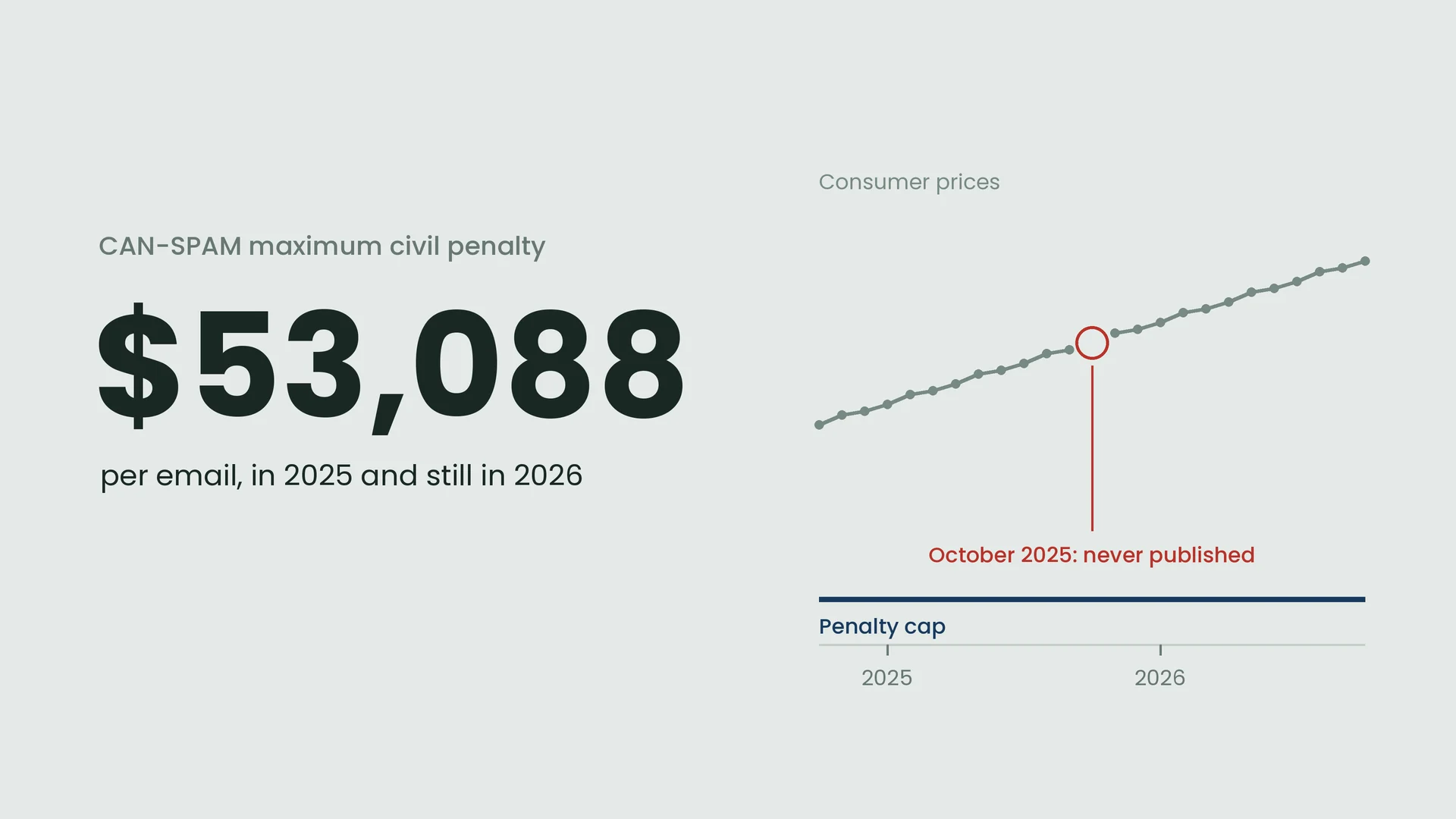
WASHINGTON — In a regulatory decision carrying profound implications for the digital marketing and email compliance sectors, the Federal Trade Commission (FTC) confirmed on September 15, 2026, that the maximum civil penalty for violations of the Controlling the Assault of Non-Solicited Pornography and Marketing (CAN-SPAM) Act will remain capped at $53,088 per individual email for the remainder of the year.
Published officially in the Federal Register, the notice solidifies that civil penalty amounts will experience no upward movement throughout 2026, effectively maintaining the thresholds established in January 2025. While this freeze provides a temporary reprieve for commercial entities navigating the complex landscape of digital outreach, compliance experts warn that the underlying mechanics of federal enforcement remain as stringent as ever. Furthermore, the decision sets the stage for a dramatic catch-up adjustment in 2027, as deferred inflation metrics converge.
Main Facts
The core mechanism governing the FTC’s announcement centers on the statutory penalties associated with illegal commercial messaging under federal law.
- The Penalty Ceiling: The current maximum civil penalty sits at $53,088 per non-compliant email, codified under 16 CFR 1.98. Because CAN-SPAM violations are prosecuted as breaches of the broader FTC Act, each individual message sent in violation of the statute constitutes a separate, actionable offense.
- The Legislative Freeze: According to the notice published on September 15, 2026 (linked to the official Federal Register entry 2026-18853), the FTC will not apply its customary annual inflation adjustment for the 2026 calendar year, choosing instead to freeze penalties at 2025 levels.
- The Root Cause: The suspension of the adjustment is not a policy shift regarding the severity of spam, but rather the administrative fallout from a federal government shutdown in the autumn of 2025, which disrupted critical economic data collection by the Bureau of Labor Statistics (BLS).
- State vs. Federal Contrast: The federal penalty landscape stands in stark contrast to state-level developments, such as recent legislative amendments in Washington State, where the statutory damages under the Commercial Electronic Mail Act (CEMA) were adjusted downward, leaving federal enforcement as the primary heavy artillery against mass unsolicited messaging.
Chronology of Events
The freezing of the 2026 civil penalties is the culmination of a disrupted administrative timeline stretching back nearly a year. Understanding how the FTC arrived at its September confirmation requires examining the sequence of economic hurdles and bureaucratic directives that unfolded across Washington, D.C.
Autumn 2025: The Government Shutdown and Data Blackout
Under the Federal Civil Penalties Inflation Adjustment Act Improvements Act of 2015, federal agencies are legally mandated to review and raise their civil penalties each January. This calculation relies directly on the Consumer Price Index (CPI) metrics comparing the month of October in the current year to the October preceding it.
However, during the autumn of 2025, a lapse in federal appropriations resulted in a government shutdown. During this critical data-gathering window, operations at the Bureau of Labor Statistics were severely impacted, resulting in the failure to produce and finalize the official October 2025 CPI figures required by law to compute the upcoming year’s adjustments.
April 17, 2026: OMB Memo M-26-11
With the baseline economic data missing, federal agencies faced a legal conundrum regarding how to implement the mandatory January adjustments. To resolve the administrative deadlock, the Office of Management and Budget (OMB) stepped in on April 17, 2026, issuing Memo M-26-11.
This official directive formally instructed executive agencies to cancel the 2026 civil penalty adjustments entirely, given the absence of the requisite baseline data from the BLS. The memo effectively tied the hands of regulatory bodies across the federal government, preventing them from independently calculating or applying estimated inflation bumps for the year.
September 15, 2026: The Federal Register Confirmation
Although the OMB memo was issued in the spring, regulatory changes often require formal publication to provide absolute legal certainty to the regulated public. On September 15, 2026, the FTC formally completed this requirement by publishing its confirmation in the Federal Register.
The notice verified that 16 CFR 1.98 would remain unaltered for the remainder of 2026, cementing the $53,088 per-email cap and providing finality to legal counsel, email service providers (ESPs), and enterprises tracking compliance obligations for the fiscal year.
Supporting Data and Regulatory Mechanics
To fully comprehend the weight of a $53,088 penalty, it is necessary to examine the statutory architecture of CAN-SPAM enforcement and how it compares to both historical thresholds and concurrent state-level statutes.
The Mathematics of Federal Enforcement
Under 16 CFR 1.98, the FTC adjusts its penalty caps annually based on the cost-of-living multiplier supplied by the OMB. The path to the current $53,088 figure reflects years of incremental adjustments designed to keep pace with inflation since the CAN-SPAM Act was signed into law in 2003.
While a single email carrying a potential $53,088 fine is striking, commercial marketing campaigns routinely deploy millions of messages simultaneously. In massive, highly coordinated spam campaigns, the theoretical aggregate total of statutory fines can easily scale into the billions of dollars. While courts and regulators rarely exact the absolute maximum statutory penalty for every single infraction in settlement negotiations, this high ceiling serves as the foundational leverage point from which the FTC initiates legal action and negotiates civil penalties.
+-----------------------------------------------------------------+
|               CAN-SPAM Maximum Penalty Evolution                |
+-----------------------------------------------------------------+
|  Year Established / Active  |  Maximum Penalty Per Email        |
+-----------------------------------------------------------------+
|  January 2025               |  $53,088                          |
|  Remainder of 2026 (Frozen) |  $53,088                          |
|  2027 (Projected)           |  Two-Year Compound Adjustment     |
+-----------------------------------------------------------------+
The Federal vs. State Landscape: Washington’s CEMA
The significance of the FTC’s $53,088 federal penalty is amplified when contrasted with shifts in state-level commercial email legislation.
Washington State, historically a pioneer in digital privacy and anti-spam legislation through its Commercial Electronic Mail Act (CEMA), recently amended its statutory framework. Effective June 11, Washington’s amended CEMA cut its statutory damages from $500 down to $100 per email for eligible cases filed under state law.
This dramatic reduction at the state level highlights the widening chasm between local remedies and federal enforcement. To put the disparity into perspective, a single federal CAN-SPAM violation carrying the FTC’s maximum penalty is mathematically equivalent to more than 500 individual state-level violations under Washington’s newly revised CEMA framework. Consequently, federal oversight remains the primary deterrent for large-scale bad actors operating across state and international lines.
Official Responses and Industry Stakeholder Reactions
The announcement of the penalty freeze has elicited a diverse array of responses from legal experts, email marketing trade associations, and consumer advocacy groups.
Legal and Compliance Perspectives
Corporate defense attorneys specializing in FTC enforcement have largely viewed the September 15 confirmation with a mixture of relief and cautious skepticism.
"While a freeze provides predictability for corporate budgeting and compliance auditing through the end of 2026, it is crucial that organizations do not misinterpret this administrative pause as a weakening of enforcement priorities," noted a partner at a Washington, D.C.-based privacy and advertising law firm. "The FTC remains hyper-vigilant regarding deceptive header information, misleading subject lines, and the failure to honor opt-out requests within the legally mandated 10-business-day window."
Furthermore, compliance officers have turned their attention immediately to the horizon. Because the 2026 inflation adjustment was cancelled rather than permanently waived, legal analysts anticipate that the adjustments deferred this year will roll over into the calculation for January 2027. Unless Congress intervenes or macroeconomic trends shift dramatically, the 2027 adjustment will effectively compound two years of inflation into a single upward revision, potentially pushing the per-email penalty significantly higher at the start of the next year.
Digital Marketing and ESP Reactions
Email service providers (ESPs) and legitimate marketing associations have used the announcement to reiterate the importance of robust permission-based marketing infrastructures. Industry bodies emphasize that while the dollar amount per email is frozen, the reputational and operational costs of an FTC investigation far outweigh the immediate financial penalties.
"Legitimate enterprises are not breathing a sigh of relief because they plan to test the boundaries of CAN-SPAM; rather, they are using this stability to upgrade their consent-management platforms," explained a representative from an international email marketing coalition. "The real challenge for our sector isn’t the static nature of the 2026 penalty, but the fragmented compliance requirements spanning international borders, such as GDPR and CAN-SPAM alignment."
Implications for Businesses and Future Outlook
As the business community looks past the remainder of 2026 toward the future of digital communications enforcement, several key takeaways emerge from the FTC’s administrative decision.
1. Zero Tolerance for Lax Opt-Out Mechanisms
The stability of the $53,088 penalty threshold should not embolden marketers to slacken their compliance protocols. The FTC’s enforcement division continues to prioritize cases where commercial entities deliberately obscure unsubscribe links, fail to process opt-outs promptly, or deploy deceptive "from" lines. Even a fraction of a percent of a massive enterprise mailing list containing non-compliant emails can expose the parent company to catastrophic regulatory liability.
2. Preparing for the 2027 Dual-Inflation Jump
Chief compliance officers and financial controllers must factor the impending 2027 adjustment into their forward-looking risk management assessments. Because the BLS data gap caused a skipped cycle in 2026, the 2027 update will account for cumulative inflationary pressures spanning two full years. Organizations that budget for regulatory risk must anticipate a substantial bump in the maximum penalty cap come January 2027.
3. The Enduring Primacy of Federal Oversight
With state-level statutes like Washington’s CEMA scaling back statutory damages to $100 per email, the burden of deterring large-scale commercial spam rests squarely on the shoulders of federal regulators and private-attorney-general actions under federal frameworks. As cross-border data flows and SMS-to-email convergence complicate the digital marketing ecosystem, the FTC’s authority under the CAN-SPAM Act remains the premier instrument for safeguarding consumer inboxes.
Ultimately, while the September 15 Federal Register notice provides a momentary financial anchor for the remainder of 2026, it serves primarily as a brief intermission before regulatory penalties resume their upward trajectory in the new year. Commercial senders are advised to use this window to audit their infrastructure, verify opt-out compliance, and fortify their adherence to federal standards before the regulatory landscape shifts once again.