By Paid Media Desk
Published: Industry Insights & Analysis
Main Facts
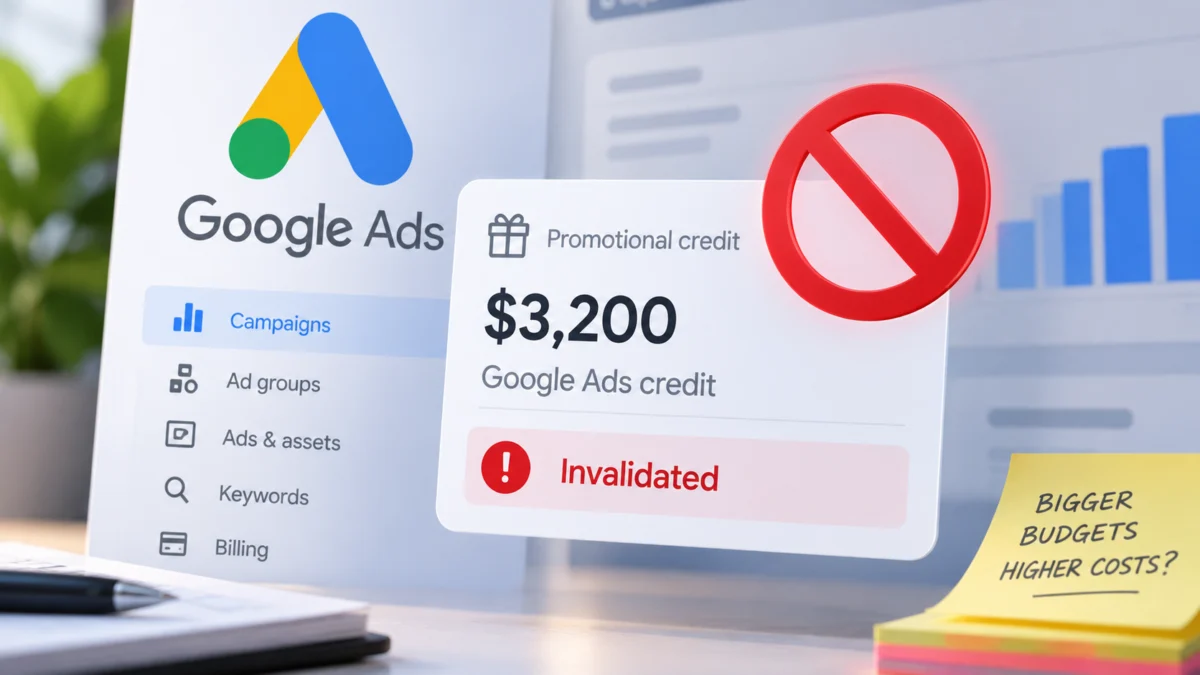
A growing controversy has erupted within the digital marketing community following troubling reports that Google Ads promotional credits are being abruptly invalidated after advertisers have successfully met and fulfilled all qualifying spending requirements. Rather than receiving the promised matching funds or promotional balance to offset their initial outlays, businesses are finding their credits marked as “Invalidated” weeks—and sometimes months—after the underlying capital has already been paid out to Google.
This unexpected policy enforcement leaves companies grappling with significantly higher advertising overhead than originally budgeted. For small and medium-sized enterprises (SMEs) operating on tight margins, a sudden revocation of a multi-thousand-dollar credit can completely undermine financial forecasting, forcing marketing teams to absorb heavy, unrecouped losses.
The issue first came to light via industry expert David Melamed, a seasoned Pay-Per-Click (PPC) consultant, who detailed multiple instances of clients losing promised incentives without warning or an apparent mechanism for appeal. Because the qualifying campaign spend has already occurred, businesses cannot reverse the transactions, effectively trapping them in higher-cost ad cycles that they likely would have bypassed entirely without the lure of the promotional incentive.
Chronology of Events
The troubling pattern of invalidated promotional credits came to public attention through a series of disclosures by PPC professionals navigating client account setups.
- Initial Account Funding & Campaign Launch: Advertisers opt into Google Ads promotional offers—such as spending a specific tier amount (e.g., $3,200) within a designated timeframe to unlock a matching promotional credit. Businesses scale up their operations, deposit funds, and hit the required spend thresholds.
- The Waiting Period: Weeks pass as campaigns run and agencies optimize performance, under the assumption that the earned promotional balance will soon be applied to offset ongoing advertising costs.
- The Invalidation Notice: More than a month after fulfilling the spending criteria, advertisers log into their dashboards to find their anticipated credits stamped as “Invalidated.”
- Discovery of Technical Technicalities: Upon closer inspection, consultants like David Melamed discover arbitrary reasons for the revocations. In one documented case, a new advertiser’s credit was stripped because their manager account’s billing profile was initially utilized to set up the child account. In other cases, no clear explanation is provided at all.
- Public Exposure & Industry Outcry: Melamed takes to LinkedIn to expose the phenomenon, labeling the practice a deceptive hurdle for marketers. The post quickly gains traction across the paid search community.
- Google’s Acknowledgment: Google Ads Liaison Ginny Marvin responds publicly to Melamed’s LinkedIn exposé, stating she has escalated the issue to the internal product and engineering teams, though a definitive policy review or permanent fix has yet to be formally announced.
Supporting Data and Technical Breakdown
To understand the scale of the issue, industry analysts are examining the mechanics of how promotional credits operate within the broader Google Ads ecosystem.
The Financial Impact on Budgets
In one primary case study highlighted by Melamed, an advertiser explicitly committed a capital investment of $3,200 with the expectation that an equivalent promotional credit would match it, reducing their net cost-per-acquisition (CPA). When that $3,200 credit was retroactively invalidated over 30 days later, the business absorbed a 100% variance from its expected promotional return.
Ambiguous Invalidation Triggers
Google’s promotional terms and conditions are notoriously complex, containing strict clauses regarding:
- Geographic restrictions.
- New versus existing account classifications.
- Billing profile linkages and corporate hierarchies.
However, marketers argue that enforcing these rules after the advertiser has already expended real capital creates a profound systemic imbalance. While one invalidated credit was traced back to a manager-level billing profile configuration, others lack any transparent diagnostic trail. Advertisers are left guessing which hidden rule triggered the cancellation.
Ripple Effects on Auction Dynamics
Beyond individual account balance sheets, some PPC experts argue that invalidated promotional credits have macro-level implications for the entire auction marketplace. Promotional offers inherently act as a psychological catalyst, encouraging advertisers to bid more aggressively and push higher daily budgets because they view a percentage of their upfront spending as "discounted."
When these credits vanish after the money is spent, it means those inflated bids and aggressive budget expansions have already entered the Google Ads auction pool. This artificial stimulation can temporarily drive up Cost-Per-Click (CPC) rates and increase competition for impressions, impacting other advertisers bidding in the same vertical. While this broader auction impact remains an expert assessment rather than a universally quantified metric, it underscores the systemic friction caused by unpredictable promotional programs.

Official Responses and Industry Engagement
As pressure mounted across social media and digital marketing forums, Google acknowledged the mounting complaints through its designated communication channels.
Google’s Official Stance
Ginny Marvin, the official Google Ads Liaison, addressed the controversy directly in the comments section of David Melamed’s viral LinkedIn post. Marvin responded:
"Thank you for bringing this to our attention, David. I’ve passed this along to the team."
While this acknowledgment demonstrates that Google is aware of the friction, the tech giant has not yet issued a comprehensive public statement explaining the technical root cause behind the wave of invalidations. Furthermore, Google has not clarified whether it plans to introduce a structured appeals process for businesses caught in the crossfire.
The Absence of an Appeal Pathway
One of the most glaring operational flaws highlighted by consultants is the complete lack of recourse. When an ad account is penalized, suspended, or experiences a billing discrepancy, standard support channels often provide automated responses or dead ends. For invalidated promotional credits, there is currently no dedicated dispute form, escalation ticket type, or direct path to challenge the decision. Once a credit is marked invalid, the decision is treated as final by the automated system, leaving agencies and clients with no avenue for restitution.
Implications for Advertisers and the Paid Search Industry
The unfolding situation carries severe strategic and financial implications for digital marketers, agencies, and enterprise brands alike.
1. Shift from Guaranteed Budget to Speculative Risk
Historically, agencies have factored promotional credits into media planning forecasts, treating them as reliable liquid assets once spending thresholds are verified. These recent events force a paradigm shift: promotional credits can no longer be treated as guaranteed campaign capital. Marketers must now advise clients to budget under the worst-case scenario—assuming that matching credits might be revoked at any moment.
2. Heightened Due Diligence Required
To mitigate future losses, paid media specialists must conduct rigorous audits of account setups before launching campaigns intended to qualify for promotions. Key focus areas include:
- Verifying that standalone billing profiles are correctly isolated from manager accounts prior to account creation.
- Reviewing fine-print eligibility criteria with a fine-toothed comb.
- Monitoring credit status dashboards daily rather than assuming fulfillment equals reward disbursement.
3. Trust and Transparency in Platform Relations
Incidents of this nature erode trust between major ad platforms and the agencies that manage billions of dollars in ad spend. When promotional incentives—often used as the primary hook to onboard new advertisers onto platforms like Google Ads—turn into unexpected financial liabilities, it damages platform credibility.
Conclusion and Next Steps
The bottom line for the digital marketing industry is clear: Google Ads promotional credits currently carry an unquantified level of operational risk. Until Google implements a transparent review mechanism, clearer automated notifications explaining why credits are flagged, and a fair appeal process for retroactively revoked funds, advertisers must proceed with extreme caution. Marketers must recalibrate their financial models to ensure that unexpected credit invalidations do not jeopardize client relationships or sink campaign profitability.