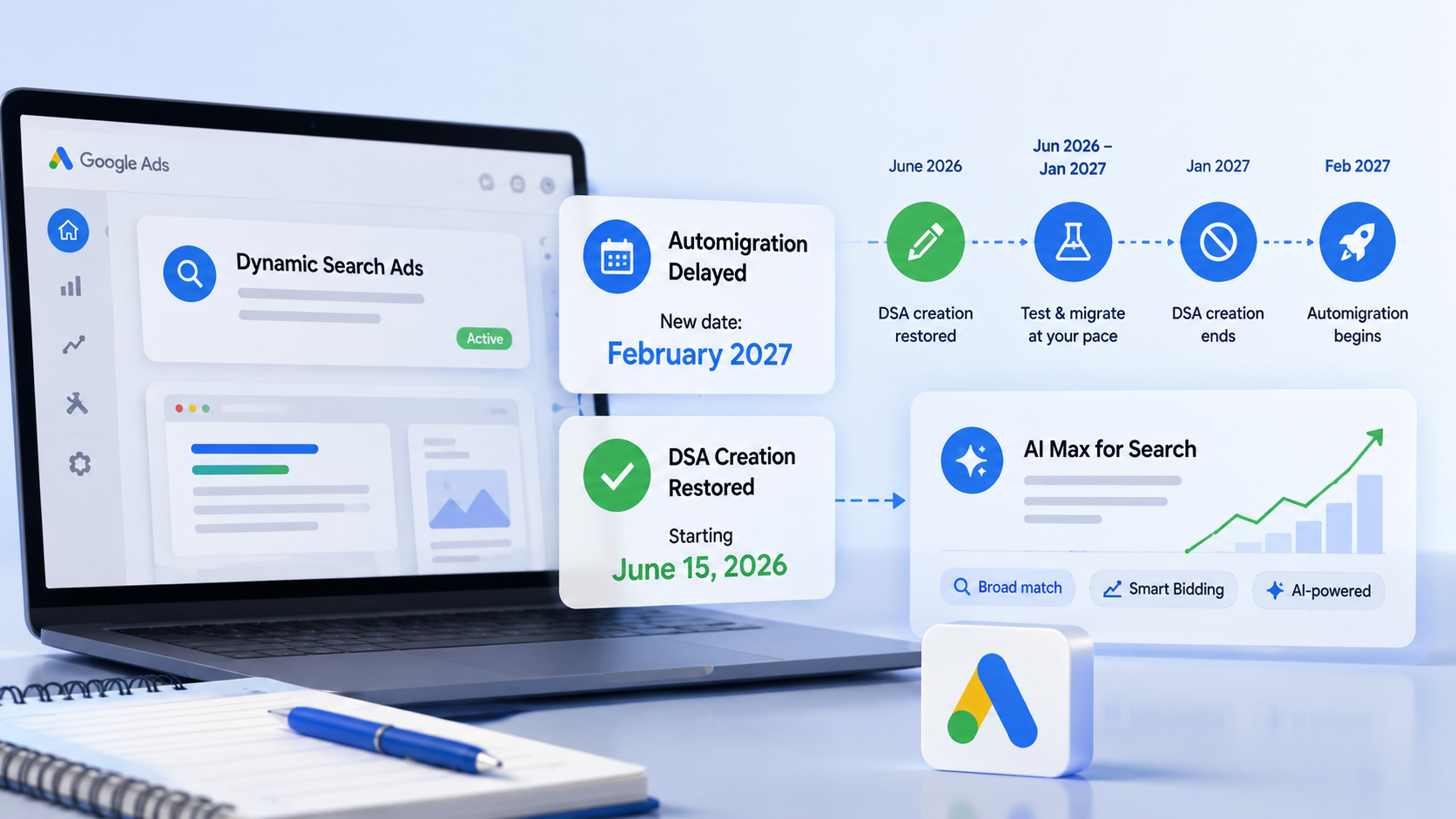
In a notable concession to the search marketing community, Google has officially revised its timeline for retiring Dynamic Search Ads (DSA). The tech giant is pushing back the automatic migration of DSA campaigns to AI-powered alternatives by five months, shifting the hard deadline from September 2026 to February 2027.
In an even more surprising reversal of its previous deprecation roadmap, Google has restored the ability for advertisers to create brand-new DSA campaigns. This change, which went into effect on June 15, temporarily walks back an earlier phase-out step designed to restrict new DSA setups.
The decision represents a significant tactical victory for search engine marketing (SEM) professionals and enterprise advertisers. By extending the runway, Google is giving advertising teams crucial extra time to test, benchmark, and manually migrate their legacy campaigns to AI Max for Search (or Search campaigns leveraging broad match paired with Smart Bidding) on their own terms.
1. Main Facts: The Policy Shift and What Is Changing
For over a decade, Dynamic Search Ads have served as a foundational tool for search marketers, particularly those managing large-scale e-commerce inventories or content-heavy websites. By crawling a website’s index and dynamically generating headlines to match user search queries, DSAs bypassed the need to manage thousands of individual keywords.
However, as part of Google’s broader shift toward artificial intelligence and consolidated campaign types, the company announced plans to phase out DSAs in favor of "AI Max for Search" campaigns.
The latest announcement introduces several critical changes to this transition plan:
- The Migration Postponement: The automated upgrade of existing DSA campaigns to AI Max for Search has been delayed from September 2026 to February 2027.
- Reinstatement of Campaign Creation: Since June 15, advertisers have regained the ability to create new DSA campaigns within the Google Ads platform. This capability had previously been restricted as part of the initial sunsetting schedule.
- The "AI Max" Default: Despite the extension, Google is doubling down on its AI-first trajectory. AI Max has now officially become the default setting when advertisers set up new Search campaigns.
- Partial September 2026 Transitions: While the complete sunset of DSA is delayed to 2027, certain component-level transitions will still take place in September 2026. Specifically, automatically created assets (ACA) and campaign-level broad match settings will transition to AI Max on the original timeline.
2. Chronology: The Road to February 2027
To help digital marketing teams align their media planning, budgeting, and testing cycles, here is the updated chronological roadmap for the Dynamic Search Ads transition:
[June 15] ────────────────► [September 2026] ──────────────► [February 2027]
DSA Campaign Creation       Partial Migration:               Final Sunset:
Re-enabled                  ACA & Campaign-Level             All remaining DSA
                            Broad Match transition           campaigns automatically
to AI Max migrated to AI Max- June 15 (Reversal Step): Google officially restores the ability for all advertisers to build and launch new Dynamic Search Ads campaigns. Marketers can use this window to run parallel tests against AI Max.
- September 2026 (Partial Milestone): The original deadline remains active for specific back-end technologies. Google will transition campaign-level broad match settings and automatically created assets (ACA) to the AI Max framework.
- February 2027 (The Final Sunset): Google will execute the final, system-wide automatic migration. Any remaining legacy DSA campaigns will be automatically converted into AI Max for Search campaigns (or standard Search campaigns utilizing broad match and Smart Bidding).
3. Supporting Data: DSA vs. AI Max for Search
To understand why this delay is so impactful for advertisers, it is necessary to examine the structural and technological differences between legacy Dynamic Search Ads and Google’s new AI Max for Search framework.
Understanding Dynamic Search Ads (DSA)
Introduced in 2011, DSA campaigns do not rely on traditional keywords. Instead, they use Google’s organic web-crawling technology to match search queries directly to the content on an advertiser’s website.
- Targeting mechanism: Based on landing page URLs, website categories, or page feeds.
- Ad generation: Google dynamically generates the headline and selects the landing page; the advertiser writes the description lines.
- Control level: High control over negative keywords, category targeting, and landing page exclusions.
Understanding AI Max for Search
AI Max represents the next generation of Search engine marketing. It combines Google’s most advanced machine learning algorithms to automate targeting, bidding, and ad creative.
- Targeting mechanism: Relies heavily on broad match keywords, semantic search intent, and advertiser-provided assets (including text, images, and videos).
- Ad generation: Dynamically mixes and matches headlines, descriptions, and assets using Generative AI and Automatically Created Assets (ACA).
- Bidding mechanism: Exclusively utilizes Smart Bidding (Target CPA, Target ROAS, Maximize Conversions, or Maximize Conversion Value).
Performance Metrics and the Push for AI Max
Google’s push toward AI Max is backed by internal data suggesting superior performance and faster ramp-up times for new advertisers. According to Google Ads Liaison Ginny Marvin, testing revealed that campaigns utilizing AI Max achieved their first conversion significantly faster during the first two weeks following launch compared to traditional setups.
This metric explains why Google has integrated AI Max as the default setting for new Search campaigns. The automated setup reduces the barrier to entry for novice advertisers and helps them see immediate utility from their ad spend.
However, experienced PPC (Pay-Per-Click) professionals have historically expressed skepticism regarding "black box" automated solutions. For enterprise brands with strict compliance guidelines, brand safety parameters, and precise ROI targets, the loss of granular control over search queries and bidding signals remains a major concern. The five-month extension addresses these anxieties by providing a structured testing buffer.

4. Official Responses: Why Google Adjusted Course
The decision to delay a major product sunset is rare for Google, which typically adheres strictly to its infrastructure migration timelines. According to official statements, the decision was driven entirely by advertiser feedback.
Feedback from the Google Ads Liaison
Ginny Marvin, the official Google Ads Liaison, addressed the update directly on social media and industry forums. Marvin acknowledged that digital marketing agencies and in-house enterprise teams requested more time to prepare their accounts, audit their existing structures, and execute thorough A/B testing.
"We heard from advertisers that they wanted more time to prepare for this transition," Marvin stated. "By extending the timeline to February 2027 and restoring DSA creation capabilities in the interim, we are giving advertisers the flexibility they need to test AI Max and ensure a smooth migration."
Marvin also shed light on the decision to make AI Max the default configuration for new Search campaigns, highlighting that the change aims to streamline workflows while still leaving room for advanced marketers to opt out or customize their settings manually during the creation process.
Developer Portal and API Guidance
In an update published on the Google Ads Developers Blog, Google emphasized the technical benefits of a manual transition over an automated one. The developer team noted that while the auto-migration tool in February 2027 will seamlessly transfer settings, voluntary upgrades performed by advertisers themselves allow for cleaner historical data mapping, customized asset group configurations, and better API integration management.
5. Strategic Implications: What Advertisers Should Do Now
The five-month extension should not be viewed by digital marketers as a reason to procrastinate. Instead, industry experts recommend using this period to execute a highly strategic, phased migration plan. Relying on Google’s automatic migration in February 2027 carries risks, including lost historical reporting data, sub-optimal ad copy pairings, and sudden performance fluctuations.
                  CRITICAL ACTION PLAN FOR PPC TEAMS
┌────────────────────────────────────────────────────────────────────────┐
│ 1. AUDIT                                                               │
│    Identify all active DSA campaigns, landing page targets, and        │
│    historical performance benchmarks.                                  │
├────────────────────────────────────────────────────────────────────────┤
│ 2. EXPERIMENT                                                          │
│    Run 50/50 split tests: Legacy DSA vs. AI Max for Search.            │
├────────────────────────────────────────────────────────────────────────┤
│ 3. OPTIMIZE                                                            │
│    Refine Automatically Created Assets (ACA) and establish robust      │
│    brand safety / negative keyword lists.                              │
├────────────────────────────────────────────────────────────────────────┤
│ 4. MIGRATE                                                             │
│    Manually upgrade campaigns before February 2027 to preserve         │
│    historical data and maintain control.                               │
└────────────────────────────────────────────────────────────────────────┘
1. Conduct a Comprehensive Campaign Audit
The first step is to map out every active DSA campaign across all client or brand accounts. Marketers should document:
- Which landing page feeds or URL rules are currently driving the most efficient conversions.
- The exact search queries that legacy DSA campaigns are capturing.
- The negative keyword lists currently applied to DSA campaigns to prevent wasteful spending.
2. Run Parallel, Side-by-Side Experiments
Rather than waiting for a forced transition, advertisers should use Google’s draft and experiments tool to run clean A/B tests.
- The Setup: Set up a legacy DSA campaign to run alongside an AI Max for Search campaign using the same landing page targets and budget.
- The Evaluation: Compare key performance indicators (KPIs) such as Cost Per Acquisition (CPA), Return on Ad Spend (ROAS), Click-Through Rate (CTR), and conversion volume over a 30- to 60-day period.
- The Adjustments: Use these insights to feed Google’s machine learning algorithm with better asset inputs (headlines, descriptions, and site extensions) to see if AI Max can match or exceed legacy DSA performance.
3. Leverage Voluntary Migration Tools
Google is expected to release specialized, voluntary migration tools within the Google Ads UI and API. Marketers should utilize these tools to manually upgrade their campaigns. Manual upgrades are superior to automatic upgrades because they allow advertisers to:
- Review and edit automatically generated headlines and assets before they go live.
- Ensure that historical campaign learnings, quality scores, and bidding signals are carried over cleanly.
- Organize new AI Max campaigns into clean asset groups that align with specific product lines or business categories.
4. Prepare for the September 2026 Component Shift
Advertisers must remember that September 2026 remains a critical date. Because campaign-level broad match settings and Automatically Created Assets (ACA) will transition to the AI Max infrastructure at that time, search teams must ensure that their brand safety lists and account-level negative keywords are fully optimized ahead of schedule. This will prevent broad match expansion from matching ads to irrelevant or brand-damaging queries.
Conclusion: A Balanced Path Forward
Google’s decision to extend the DSA transition timeline represents a pragmatic compromise. It acknowledges the real-world operational complexities faced by agency partners and enterprise brands while keeping Google firmly on its path toward an AI-driven advertising ecosystem.
For search marketers, this delay provides a valuable window of control. By proactively auditing, testing, and manually migrating legacy frameworks over the next year and a half, brands can transition to AI Max for Search smoothly—protecting their conversion volumes, maintaining cost efficiency, and keeping their search strategies highly competitive.