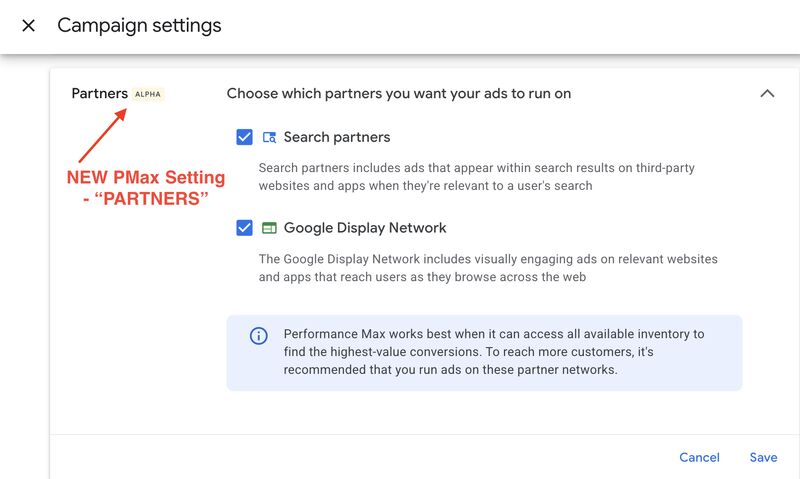
In a development that could fundamentally reshape how automated advertising campaigns are managed, Google has begun testing a new "Partners (Alpha)" setting within its flagship Performance Max (PMax) campaigns. This feature, currently visible to a limited selection of advertisers, introduces a level of control that has been conspicuously absent since the channel’s inception: the explicit ability to opt in or out of the Google Search Partners (GSP) network and the Google Display Network (GDN).
For years, digital marketers have voiced frustrations over the "black box" nature of Performance Max, where machine learning algorithms dictate ad placements across Google’s entire ecosystem without giving advertisers granular control over individual networks. This new alpha test suggests that Google may finally be listening to industry demands for transparency and placement autonomy.
Main Facts: The "Partners (Alpha)" Feature at a Glance
The discovery of the "Partners (Alpha)" setting marks a potential turning point in Google’s automation-first strategy. The feature was first spotted and shared publicly on LinkedIn by PPC Growth Strategist Saquib Syed, sparking immediate discussion across the global digital marketing community.
Under the current standard configuration of Performance Max, Google automatically distributes ad spend across all available inventory, including:
- Google Search
- Google Maps
- Google Discover
- Gmail
- YouTube
- Google Search Partners (GSP) (third-party websites that partner with Google to show search ads)
- Google Display Network (GDN) (a network of millions of websites and apps that show display ads)
Until now, advertisers could not natively exclude GSP or the GDN within the PMax campaign creation or settings menu. They were packaged as an all-or-nothing deal under the premise that Google’s AI would automatically optimize budget allocation to yield the best overall return on ad spend (ROAS) or cost per acquisition (CPA).
The newly discovered "Partners (Alpha)" setting introduces checkboxes that allow advertisers to manually toggle the following options on or off:
- Include Google Search Partners
- Include Google Display Network
By unchecking these options, advertisers can restrict their PMax campaigns to Google’s owned-and-operated properties (such as core Search, YouTube, Gmail, and Discover), shielding their budgets from third-party websites and external display placements that are often associated with lower-intent traffic or brand-safety concerns.
Chronology: The Evolution of Control in Performance Max
To understand the significance of this alpha test, it is necessary to trace the history of Performance Max and the industry’s ongoing battle for campaign transparency.
[Late 2020] Google launches Performance Max in beta.
      │
[Nov 2021] PMax rolls out globally; Smart Shopping and Local campaigns are deprecated.
      │
[2022 - 2023] Advertisers express frustration over "black box" mechanics; search arbitrage and low-quality placements on Search Partners draw criticism.
      │
[Late 2023] Major industry reports highlight brand safety and ad fraud issues on third-party networks, putting pressure on Google.
      │
[Early 2024] Google introduces minor safety controls and account-level exclusions, but PMax remains heavily automated.
      │
[Mid-2024] "Partners (Alpha)" setting is spotted in the wild, offering direct opt-out toggles for GSP and GDN.
1. The Launch and the "Black Box" Era (2020–2021)
Google introduced Performance Max in beta in late 2020 and rolled it out globally in November 2021. Designed to replace Smart Shopping and Local campaigns, PMax was marketed as a revolutionary, AI-driven campaign type capable of finding converting customers across all of Google’s channels from a single campaign. However, this convenience came at the cost of control. Advertisers could no longer see exactly where their ads were serving, nor could they easily prevent their ads from appearing on third-party partner websites.
2. The Rise of Workarounds and Friction (2022–2023)
As PMax became the default campaign type for e-commerce and lead-generation advertisers, complaints began to mount. Marketers noticed that significant portions of their budgets were being diverted to the Google Display Network and Search Partners, often resulting in high click volumes but dismal conversion rates.

To bypass these limitations, the PPC community developed various workarounds:
- Requesting Google representatives to manually exclude Search Partners at the account level.
- Utilizing Google Ads API scripts to monitor and flag low-quality placements.
- Implementing account-level placement exclusion lists to block specific websites and mobile apps.
While these workarounds provided some relief, they were cumbersome, required technical expertise, and were not officially supported or easily accessible to average advertisers.
3. Industry Scrutiny and Brand Safety Concerns (Late 2023)
In 2023, independent research and media investigations put Google’s third-party networks under a microscope. Reports alleged that ads from major brands were being served on low-quality, MFA (Made for Advertising) websites, pirated content platforms, and sites violating brand-safety guidelines via the Google Search Partners and Display networks.
In response to growing pressure from ad buyers and brand safety organizations, Google temporarily allowed advertisers to opt out of Search Partners across all campaign types—including PMax—via a special request form, but a permanent, user-friendly UI toggle remained elusive until now.
Supporting Data: Why Marketers Demand GSP and GDN Exclusions
The demand for network-level exclusions in Performance Max is driven by measurable performance discrepancies between Google’s owned-and-operated properties and its partner networks.
The Search Partners (GSP) Problem
While Google Search Partners includes reputable search engines like Ask.com, it also encompasses thousands of smaller search widgets, parked domains, and search arbitrage websites.
Industry benchmarks indicate several pain points associated with GSP:
- Lower Conversion Rates (CVR): Traffic from GSP typically converts at a significantly lower rate than traffic from core Google Search, as users on partner sites are often engaged in different online activities and exhibit lower purchase intent.
- Click Spam and Invalid Traffic: Search arbitrage sites often use deceptive layouts to encourage accidental clicks, inflating the advertiser’s costs without delivering genuine customer interest.
The Google Display Network (GDN) Challenge
The GDN spans over two million websites and mobile applications. Within a PMax framework, the GDN is frequently used by Google’s algorithm to spend remaining budget or to retarget users. However, display traffic in PMax has historically suffered from:
- Accidental Mobile App Clicks: A significant portion of GDN spend in automated campaigns often goes toward mobile games and utility apps, where users (frequently children or distracted adults) click on banner ads accidentally.
- Lead Generation Fraud: For B2B and lead-generation advertisers, GDN placements within PMax have been notorious for generating spam leads—fake form submissions generated by bots designed to monetize publisher sites through Google’s AdSense program.
| Metric / Attribute | Core Google Search & YouTube | Google Search Partners (GSP) | Google Display Network (GDN) |
|---|---|---|---|
| User Intent | Extremely High | Moderate to Low | Low (Passive Browsing) |
| Conversion Quality | High | Variable / Often Low | Low (High Risk of Spam Leads) |
| Brand Safety Risk | Low (Highly Controlled) | Moderate | High (Requires Extensive Exclusions) |
| Typical Role in PMax | Bottom-of-Funnel Conversion | Incremental Reach | Top-of-Funnel / Budget Consumption |
According to various agency-led studies, excluding the Display Network and Search Partners from lead-generation campaigns can reduce spam lead volume by up to 80% while dramatically improving the overall quality of sales-ready leads. For e-commerce advertisers, focusing budget strictly on high-intent search and shopping placements often yields a healthier, more predictable ROAS.
Official Responses: Google’s Stance and Testing Procedures
At the time of writing, Google has not released an official global press release or updated its formal documentation regarding the "Partners (Alpha)" setting. This is standard operating procedure for Google Ads, which frequently tests new UI elements and targeting controls in select accounts before committing to a wider rollout.
Historically, Google’s product teams have defended the bundled nature of Performance Max by asserting that:
- Machine Learning Requires Scale: Google argues that its smart bidding algorithms perform best when they have access to the widest possible pool of inventory. By limiting the networks available, advertisers risk choking the algorithm’s ability to find cost-effective conversions in unexpected places.
- Cross-Channel Synergy: Google maintains that a user might see a display ad on the GDN, research the product on YouTube, and ultimately convert via a Search ad. Restricting the top-of-funnel networks (like GDN) could theoretically harm bottom-of-funnel search performance.
However, the introduction of this Alpha test indicates that the pressure from high-spend advertisers and agency partners has reached a tipping point. If Google decides to transition this feature from Alpha to Beta, and eventually to General Availability (GA), it will represent a significant concession, acknowledging that a one-size-fits-all automated approach does not suit every business model.
Implications: What This Means for the Future of PPC Advertising
If the "Partners (Alpha)" setting is rolled out globally, the implications for brands, agencies, and the broader digital advertising ecosystem will be profound.
1. A Rebirth of Lead Generation on Performance Max
Lead-generation marketers have largely abandoned or heavily restricted their use of Performance Max due to the influx of fraudulent form submissions coming from mobile apps and third-party display sites. With the ability to completely opt out of GDN and GSP, lead generators can confidently deploy PMax, knowing their budgets will be focused on high-intent Google Search, Gmail, and YouTube inventory.
2. Greater Budget Efficiency for SMBs
Small and medium-sized businesses (SMBs) with limited budgets often cannot afford the trial-and-error period required for PMax to optimize across third-party networks. Direct control over these settings will allow smaller advertisers to run lean, highly targeted PMax campaigns that prioritize core search and shopping placements from day one.
3. Shift in Agency-Client Relationships
For digital marketing agencies, the lack of control in PMax has been a persistent point of friction with clients who demand transparency. The ability to toggle partner networks on or off gives agencies a new lever to pull during optimization cycles, allowing them to demonstrate strategic value and tailored campaign management rather than simply relying on Google’s automated recommendations.
4. Pressure on Google’s Ad Revenue and Publisher Network
If a substantial percentage of advertisers choose to opt out of GSP and GDN, Google could see a decrease in ad spend allocated to its partner networks. This could, in turn, impact the revenue of third-party publishers who rely on Google AdSense and Google Ad Manager to monetize their traffic. Consequently, Google may be incentivized to improve the quality and brand safety of its partner networks to encourage advertisers to opt back in.
Conclusion: The Path Forward for Advertisers
The discovery of the "Partners (Alpha)" setting is a clear signal that the era of absolute, uncompromising automation in Google Ads may be shifting toward a hybrid model of "guided automation." While Google’s machine learning algorithms remain highly capable of optimizing bids and creative assets, advertisers are successfully clawing back control over where those assets are displayed.
Advertisers should immediately check their Performance Max campaign settings to see if their accounts have been selected for this Alpha test. For those who find the setting active, running a split test—comparing a standard PMax campaign against a partner-excluded PMax campaign—could provide valuable, account-specific data on whether GSP and GDN are truly contributing to business growth or simply draining valuable marketing resources.