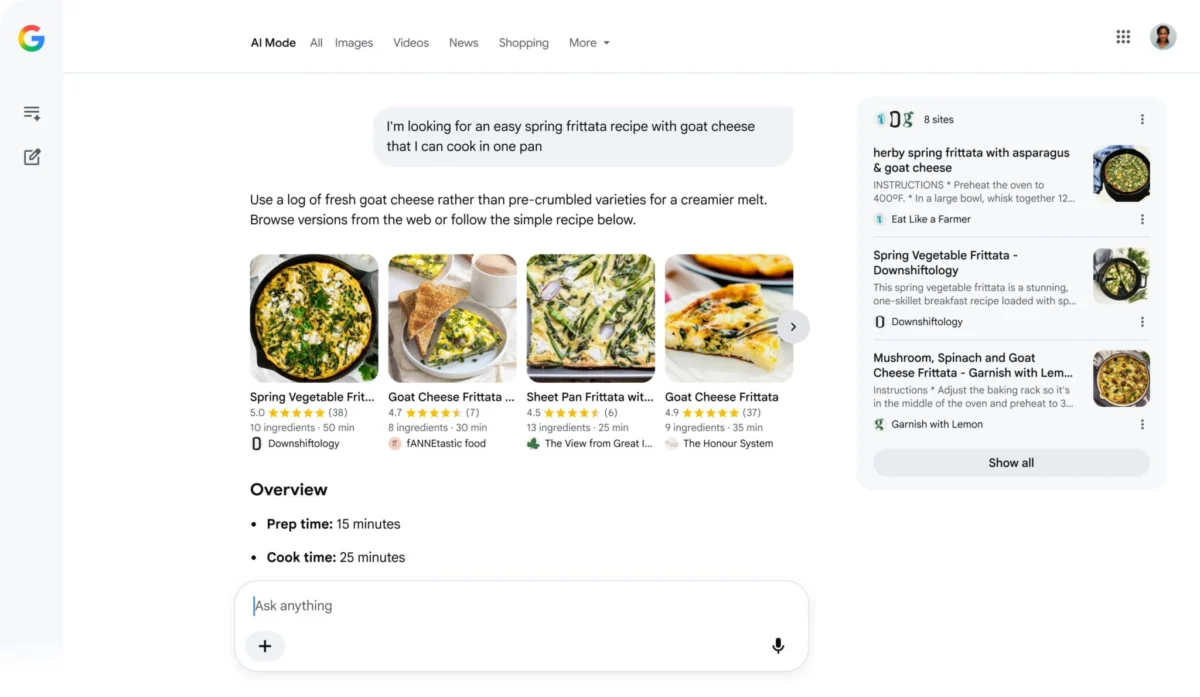
In an ongoing effort to address intensifying criticism from the digital publishing industry, Google has rolled out a significant update to how recipe search results are displayed within its generative AI interface, known as "AI Mode." The update introduces prominent, link-heavy cards at the top of AI-generated recipe responses, displaying critical creator metadata such as the author’s name, user ratings, and ingredient counts.
This move represents a tactical shift for the search giant, which has faced severe backlash from food bloggers and content creators. Publishers argue that Google’s generative AI experiences—designed to summarize web content directly on the search results page—threaten to decimate the referral traffic that sustains the independent web.
1. Main Facts: The Anatomy of Google’s New AI Recipe Cards
The latest update to Google’s AI Mode fundamentally alters the visual hierarchy of culinary search queries. Previously, when a user searched for a recipe, Google’s generative engine would often synthesize a list of ingredients and instructions directly within the chat or overview interface. This kept users within Google’s ecosystem, eliminating the need to click through to the source website—a phenomenon digital marketers refer to as a "zero-click search."
+-------------------------------------------------------------+
| [AI Mode Response: "How to make chocolate chip cookies"]    |
|                                                             |
|  +-----------------------+   +-----------------------+      |
|  | [Image]               |   | [Image]               |      |
|  | Best Chocolate Chip   |   | Easy Cookie Recipe    |      |
|  | by Sally's Baking     |   | by Foodie Central     |      |
|  | ★★★★★ (4.9)           |   | ★★★★☆ (4.5)           |      |
|  | 9 Ingredients         |   | 7 Ingredients         |      |
|  +-----------------------+   +-----------------------+      |
|                                                             |
| Here is a quick summary of how to bake cookies...           |
+-------------------------------------------------------------+
Under the new layout, Google has integrated highly visible, interactive cards at the very top of the AI-generated response. These cards feature:
- High-Resolution Source Imagery: Visual previews of the completed dish, pulled directly from the publisher’s website.
- Creator and Brand Names: Explicit attribution showing the name of the blog, chef, or publisher (e.g., "Sally’s Baking Addiction" or "Serious Eats").
- User Ratings: Star ratings aggregated from the publisher’s structured data, providing searchers with immediate social proof.
- Ingredient Counts: A quick-glance metric showing how many ingredients are required, helping users gauge the complexity of the recipe before clicking.
- Direct Hyperlinks: The entire card acts as a direct, high-priority link to the creator’s original recipe page.
According to Robby Stein, a product lead at Google, these changes are specifically engineered to make it "even easier to discover and visit recipe pages with AI Mode." By elevating these rich cards to the top of the conversational interface, Google hopes to transform its AI responses from final destinations into starting points for deeper web exploration.
2. Chronology: The Evolution of AI Search and Publisher Friction
The tension between Google and the culinary blogging community has been building for several years, escalating rapidly with the integration of Large Language Models (LLMs) into mainstream search.
[May 2023] ────────────────> [March 2024] ───────────────> [Late 2024] ───────────────> [Present]
Google launches SGE;         First major update to        Backlash peaks over          Latest update rolls out;
publishers warn of           recipe results in AI         "AI recipe slop" during      Top Stories carousels
zero-click traffic drops.    Mode announced by Stein.     Thanksgiving holiday.        tested in AI Overviews.
May 2023: The Launch of SGE
Google introduced the Search Generative Experience (SGE) at its annual I/O conference. Almost immediately, food and lifestyle publishers raised the alarm. Because recipes rely on structured, easily digestible instructions, they were among the easiest content types for Google’s LLM to scrape, summarize, and display without sending traffic to the original creators.
March 2024: The First Concession
Following months of feedback and declining traffic metrics from early SGE testers, Google’s Robby Stein announced the first major wave of updates specifically targeting recipe queries. At the time, Stein acknowledged the community’s frustration, stating, "We’ve heard feedback on recipe results in AI Mode, and we’re making updates to better connect people with recipe creators on the web." This update introduced basic link citations but fell short of the highly visual, data-rich cards seen in the latest iteration.
Late 2024: The "AI Recipe Slop" Controversy
The debate reached a boiling point during the holiday season. Industry analysts and culinary writers pointed out a proliferation of what they termed "AI recipe slop"—bizarre, untested, and sometimes chemically impossible recipes generated entirely by AI or scraped and improperly synthesized from human blogs. During Thanksgiving, users reported AI search summaries recommending dangerous cooking times or omitting critical safety steps for handling poultry. This quality crisis forced Google to reconsider how it sources and presents culinary instructions.
The Present: Visual Attribution and Carousel Testing
The current update represents the most aggressive step Google has taken to appease publishers while maintaining its AI-first search strategy. Concurrently, search analysts have spotted Google testing "Top Stories" news carousels within its standard AI Overviews, indicating that the push for richer publisher attribution is expanding beyond the culinary niche into hard news and lifestyle journalism.

3. Supporting Data: The Economics of the Food Blogging Industry
To understand why this design update is so critical, it is necessary to examine the unique economic model of online food publishing. Unlike subscription-based news outlets, the vast majority of independent food blogs rely entirely on ad impressions and affiliate marketing to survive.
The Ad-Supported Model
Independent culinary publishers typically partner with premium ad management networks such as Raptive (formerly AdThrive) or Mediavine. These networks pay publishers based on Revenue Per Mille (RPM)—the revenue generated per one thousand pageviews.
Because recipe pages are highly visual and require users to spend significant time on the page while cooking, they command high ad engagement. A single user scrolling through a blog post to read tips, view step-by-step photos, and ultimately print the recipe card generates vital ad impressions.
| Metric | Traditional Search Journey | Zero-Click AI Search Journey |
|---|---|---|
| User Action | Clicks link $rightarrow$ Lands on blog $rightarrow$ Scrolls page | Reads recipe summary directly on Google |
| Publisher Impressions | High (Display ads, video ads, affiliate links) | Zero |
| Publisher Revenue | Sustained ($20 – $50+ RPM) | Zero |
| Google Revenue | Search page ads | Search page ads + User retention |
When Google’s AI summarizes a recipe on the Search Engine Results Page (SERP), the user has no incentive to click through to the actual blog. This results in a catastrophic drop in pageviews and, consequently, ad revenue. Industry surveys conducted in late 2024 suggested that some independent food bloggers experienced search traffic declines of up to 40% following the wider rollout of Google’s AI Overviews.
The Irony of Schema Markup
For over a decade, Google has encouraged publishers to implement "Recipe Schema"—a type of structured JSON-LD code added to the backend of websites. This code explicitly tells Google’s crawlers the exact ingredients, preparation times, cooking times, and calorie counts of a recipe.
Historically, publishers complied with schema guidelines because it earned them "Rich Snippets" (such as star ratings and thumbnail images) in standard search results, which boosted click-through rates. However, with the advent of AI Mode, publishers realized that Google was using this very same structured data to feed its LLMs, allowing the AI to generate highly accurate summaries without directing users to the host site. The new update attempts to resolve this irony by converting that structured schema data back into a highly clickable, attribution-rich promotional card.
4. Official Responses and Industry Reaction
Google’s public stance on the update frames it as a win-win scenario that balances technological innovation with ecosystem sustainability.
In his public announcement on X (formerly Twitter), Google’s Robby Stein emphasized user experience and discovery:
"We want to make it even easier to discover and visit recipe pages with AI Mode. These prominent links at the top of responses, complete with useful details like creator names, ratings, and ingredient counts, are designed to connect users directly with the experts who spend hours testing these dishes."
Despite Google’s optimistic framing, the reaction from the publishing and SEO communities has been a mix of cautious optimism and deep-seated skepticism.

The Publisher’s Perspective
Many independent creators view the update as a necessary, albeit minor, concession. Food blogging advocates point out that while prominent links are an improvement over plain-text summaries, they still require users to navigate an AI interface before reaching the actual content.
Marc Hudson, an SEO consultant specializing in lifestyle brands, shared his analysis:
"Google is finally acknowledging that they cannot build a successful search engine if they starve the creators who supply their data. However, placing cards at the top of the AI response is a bandage, not a cure. The fundamental design of AI search is still built around keeping the user on Google’s platform for as long as possible."
The "AI Slop" Factor
The update is also seen as a self-preservation tactic for Google. LLMs are notoriously poor at original culinary creation. Because baking is a science requiring precise chemical ratios, AI-generated recipes often fail because the models synthesize instructions based on statistical word associations rather than culinary physics. By redirecting users to verified human creators with high ratings, Google protects its users from cooking failures and shields itself from the reputational damage associated with "AI slop."
5. Implications: The Future of SEO and the Open Web
The latest update to Google’s AI Mode has profound implications for search engine optimization (SEO), digital publishing, and the broader relationship between tech giants and content creators.
                  +-----------------------------------+
                  |   Publisher creates high-quality  |
                  |     recipe with Schema Markup     |
                  +-----------------+-----------------+
                                    |
                                    v
                  +-----------------+-----------------+
                  |   Google AI indexes content &     |
                  |   displays visual Creator Card    |
                  +-----------------+-----------------+
                                    |
                                    v
                  +-----------------+-----------------+
                  |   User sees rating, reviews, &    |
                  |  clicks through to publisher site |
                  +-----------------+-----------------+
                                    |
                                    v
                  +-----------------+-----------------+
                  | Publisher earns ad revenue and    |
                  | continues creating original content|
                  +-----------------------------------+
The Evolution of "E-E-A-T"
Google’s Search Quality Rater Guidelines emphasize E-E-A-T (Experience, Expertise, Authoritativeness, and Trustworthiness). By displaying the "creator name" prominently at the top of AI results, Google is signaling that personal branding and author authority are more important than ever.
In the AI era, anonymous, faceless recipe websites are likely to struggle. To win placement in these new AI cards, publishers must double down on building a recognizable brand, securing authentic user reviews, and establishing clear authorship.
Structured Data is Non-Negotiable
For technical SEOs, this update reinforces the critical importance of structured data. The details featured on the new cards—such as ratings and ingredient counts—are pulled directly from schema markup. Sites with incomplete, broken, or outdated schema will likely be excluded from these prominent visual placements, effectively rendering them invisible in AI-driven search environments.
The Legal and Ethical Battleground
More broadly, this update highlights the delicate leverage publishers still hold over search engines. If publishers block Google’s crawlers via robots.txt to prevent their content from training AI models, Google’s search quality will rapidly degrade. By introducing these publisher-friendly cards, Google is attempting to offer enough referral traffic to incentivize creators to keep their virtual doors open to Googlebot.
Whether these visual links will restore traffic to pre-AI levels remains to be seen. For now, the update represents a rare, visible compromise in the high-stakes battle over who controls—and profits from—the information on the open web.