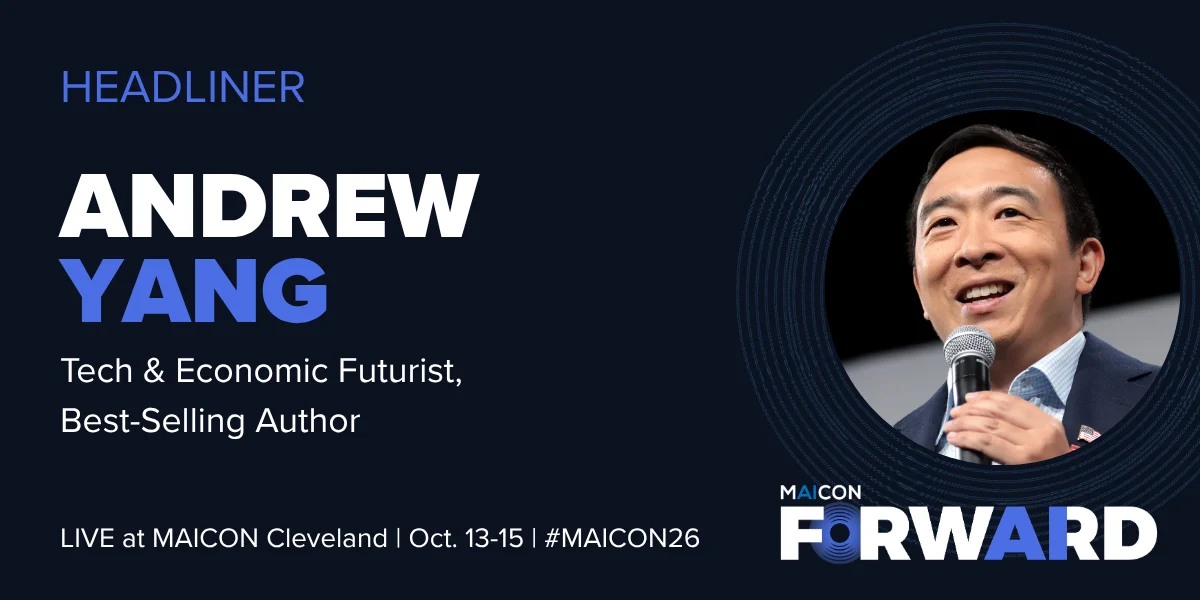
The central challenge facing modern leadership is no longer merely technological integration; it is institutional survival. As artificial intelligence evolves at a velocity that far outstrips the ability of our governments, educational systems, and economic frameworks to adapt, leaders are left searching for a compass. At the center of this dialogue stands Andrew Yang, the entrepreneur, author, and former presidential candidate who has spent years sounding the alarm on the societal shifts precipitated by automation.
As the featured keynote speaker for MAICON 2026, Yang brings a uniquely prescient perspective to the stage. His message—that AI is not merely a tool for efficiency but a foundational disruptor of the American social contract—is no longer a fringe theory. It is the urgent reality of the 21st-century workplace.
The Prophet of Automation: A Chronology of Foresight
To understand the weight of Yang’s voice at MAICON 2026, one must look at the trajectory of his public life, which has been defined by a singular, persistent focus on the intersection of technology and human livelihood.
The 2020 Pivot
When Yang launched his 2020 presidential bid, his platform was widely considered eccentric. While his peers focused on traditional political debates, Yang centered his campaign on the "Human-Centered Economy." He warned that AI and advanced automation were not coming in some distant, futuristic scenario—they were arriving, and they were poised to dismantle the traditional labor market. At the time, with the economy experiencing a period of sustained growth, many observers dismissed his warnings as alarmist.
The Turning Point
The intervening years have proven those skeptics wrong. The rapid proliferation of Large Language Models (LLMs) and generative AI has transitioned from experimental research to industrial utility in less than half a decade. In a 2024 blog post titled AI and the Rest of Us, Yang provided a sobering anecdote: a company that had previously employed 15 designers to ideate and create graphics had liquidated the entire department, replacing them with AI workflows. This is no longer a hypothetical risk; it is a current economic reality.
The Evolution of the Discourse
Since his presidential run, Yang has transitioned from a political insurgent to a policy bridge-builder. Through the Forward Party and his extensive work with technologists and labor advocates, he has moved the conversation from "Will AI happen?" to "How do we ensure that AI serves the humanity it replaces?" His 2025 TED Talk served as a milestone, cementing the necessity of Universal Basic Income (UBI) and other structural safety nets as essential components of an AI-ready society.
Supporting Data: The Disruption is Quantifiable
The disruption Yang speaks of is supported by a growing body of data that paints a stark picture for the workforce. According to industry analysis and labor reports from the last 24 months, the "AI effect" is manifesting in three distinct phases:
- The Creative Displacement Phase: Contrary to early predictions that AI would only impact manual labor, the current wave is disproportionately affecting white-collar, creative, and analytical roles. Marketing, coding, legal research, and entry-level administrative tasks are currently the primary targets for automation.
- The Velocity Gap: Research indicates that the time it takes for a new AI capability to reach mass adoption has shrunk from years to months. For organizations, this means that strategic planning cycles, which traditionally spanned three to five years, are now effectively obsolete.
- The Productivity Paradox: While AI increases output, it does not inherently guarantee an increase in human prosperity. Data suggests that without structural interventions, the gains from AI are being captured by capital owners, while the labor force experiences wage stagnation and increased job insecurity.
The Human-Centered Approach: Official Perspectives and Philosophical Frameworks
Yang’s perspective is rarely "anti-tech." Instead, it is a nuanced argument for "Human-Centered Governance." He argues that technology, if left to the invisible hand of the market without guardrails, will inevitably prioritize short-term profit over social stability.
"Left to its own devices, there will be some major downsides," Yang has noted. "If we want more of the good and less of the bad, it will be up to us and our leaders."
This philosophy represents a departure from the traditional Silicon Valley narrative of "move fast and break things." Instead, Yang advocates for a "move deliberately and fix the systems" approach. This involves:
![Andrew Yang: How AI Can Build a Future that Works for Everyone [MAICON 2026]](https://www.marketingaiinstitute.com/hubfs/Andrew%20Yang.png)
- Decoupling Survival from Labor: Exploring how the economy can function when human labor is no longer the primary driver of productivity.
- Investment in Human Capital: Shifting education from rote memorization—which AI does better—to human-centric skills like empathy, complex negotiation, and high-level strategy.
- Economic Safety Nets: Revisiting UBI not as a handout, but as a "dividend" of technological progress, ensuring that every citizen has a floor upon which they can stand during periods of transition.
Implications for Today’s Leaders
For the thousands of executives, managers, and policy influencers attending MAICON 2026, the implications of Yang’s framework are immediate and practical. The decisions made today regarding AI implementation will dictate the organizational culture and societal standing of these companies for decades to come.
1. Strategic Workforce Planning
Leaders must stop viewing AI as a way to "cut costs" and start viewing it as a way to "reorganize value." If AI replaces a task, how is that employee’s role redefined to provide value that machines cannot replicate? This requires a massive investment in internal reskilling rather than wholesale displacement.
2. Risk Management and Ethics
Risk is no longer limited to cybersecurity. There is now a "social risk" associated with AI adoption. Companies that aggressively automate without considering the impact on their workforce may find themselves facing talent retention crises, reputational damage, and a loss of the institutional knowledge held by human workers.
3. Long-Term Positioning
Yang’s message at MAICON 2026 is intended to challenge the "short-termism" that plagues modern corporate governance. By looking at the broader economic landscape, leaders can position their organizations to be the architects of a stable, sustainable future rather than just reactive participants in a race to the bottom.
What to Expect at MAICON 2026
The keynote, titled "The Human-Centered Economy: Building a Future That Works for Everyone," promises to be the cornerstone of the MAICON 2026 experience. Unlike technical sessions focused on prompt engineering or model fine-tuning, Yang’s presentation will zoom out.
Attendees can expect to explore:
- The Intersection of Policy and Profit: How future regulation will likely impact AI procurement and usage.
- Redefining Value: How businesses can measure success in an era where traditional output metrics are being inflated by AI.
- The Leadership Imperative: What the role of the CEO looks like when the workforce is a hybrid of biological and digital agents.
A Call to Action for the Future
The presence of Andrew Yang at MAICON 2026 is a signal that the AI conversation has matured. We are moving beyond the hype cycle of the "AI revolution" and entering the much more difficult phase of institutional adaptation.
For those responsible for steering their organizations through this fog, the invitation is clear: attend the sessions, engage with the data, and listen to the frameworks being proposed. Whether you are a technologist, a policymaker, or a business executive, the goal remains the same: to ensure that as we build the machines of tomorrow, we do not sacrifice the humanity of today.
Join Andrew Yang and over 50 other industry leaders at MAICON 2026 to gain the clarity, foresight, and actionable strategies required to lead in the age of intelligence. The future is moving fast, but with the right framework, it is a future we can shape.
Cathy McPhillips is the Chief Marketing Officer at SmarterX and the Marketing AI Institute. She is a leading voice in the field of AI-driven business transformation and a driving force behind the mission of MAICON.