Scaling a Software-as-a-Service (SaaS) startup from $1 million to $10 million in Annual Recurring Revenue (ARR) is widely recognized as one of the most treacherous phases of the entrepreneurial journey. It is a transitional chasm where scrappy, founder-led operations must evolve into structured, repeatable engines of enterprise growth.
Hindsight is an unforgiving teacher. Reflecting on the missteps, delays, and friction points experienced during this exact growth phase yields a definitive blueprint for building a resilient enterprise. Examining these lessons reveals a recurring theme: sustainable scaling requires early delegation, aggressive customer immersion, financial runway preservation, and a deliberate pivot from reactive firefighting to proactive institutional building.
Main Facts
The journey from $1M to $10M ARR tests the structural integrity of a startup’s leadership, product architecture, sales methodology, and financial reserves. According to retrospective analyses of high-growth SaaS companies, founders routinely fall into the trap of self-mitigation—attempting to patch departmental gaps themselves rather than hiring seasoned executives.
Key structural pivots required during this phase include:
- Transitioning from founder-led problem solving to hiring dedicated senior leadership (VPs of Engineering, Sales, and Business Development).
- Maintaining a healthy balance sheet—specifically holding at least $1 in cash reserves for every $2 in ARR to prevent under-investing in crucial growth levers.
- Moving away from full-stack, generalized sales representatives toward highly specialized inbound, outbound, and segment-specific teams.
- Elevating post-sale customer marketing and brand cultivation from secondary concerns to core operational pillars.
Chronology of Growth: The Phases of Scaling
Understanding the trajectory from $1M to $10M ARR involves recognizing when specific operational triggers must be pulled to avoid stagnation.
Phase 1: The $1M to $4M Threshold (The Firefighting Trap)
Immediately crossing the $1M ARR mark brings an overwhelming influx of support tickets, product feature requests, and early sales inquiries. Founders typically respond by rolling up their sleeves and managing sales teams, writing drip campaigns, or patching product codes themselves.
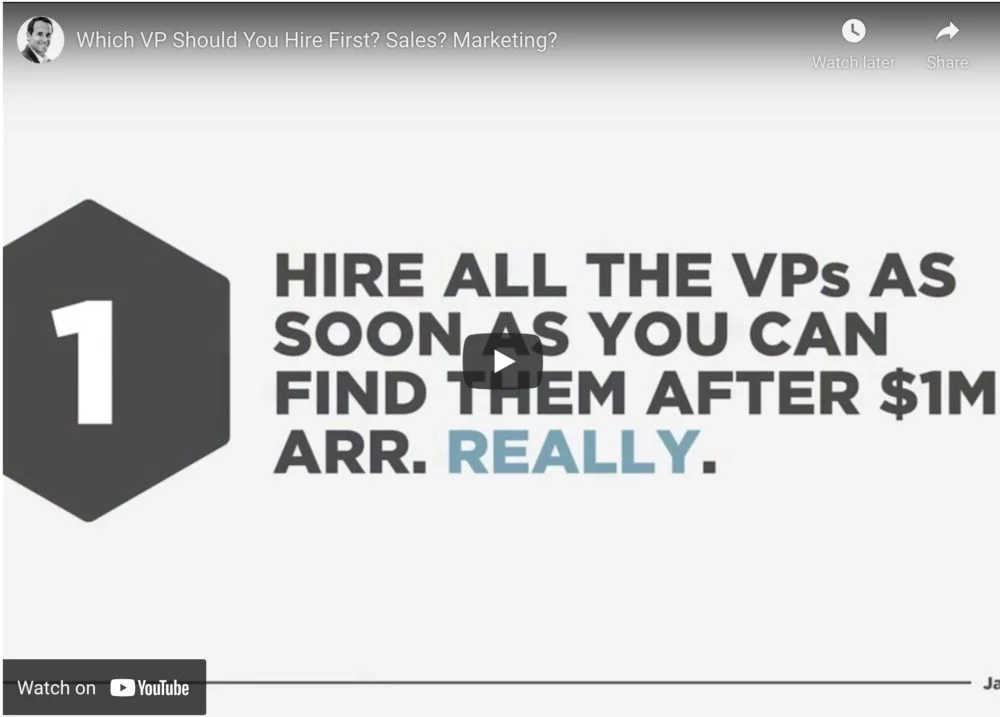
Chronologically, this is where the primary structural error occurs: delaying the recruitment of functional VPs. By acting as a universal backstop, the CEO creates a bottleneck. Instead of using valuable time to recruit executive talent who can wholly own these functions, the founder becomes trapped in endless recruitment backfills for lower-tier operational roles.
Phase 2: The $4M to $8M Threshold (Financial Balancing and Technical Evolution)
As companies approach $4M in ARR, many achieve cash-flow positivity. While this grants a liberating sense of independence from venture capital cycles, it often introduces a hidden tax: balance sheet starvation. Operating with insufficient cash reserves ($1.5M in the bank against $4M+ in ARR) triggers psychological hesitation. When leadership feels the fuel tank is running low, they routinely under-invest in critical scaling initiatives, such as opening regional offices or aggressively expanding sales headcount.
Simultaneously, this phase demands a critical engineering evolution. The original CTO-led development team, which excelled at early-stage iteration and rapid MVP deployment, often hits a wall around 8 to 9 developers. Technical debt mounts, and enterprise readiness suffers. Transitioning to a seasoned Vice President of Engineering becomes imperative to satisfy strict enterprise requirements regarding security, data protection, and code compliance.
Phase 3: The $8M to $10M Threshold (Brand Domination and Specialization)
As the company approaches the $10M ARR milestone, the market shifts. Early adopters—who are inherently willing to take risks on unproven technology—give way to the mainstream majority. At this juncture, a company’s mini-brand must mature into an established market presence. Specialized outbound sales motions, dedicated customer marketing teams, and localized customer conferences must be firmly established to cement market share against entrenched competitors.
Supporting Data and Strategic Metrics
To operationalize the transition from $1M to $10M ARR, founders must measure and track specific operational benchmarks:
- Customer Engagement Velocity: Founders should commit to conducting a minimum of 6 customer Zoom sessions per week and visiting top-tier accounts via in-person travel at least twice a quarter. Data shows that active, executive-level in-person touchpoints drastically reduce churn; companies report a near-zero churn rate among top-tier accounts visited consistently by leadership.
- Balance Sheet Ratios: To safely fund aggressive expansion—such as hiring 20 additional sales reps or launching major marketing campaigns—companies should maintain a balance sheet ratio of $1 in cash reserves for every $2 in ARR. Operating below a 50% cash-to-ARR ratio forces conservative capital allocation precisely when the company should be accelerating.
- Sales Specialization Multipliers: Transitioning from "full-stack" generalist sales reps to a specialized structure (separating outbound prospecting, inbound qualification, and mid-market/enterprise closing) dramatically increases calendar efficiency. A specialized SME closer should average 4 qualified appointments per day, doubling the effective productivity of a generalist handling administrative preparation and lead generation.
- Post-Sale Marketing Investment: While customer success teams handle retention, dedicated post-sale customer marketing is required to drive upsells and competitive displacements. Mature SaaS organizations should allocate 5% to 10% of recurring revenue streams specifically toward post-acquisition customer marketing.
Official Perspectives and Expert Insights
Industry veterans and high-growth operators consistently emphasize that structural discipline must supersede raw hustle during the scale-up phase.
Addressing the common pitfalls of partnerships, tech industry leaders note:
"The #1 mistake founders make in partnerships and business development? They don’t hire anyone full-time to manage the partnership. As CEO, you are great at forging that relationship. But maintaining it? That’s a full-time job." — Industry analysis on strategic alignment.
On the psychological and operational dangers of lean balance sheets, executive advisors highlight the necessity of adequate financial cushion:
"To really invest in your team, product, etc. you need at least $1 on the balance sheet for each $2 in ARR. At $20m ARR? You need $10m in the bank to make the hires, burn the tokens, etc. to really get to the next level. Below that… you hesitate."
Furthermore, experts stress that customer conferences and community-building cannot be deferred until a company reaches mega-cap status. Gathering even a core group of 10 to 20 foundational users for intimate dinners or half-day meetups fosters a deep sense of shared ownership, driving long-term product advocacy and word-of-mouth acquisition.
Implications for Future SaaS Leadership
The cumulative impact of these ten strategic corrections reshapes how modern software companies approach hyper-growth.
- From Reactive to Proactive Leadership: Founders must abandon the hero mentality. Fixing broken sales funnels or patching product features independently provides short-term relief but long-term paralysis. Delegating ownership to specialized executives is the only pathway to operational scale.
- The Shift from Product-Led to Brand-Led Growth: While product-market fit drives the initial surge to $1M ARR, and second-order revenue fuels the climb to $5M, the final push to $10M and beyond relies heavily on brand equity. Mainstream buyers rely on market reputation, third-party validation, and industry dominance to make purchasing decisions.
- Capital Efficiency vs. Strategic Aggression: Achieving cash-flow positivity is a commendable milestone, but premature frugality can handicap a company’s growth ceiling. Strategic debt or calculated equity injections are often necessary to keep the financial "gas tank" full, ensuring the organization can aggressively lean into market opportunities rather than hesitating out of cash scarcity.
Ultimately, navigating the corridor between $1M and $10M ARR is less about working harder and more about building smarter systems. By institutionalizing executive recruitment, financial cushioning, customer immersion, and market specialization early, SaaS leaders can build resilient, enduring enterprises capable of withstanding market shifts for decades to come.