The digital agency landscape is undergoing a profound paradigm shift. For decades, the playbook for scaling a web development firm relied on a linear model: more clients required more code, which in turn demanded more human headcount. However, as the industry moves deeper into 2026, exponential technological advances—led by the explosion of artificial intelligence—are rewriting the rules of engagement.
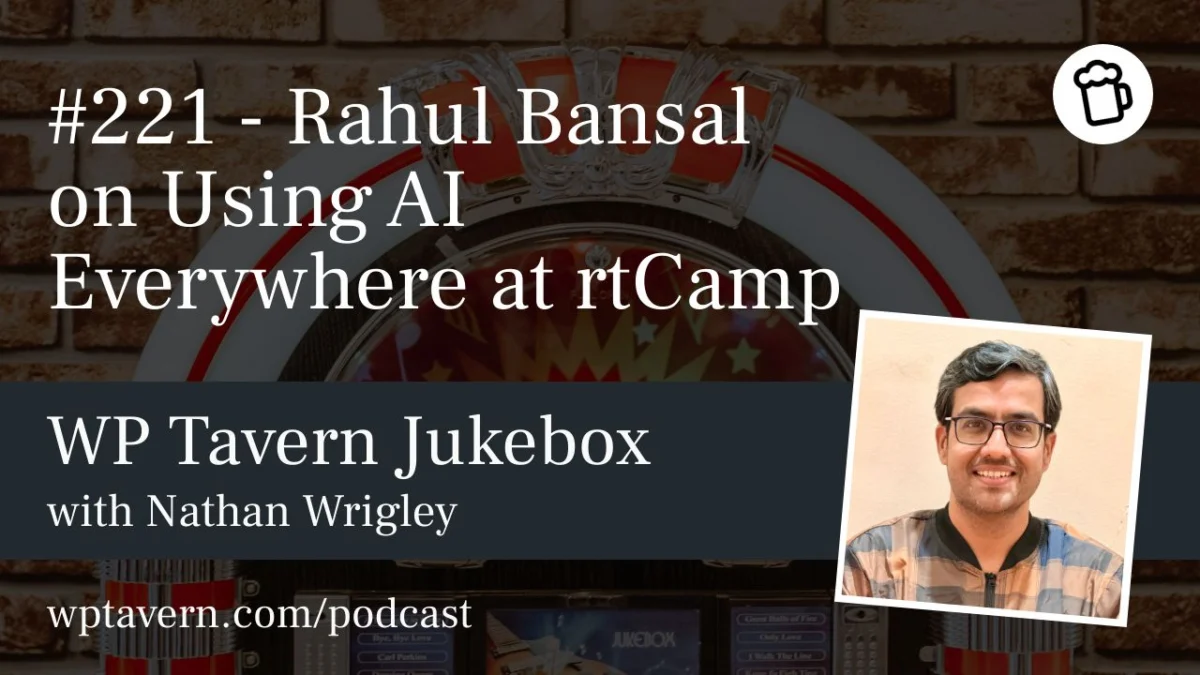
In a recent comprehensive interview on the WP Tavern Jukebox Podcast, host Nathan Wrigley sat down with Rahul Bansal, founder and CEO of rtCamp, to discuss the realities of running an enterprise-level WordPress agency. Recorded in the wake of WordCamp Asia, the conversation explored Bansal’s strategic insights on hiring complementary skill sets, niche specialisation, and rtCamp’s bold, aggressive transition toward an "AI-everywhere" operational model.
Main Facts: The Evolution of an Enterprise Giant
Founded 17 years ago, rtCamp has grown from a modest tech-blogging network into a globally recognized enterprise agency. Today, the company counts Fortune 500 companies, major publishers, and tech giants like Google among its core clients. Specializing in everything from large-scale website builds and complex migrations to custom Chrome extensions and SaaS connectors, rtCamp manages a large team of specialists delivering high-end WordPress solutions.
However, the core narrative surrounding rtCamp is no longer just its storied past; it is the agency’s radical pivot toward artificial intelligence. Under Bansal’s leadership, the company has adopted a hardline philosophy: If a business or technical process can be executed by AI, it will be.
Rather than treating AI as a superficial "bolt-on" feature or trying to build foundational AI models themselves, rtCamp has restructured its internal operations to let AI handle the heavy lifting of project management, pre-sales proposals, data mapping, and proof-of-concept prototyping. The result is a dramatic reduction in operational overhead, faster project delivery timelines, and a structural shift in team composition away from traditional coding and toward AI prompt engineering and strategic consulting.
Chronology: From Tech Bloggers to Enterprise Innovators
The Genesis: 2006–2009
Bansal’s journey in the WordPress ecosystem began long before rtCamp was officially established as an agency. In 2006, Bansal was operating a broad technology blog network in India—a digital property that generated massive traffic and required advanced customisation of WordPress to scale. At a time when Joomla was the market leader and custom PHP scripts were the industry norm, rtCamp’s founders chose WordPress simply because it was the platform they used themselves.
"It wasn’t any ideological decision," Bansal explained during the podcast. "The ideology is at the open-source level… There was no reason for us to have our blog running on WordPress and website running on Joomla."
The Agency Pivot
As the blog network scaled, competitors and other tech publishers began approaching rtCamp to ask for custom development help. Recognising that customising WordPress was faster and more lucrative than editorial production, the team gradually phased out their media operations and fully transitioned into a specialised WordPress development agency.
Post-COVID Expansion and the Modern Era
Following the digital boom of the COVID-19 pandemic, rtCamp experienced rapid growth, expanding its workforce to roughly 200 employees. To manage this scaling enterprise, the company undertook a massive internal refactoring of its software stack. Eschewing siloed proprietary platforms, rtCamp adopted Frappe ERPNext, an open-source enterprise resource planning tool that unified its accounting, payroll, CRM, and project management into a single source of truth.
This foundational move inadvertently prepared rtCamp for the AI revolution. When generative AI tools matured, rtCamp did not have to scramble to connect disparate software APIs; their data was already unified and clean, priming it for immediate AI integration.
Supporting Data and Strategic Frameworks
Bansal’s WordCamp Asia presentation, titled "How to Start an Enterprise WordPress Agency in 2026," outlined several data-driven and experiential frameworks for agency survival and growth.
1. Hiring Your "Complementary Set"
Drawing inspiration from set theory learned in mathematics classes during his youth, Bansal advocates against the natural human bias of hiring people who mirror the founder’s skill set.
- The Strategy: When scaling from freelancing to an agency, founders should list their weaknesses and hire individuals who completely cover those gaps. Bansal noted that early on, as a strong engineer with poor sales skills and unpolished English, he intentionally hired co-founders and team members with opposite strengths.
- The Relevance Today: This principle remains timeless, extending even to client acquisition. Agencies should seek out clients who do not understand WordPress deeply—such as non-technical enterprise marketing teams. This ensures the agency’s expertise is valued as a premium, non-commoditised service rather than a race to the bottom on hourly rates.
2. Niche Down Within the Niche
When rtCamp started, declaring oneself a "WordPress agency" was a powerful differentiator, especially in a region dominated by general IT outsourcing. Today, with tens of thousands of agencies globally, that broad declaration is no longer viable.
- The Advice: New agencies must drill down into "niches within niches." Whether focusing strictly on WooCommerce subscription businesses, complex payment gateway integrations, or enterprise migrations from proprietary platforms like Adobe Experience Manager, specialisation is mandatory to stand out in a crowded marketplace.
3. Operational Cost Reductions Through AI
Bansal revealed that rtCamp’s internal metrics show an efficiency gain ranging from 20% to over 90% across various operational workflows, with a projected baseline build-time reduction of 70% over the next two years.
- Pre-Sales Efficiency: Inbound lead qualification—once a manual process taking up to 30 minutes per inquiry—is now entirely automated by integrated AI that cross-references domain names, LinkedIn profiles, and CRM data within minutes.
- Vibe Coding Proposals: Instead of static PowerPoint presentations or Figma designs, rtCamp’s growth engineers now rapidly prototype functional WordPress sandbox environments during the pre-sales phase, giving prospective clients live sites to test before signing a contract.
Official Responses and Industry Outlook
While many industry veterans approach the rise of artificial intelligence with trepidation, Bansal maintains an optimistic, pragmatic outlook. He explicitly cautions against agencies attempting to act as AI algorithm creators.
"Our job is to apply AI, not invent AI," Bansal stressed. "We don’t have to think of what Opus 4.8 will do; let cloud engineers think of that… People will try that, figure out they built stuff nobody bought, and then they will try to say AI killed their business. No, think what existing problems we can solve with AI cheaply, efficiently, with better quality."
Rather than inventing futuristic, out-of-this-world applications, rtCamp focuses on making boring, heavy-lifting enterprise tasks—such as massive content migrations and data mapping—dramatically cheaper and faster. By reducing operational overhead, rtCamp can lower its project minimums and pass savings onto clients, accelerating enterprise adoption of WordPress.
Implications for the Future of WordPress Agencies
The systemic integration of AI at rtCamp carries deep implications for the broader WordPress ecosystem:
- The Changing Shape of the Workforce: While rtCamp has historically scaled its headcount alongside revenue, the agency’s engineering hiring has effectively flatlined. The industry is witnessing a shift away from traditional developers who can only write code toward "growth engineers" and consultants who excel at prompt engineering, strategic planning, and system architecture.
- A Shift Toward Sales and Marketing: As AI absorbs the manual labor of coding and project execution, rtCamp is pivoting its hiring strategy. Future expansion will focus heavily on sales, marketing, and high-level technical consulting rather than raw engineering capacity.
- WordPress as an AI-Ready CMS: Bansal believes that WordPress will emerge as a massive winner in the AI era. Because open-source platforms expose structured data without proprietary walled gardens, AI tools can ingest, query, and manipulate WordPress sites far more seamlessly than closed enterprise systems. This structural openness is driving an increase in enterprise migration inquiries toward WordPress.
Conclusion
Rahul Bansal’s journey with rtCamp serves as a masterclass in enterprise agency evolution. By combining foundational open-source architecture, ruthless operational standardisation, and an aggressive, pragmatic embrace of artificial intelligence, rtCamp is successfully navigating the turbulence of 2026. For agency owners currently feeling rudderless in a rapidly shifting market, the message is clear: stop fearing technological disruption, find your complementary sets, specialize deeply, and let AI become the efficient backbone of your business operations.