The narrative surrounding artificial intelligence in marketing has shifted rapidly over the past twenty-four months. For most organizations, the initial phase of "AI adoption"—the deployment of chatbots, content generators, and predictive analytics suites—is largely complete. Marketing departments are now saturated with high-powered tools. Yet, a glaring paradox remains: while tool access has reached an all-time high, the fundamental architecture of marketing work remains largely unchanged.
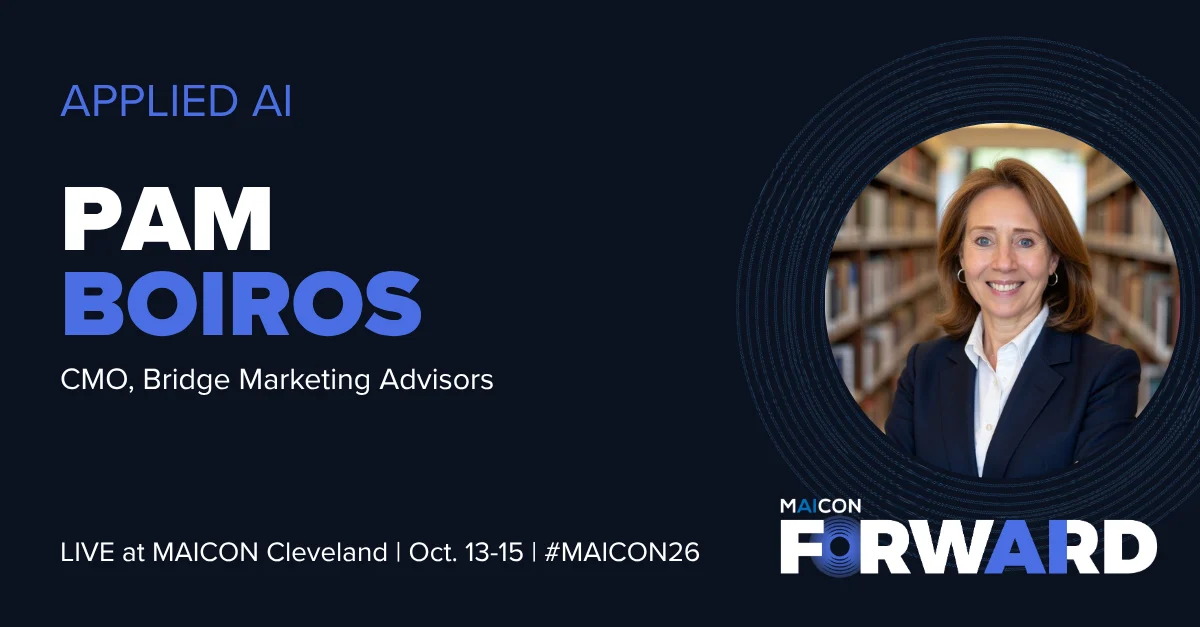
This disconnect is the focal point of a major industry conversation taking place at the upcoming Marketing Artificial Intelligence Conference (MAICON) 2026. Pam Boiros, a fractional Chief Marketing Officer at Bridge Marketing Advisors and a seasoned AI strategist, is set to address this critical gap in her keynote session, "AI Adaptation: The People Side of Scale."
As organizations move into the next phase of the AI revolution, the focus must shift from merely licensing software to fundamentally redesigning the human-machine collaboration.
The Chasm Between Adoption and Adaptation
To understand the current state of the industry, one must first distinguish between the act of purchasing software and the act of operationalizing it. Pam Boiros, who has previously steered marketing organizations at industry leaders like Skillsoft and meQuilibrium, defines the transition point clearly.
"You know you’ve moved from AI adoption to AI adaptation when AI stops feeling like a separate initiative and starts changing how the work itself gets done," Boiros explains.
Adoption is a binary state. It is easily measured by license counts, training attendance records, and the emergence of isolated, individual use cases. Adaptation, however, is a systemic evolution. It requires a total redesign of workflows where human judgment and machine efficiency are intentionally integrated rather than accidentally collided. In an adaptive culture, managers are no longer just monitoring output; they are coaching AI-assisted workflows and establishing clear guardrails that empower employees rather than restricting them.
The Five Building Blocks of AI Adaptation
Boiros’s framework for long-term AI success rests on five foundational building blocks. While she keeps the specific components of this framework as a focal point for her MAICON session, she emphasizes that most leadership teams fundamentally underestimate one specific pillar: organizational culture.
The Culture of Psychological Safety
In many corporate environments, "culture" is a buzzword, but in the context of AI, it is a tangible operational constraint. AI forces employees to grapple with new skills, admit to knowledge gaps, and abandon processes they may have mastered over decades.
"Culture shows up in what people actually feel safe and empowered to do every day," says Boiros.
In organizations that prioritize polished, error-free results, employees naturally default to caution. They fear that experimenting with AI might lead to a mistake, or worse, that admitting they don’t know how to use an AI tool will make them appear obsolete. This leads to "shadow AI"—where employees experiment in secret—or total avoidance.
The most successful teams do the opposite. They incentivize curiosity. They treat "failed" AI experiments as valuable data points rather than performance issues. When leadership transparently shares their own struggles with AI tools, it signals that the transition is a team-wide journey rather than a top-down mandate.
Unmasking the Resistance: Why "More Training" Fails
After three years of intensive research and training for marketing teams, Boiros has identified that the primary barrier to AI implementation is not technical—it is psychological.
Resistance to AI is rarely a conscious rejection of technology. Instead, it manifests as a lack of time, perceived irrelevance, or a bad first experience. When a marketer says, "I don’t have time to learn another tool," they are often actually saying, "I am overwhelmed, and I fear that this tool will increase my workload rather than decrease it."
Boiros argues that the traditional corporate response—throwing more training seminars at the problem—is largely ineffective. "What works better is creating space for people to learn without feeling like they’re taking on a second job," she asserts.
The Strategy of Small Wins
The most effective path to adaptation is rooted in the "start with the work" philosophy. Rather than forcing teams to adopt an AI-first mentality overnight, leaders should identify specific, tedious tasks that employees already perform. By providing protected time to experiment with these tasks, the narrative changes from "Why do I have to use this?" to "Where else could this help me?" This shift turns the tool from a source of anxiety into a source of agency.
Measuring Success in the AI Era
As organizations move toward adaptation, the metrics of success must also evolve. Traditional marketing KPIs—leads generated, click-through rates, and conversion metrics—remain important, but they do not capture the efficiency of the human-AI partnership.
Leaders should instead begin asking more sophisticated questions:
- Judgment vs. Automation: Are we spending more time on high-value human activities—like strategy, creative conceptualization, and relationship management—and less time on mechanical tasks?
- Quality of Output: Has the overall quality of our deliverables increased, or have we simply increased the volume of mediocre content?
- Resilience: Have we created workflows that can survive the next technological shift? If the specific tool we use today becomes obsolete tomorrow, is our underlying process strong enough to adapt to the next model?
Implications for Leadership and Strategy
The implications of this shift are profound for marketing leaders. We are entering an era where the competitive advantage of a firm is no longer its access to tools—since those are increasingly commoditized—but the velocity at which its team can adapt its internal culture and workflows.
Boiros’s upcoming session at MAICON 2026 is designed to be a practical, high-impact roadmap for leaders who are currently stuck in the "adoption plateau." Attendees can expect to leave with a concrete playbook that covers:
- Confidence Building: How to foster a team culture that rewards experimentation.
- Workflow Transformation: Strategies for turning scattered AI experiments into repeatable, scalable processes.
- Risk Management: Developing guardrails that ensure brand safety and regulatory compliance without stifling innovation.
- Burnout Prevention: Managing the transition to AI in a way that respects employee capacity and mental well-being.
Looking Ahead: The MAICON 2026 Experience
The Marketing Artificial Intelligence Conference has long been the industry standard for bridging the gap between theoretical AI hype and practical business application. With an expert lineup of over 50 speakers, the 2026 edition promises to be a critical junction for the industry.
Pam Boiros stands out as a unique voice in this space. By combining the perspective of a fractional CMO with the grassroots work of the Women Applying AI community, she bridges the gap between executive-level strategy and the day-to-day realities of the marketing practitioner. Her sessions are known for being both intellectually rigorous and refreshingly candid, designed to spark honest conversations about the difficult parts of the AI transition that most conferences gloss over.
As the industry moves into 2026, the question for every marketing team is no longer "Are we using AI?" but "How has AI changed the way we think, work, and make decisions?"
For those looking to move beyond the surface-level adoption of AI tools and build a truly adaptive organization, Boiros’s session is an essential touchpoint. It offers a blueprint for leaders who recognize that the most critical element of artificial intelligence is, ironically, the human element.
To learn more about Pam Boiros and her work in AI strategy, follow her updates leading up to the conference. To join the conversation at MAICON 2026 and hear from over 50 industry leaders, register today via the official Marketing AI Institute website.