GLOBAL — In a significant strategic pivot, prominent email marketing and customer engagement platform Selzy has announced the impending retirement of its legacy Automations feature. The company is actively directing its global user base to transition their automated workflows to its newer, more robust Omnichannel Automation Scenarios product. This modernised environment is now positioned as the cornerstone of Selzy’s future development roadmap for automated customer journeys.
While a hard sunset date for the legacy system has not yet been formally codified in the company’s public migration documents, Selzy’s leadership has made it clear that support for the older infrastructure will soon cease entirely. All forthcoming feature enhancements, performance updates, and technological advancements in automated marketing will be channeled exclusively into the Omnichannel Scenarios ecosystem.
For digital marketers, small-to-medium-sized enterprise (SME) owners, and communication specialists relying on Selzy, this transition necessitates a proactive approach. Although the platform has engineered a migration pathway to ease the shift, users must navigate structural changes, manual activation protocols, and data handling caveats to ensure operational continuity.
Main Facts: What Is Changing and Why It Matters
The shift from Selzy’s traditional Automations builder to Omnichannel Scenarios is far more than a routine cosmetic redesign or interface update. It represents a fundamental technological evolution in how the platform handles customer communications, moving from linear email drip campaigns to dynamic, multi-channel journey orchestration.
The Core Transition
For years, Selzy’s legacy Automations tool served as the standard environment for setting up triggered emails, welcome sequences, and basic behavioral responses based on user activity. However, as customer expectations have shifted toward cross-channel brand engagement, the limitations of an email-only automation framework became apparent.
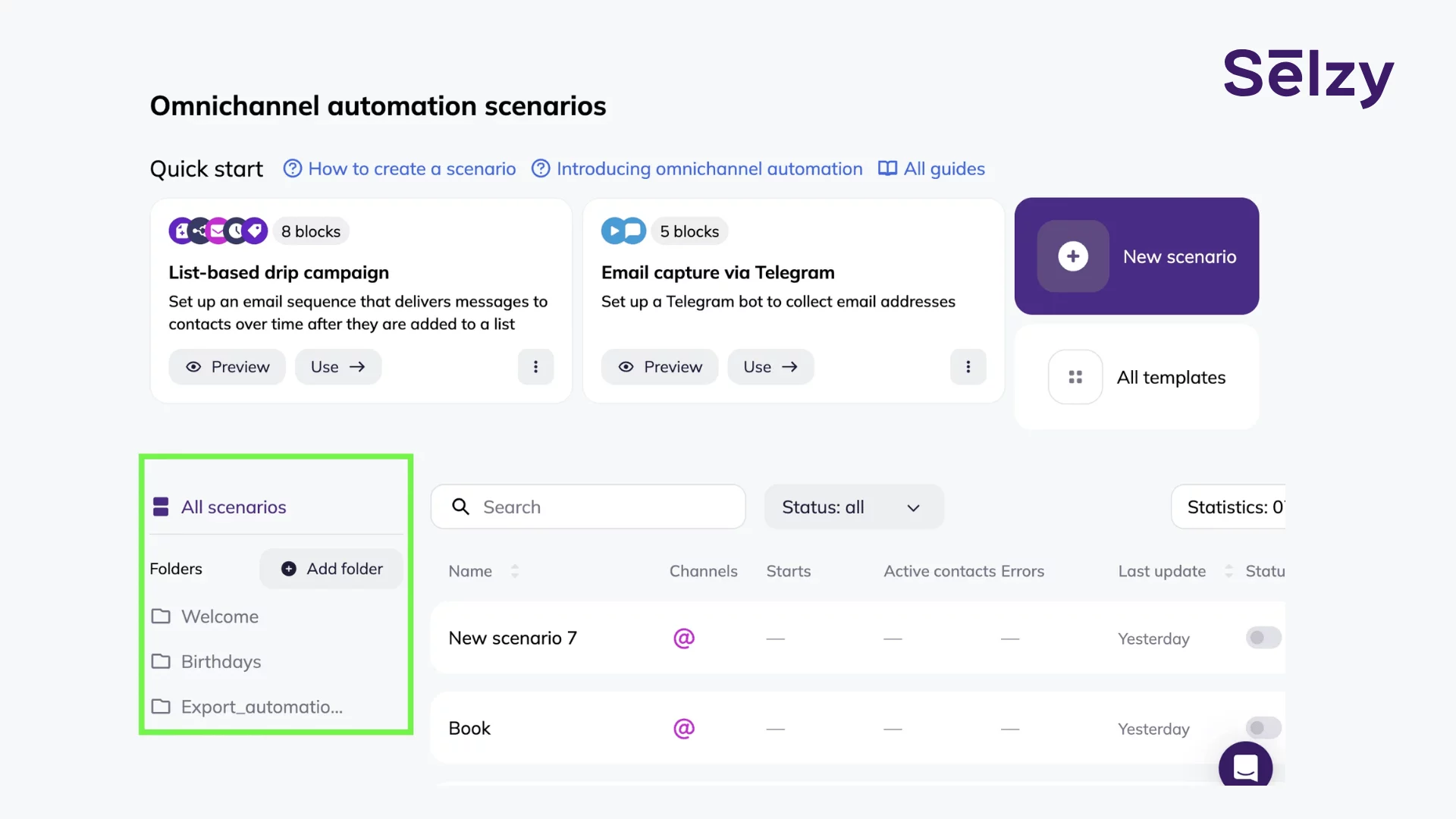
The new Omnichannel Scenarios product dissolves these silos. While email remains a foundational pillar, the updated visual workflow builder is natively designed to coordinate communication across disparate channels. At launch, the system integrates email alongside Telegram bots, allowing brands to construct unified touchpoints that speak to consumers where they are most active.
Key Architectural Enhancements
The new platform introduces several advanced capabilities designed to give marketers granular control over their campaigns:
- Expanded Channel Support: Moving beyond email to incorporate instant messaging platforms like Telegram, with future channels slated for development.
- Advanced Visual Workflow Builder: A modern drag-and-drop interface incorporating sophisticated triggers, conditional branching logic, subscriber-data updates, and multi-step actions.
- Dual Journey Framework: A clean architectural separation between Triggered Scenarios (for event-driven, behavioral, and transactional messages) and Bulk Scenarios (for mass campaigns, seasonal promotions, and large-scale data updates).
- Enhanced Analytics and Reporting: Granular block-level performance statistics, refined reporting exports, and deeper visibility into subscriber engagement metrics.
Despite these upgrades, the immediate priority for Selzy users is managing the migration of existing campaigns before the legacy environment is completely retired.
Chronology: The Roadmap to the Omnichannel Future
Understanding the timeline of this transition is vital for marketing teams aiming to avoid campaign downtime or lost customer touchpoints. While Selzy has opted against publishing an aggressive, immediate cutoff date for its legacy Automations tool, the sequence of deployment and migration stages is already well underway.
Phase 1: Introduction and Parallel Development
Over the past several quarters, Selzy developed the Omnichannel Scenarios platform alongside its existing infrastructure. Rather than forcing an abrupt overnight cutover, the company introduced the new product as an advanced alternative, allowing early adopters to test multi-channel workflows and Telegram integration while the legacy Automations tool remained fully functional.
Phase 2: Introduction of the Automated Migration Tool
To facilitate a smoother transition, Selzy’s engineering team built a dedicated conversion utility. When users initiate this process within the platform, the system automatically analyses an existing legacy automation and attempts to replicate its underlying logic, settings, and email content within the new Omnichannel Scenarios environment.
Crucially, during this phase, the original automation remains completely untouched and operational. This ensures that live campaigns do not experience immediate interruption simply because a migration process has been initiated.
Phase 3: The Current Transition Window (Active Now)
Selzy is currently in the midst of its primary migration window. The legacy Automations tool remains accessible, but users are strongly advised to audit their accounts, convert vital workflows, and verify new configurations.
Converted workflows are automatically instantiated as Triggered Scenarios in a draft state. They remain inactive by default to prevent duplicate messaging or accidental premature deployment. Marketers must manually review, test, and activate these scenarios before they can begin processing new contacts.
Phase 4: Final Sunset of Legacy Automations (Upcoming)
In the final phase of this roadmap, Selzy will officially deprecate and remove access to the legacy Automations builder. Once this phase is reached, any unconverted workflows will cease to exist within the active platform interface, making proactive migration during the current window essential for all active users.
Supporting Data: Migration Considerations and Technical Realities
Migrating enterprise or small-business marketing workflows from one structural environment to another rarely happens without technical caveats. Selzy’s documentation outlines specific parameters, limitations, and data-handling rules that users must account for during the conversion process.
The Fate of In-Flight Contacts
One of the most critical technical nuances of Selzy’s migration utility involves contacts who are actively progressing through an old automation at the moment of conversion.
According to Selzy’s technical briefs, contacts currently traversing a legacy automation do not automatically resume their journey at the equivalent step in the newly converted Scenario. When a workflow is translated, it starts fresh. Therefore, marketing teams must strategically plan their cutovers to avoid stranding active leads mid-funnel. Ideally, teams should let active legacy automations run their course to completion before transitioning incoming traffic entirely to the new Scenario-based framework.
Handling Historical Data and Analytics
Data preservation is always a top concern during platform migrations. Selzy has confirmed that historical automation statistics do not transfer into the new Omnichannel Scenarios environment.
To mitigate potential data loss for reporting, compliance, and auditing purposes, Selzy has incorporated an export function. Users are urged to export and archive their historical automation performance metrics before access to the legacy Automations tool is permanently revoked.
Once inside the new system, however, users benefit from vastly superior tracking features, including block-level performance metrics that provide deep insights into where subscribers engage, drop off, or convert within a visual workflow.
Official Responses and Strategic Industry Implications
The broader marketing technology landscape has taken note of Selzy’s pivot. Industry analysts view the move as validation of a wider, secular trend reshaping the software-as-a-service (SaaS) marketing sector.
Moving Beyond Single-Channel Thinking
For years, email marketing platforms (EMPs) and customer relationship management (CRM) tools operated in isolated verticals. Email automation platforms handled email; SMS providers handled text messaging; chat platforms managed instant messaging.
Today, consumer habits demand a seamless, multi-channel brand experience. Customers expect an interaction on a messaging app to instantly inform subsequent email communications, and vice versa. By anchoring its roadmap to Omnichannel Scenarios, Selzy is aligning itself with this modern reality.
In official statements, Selzy representatives emphasize that the company’s product strategy is firmly rooted in unifying disparate touchpoints. By merging subscriber data, triggers, conditions, and multi-channel actions into a single visual canvas, the platform eliminates the friction inherent in managing separate tools for different communication channels.
The Strategic Value of Triggered vs. Bulk Scenarios
Selzy’s structural division of its new platform into Triggered Scenarios and Bulk Scenarios addresses two distinct operational needs within modern marketing departments:
- Triggered Scenarios cater to the "always-on" lifecycle of the modern consumer. Whether executing complex welcome sequences, automated abandoned-cart reminders, or behavior-based re-engagement campaigns, these event-driven workflows run continuously in the background, reacting in real time to user actions.
- Bulk Scenarios provide heavy-duty utility for campaigns that require mass orchestration. Whether executing a coordinated Black Friday promotion, rolling out an urgent company-wide announcement, or processing a massive batch update to subscriber segmentation data, Bulk Scenarios allow brands to deploy actions across massive audiences efficiently and securely.
Practical Implications for Selzy Customers: What You Need to Do
As Selzy moves forward with this technological transition, users must take deliberate, calculated steps to safeguard their automated marketing operations.
1. Conduct a Comprehensive Automation Audit
Before initiating any automated conversions, marketing teams should review every active workflow currently housed in the legacy Automations tab. Ask critical questions:
- Which automations are actively generating revenue or engagement, and which are obsolete?
- Are there outdated logic paths or redundant email sequences that should be pruned rather than migrated?
- What is the volume of active contacts currently moving through each legacy workflow?
2. Prioritize and Convert Core Workflows
Utilize Selzy’s built-in conversion tool to translate essential, high-impact workflows into the new Omnichannel Scenarios environment. Remember that converted workflows are created as inactive drafts. Take time to carefully review the translated logic, verify that email content and subscriber data updates have transferred correctly, and perform end-to-end testing before toggling the switch to active.
3. Archive Historical Performance Data
To maintain longitudinal reporting integrity, ensure that all historical performance statistics from the legacy Automations system are exported and saved to local archives or cloud storage before the older environment is decommissioned.
4. Explore New Multi-Channel Horizons
Do not treat the migration as a mere administrative chore. Because the new ecosystem supports Telegram bots alongside email—with further channel expansions expected on Selzy’s active development roadmap—marketers should look for opportunities to enhance their existing workflows. Integrating instant messaging touchpoints into standard onboarding or retention sequences can dramatically boost overall engagement and brand recall.
Conclusion
Selzy’s decision to retire its legacy Automations functionality in favor of Omnichannel Scenarios marks a definitive turning point for the platform and its users. While transitions of this scale inevitably introduce short-term operational hurdles—such as manual workflow reviews, data exports, and strategic timing for active contacts—the long-term benefits are substantial.
By unifying email and messaging channels into a single, highly visual, and data-driven workflow builder, Selzy is providing its users with the sophisticated tools required to meet modern consumer expectations. For digital marketers utilizing the platform, the message is clear: the future of customer journey orchestration is omnichannel, and the time to migrate is now.