SAN FRANCISCO — In the hyper-accelerated world of enterprise artificial intelligence, software vendors routinely promise total operational automation. Marketing decks and flashy product demos paint a picture of autonomous customer experience (CX) agents that effortlessly solve consumer problems, handle complex inquiries, and slash human labor costs to near-zero. But how many support tickets and related issues can AI agents really, truly resolve in the wild today?
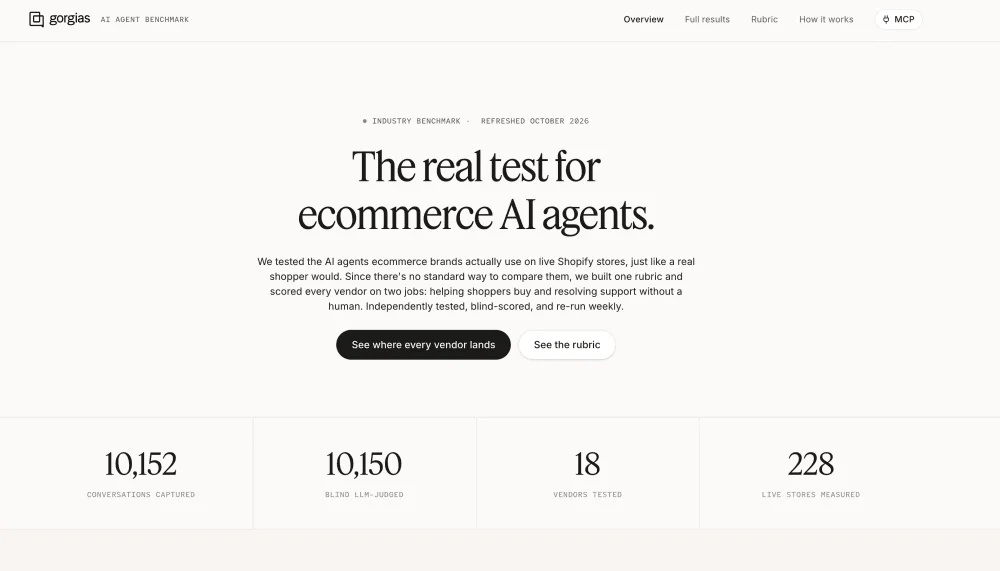
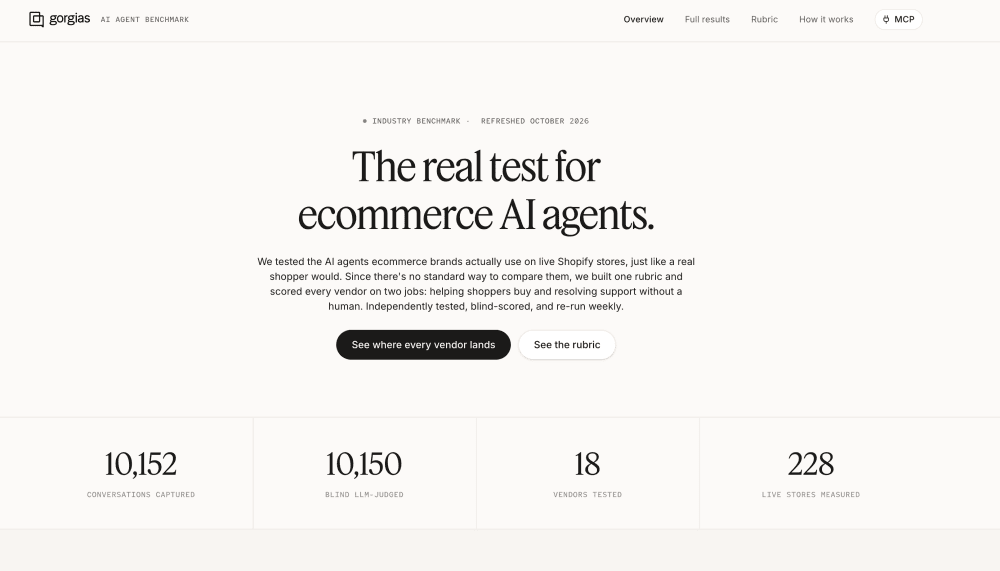
A rigorous new industry benchmark released by Gorgias—a $100M ARR AI CX leader backed early by the SaaStr Fund—cuts through the marketing noise. Testing 13 different AI vendors across 212 live, mid-market e-commerce stores carrying real inventory, the evaluation offers a rare, objective look at the current ceiling of automated customer service.
Rather than relying on controlled sandboxes, synthetic product catalogs, or scripted vendor demonstrations, the benchmark tests agents on authentic consumer interactions. Every participating agent received the identical incoming customer messages from active online stores. A blind judge then scored each vendor’s response against 26 binary checks, utilizing programmatic verification against live store data to validate factual claims regarding pricing, store policies, and Stock Keeping Units (SKUs).
The headline finding is both an endorsement of modern language models and a reality check for budget planners: the absolute best AI agents fully resolve roughly 70% of customer conversations without human intervention. However, the typical vendor on the market resolves less than half.
Main Facts: The Great Divide in AI Customer Support
The evaluation shatters the illusion that all AI customer service agents are created equal. While elite platforms are pushing automation rates toward the 75% threshold, legacy helpdesk bundles and secondary tools lag drastically behind.
According to the four-week pooled data from the benchmark, the top five performing vendors achieve automation rates ranging between 64% and 75%, with an average of 70%. Conversely, the median vendor resolve rate sits at 48%, dropping to 46% when weighted by total conversation volume.
Perhaps most striking for e-commerce operators is the performance of ubiquitous platforms. Brands that rely on software they already pay for—such as Zendesk, Intercom, and Klaviyo—will find little comfort in the data. None of these established platforms managed to resolve more than 42% of conversations in the benchmark. On this evidence, the AI solutions bundled natively into existing helpdesk or email marketing tools rank among the weakest options currently available on the market.
When evaluating vendors, researchers stress that automation rate alone can be a deceptive metric. A high automation score means very little if the AI is providing incorrect or unhelpful answers. To capture a holistic view, the benchmark evaluated vendors across both automation percentage and a blind quality score ranging from 0 to 100.
The market generally splits into three distinct operational archetypes:
- Strong on Both Metrics: A select few providers—specifically Yuma, Decagon, and Gorgias—manage to clear 64% in automation while maintaining quality scores above 65.
- High Automation, Weak Answers: Some vendors push high conversation closure rates by aggressively deflecting or rushing interactions, often at the expense of accuracy. For instance, Ada closes a high volume of conversations but scores 27 points lower on answer quality than top-tier competitors.
- Strong Answers, Low Automation: Conversely, platforms like Sierra tie for the highest quality scores in the industry but successfully resolve less than half of the conversations assigned to them.
The practical implications of low quality scores hit a company’s profit margins directly. A ticket marked "resolved" that provides a customer with an incorrect return window does not actually solve the problem; it merely creates a secondary contact. Because follow-up tickets are inherently more complex and costly to handle than initial inquiries, low-quality AI agents actively generate their own future ticket volume.
Chronology and Methodology: How the Evaluation Evolved
To understand the significance of the Gorgias evaluation, one must examine how the benchmark came to be and how its strict parameters were established.
For years, the generative AI boom forced software buyers to rely on self-reported metrics from vendors. These internal statistics frequently leveraged generous definitions of "success," counting deflected phone calls, abandoned chat sessions, or delayed customer drop-offs as automated resolutions.
Recognizing a profound information asymmetry in the market, industry stakeholders sought a standardized testing ground. Gorgias structured its evaluation to eliminate vendor bias through a strict, unyielding methodology:
- Live-Fire Testing: The evaluation eschewed simulated environments, deploying the test suite directly against 212 mid-market e-commerce operations with live inventory and genuine buyers.
- Standardized Inputs: Every competing AI agent received the exact same customer prompts, ensuring no vendor faced a disproportionately easy or difficult ticket queue.
- Blind Judging: Responses were evaluated by an independent judge blind to the vendor identity, utilizing 26 binary evaluation checks.
- Programmatic Fact-Checking: Critical commercial claims—such as whether an item is in stock, how much it costs, or what the return window is—were verified automatically against the live merchant store database.
Crucially, the benchmark defined a "resolution" strictly as an interaction handled with zero human touch. If an agent handed off the conversation to a human operator, directed the customer to a static contact form, or told them to send an email or make a phone call, the interaction was classified as an unresolved failure. The automated auditor never requested human intervention, meaning every single handoff was an autonomous decision made by the AI agent itself.
Supporting Data: Where AI Succeeds and Where It Fails
Breaking down support quality by specific topic reveals massive variances in artificial intelligence capabilities. Across the entire field of evaluated vendors, support efficacy drops by an average of 28 points when transitioning from the easiest conversation types to the hardest.
- Policy and Informational Queries: Questions that can be answered directly from a static policy page consistently score the highest. When a customer asks about general shipping timelines, warranty terms, or store locations, AI models excel.
- Transactional and Dynamic Queries: Questions requiring live system lookups, database queries, or nuanced human judgment score near the bottom.
Order tracking—typically the single largest ticket category for any e-commerce enterprise—sits stubbornly low on the performance list. Across the entire field of vendors, only about a third of post-sale tracking inquiries reach a successful, autonomous finish.
The Root Causes of Failure
The benchmark data revealed that the most common points of failure were not hallucinations or fabricated facts. Judges rarely caught agents inventing policies out of thin air. Instead, failures were driven by structural and operational roadblocks:
- Authentication Walls: Overly rigid security protocols that block legitimate customers from verifying their identities.
- Data Retrieval Loops: Agents repeatedly demanding order numbers or customer emails that were already provided in the initial prompt.
- Clarification Loops: The AI getting trapped in polite conversational loops, unable to parse the user’s intent.
- Premature Escalation: Defaulting to human handoff at the slightest hint of ambiguity.
Furthermore, onboarding and quality control emerged as far more critical to success than the underlying foundational model. The exact same AI model deployed across different stores could yield radically different results. Nearly a third of the "AI chat" widgets discovered during preliminary scans produced no functional conversation at all, underscoring the vital importance of proper implementation, guardrails, and escalation configurations.
The Trajectory: 9 Out of 10 Vendors Lost Ground
Perhaps the most sobering discovery in the evaluation is historical trend data. Tracking ten vendors with sufficient operational history over a continuous four-week period revealed a troubling trend: nine out of ten vendors experienced a decline in automation rates.
Quality metrics followed the exact same downward trajectory, with nine out of ten vendors seeing their quality scores drop—notably including Ada (-17 points), Zendesk (-15 points), Sierra (-14 points), and Gorgias (-12 points). Only a handful of niche providers, such as Envive (up 8 points in automation) and Siena (up 2 points in quality), bucked the trend.
While the benchmark does not explicitly isolate the cause of these nationwide performance drops, industry experts point to shifting store configurations, model updates, and increasingly complex seasonal consumer question sets as primary suspects. Whatever the underlying catalyst, the core takeaway for business leaders is clear: the automation rate observed during a controlled software pilot will likely not match the performance seen a month into production.
Official Responses and Industry Reactions
The release of the benchmark has sent ripples through the customer experience software sector, sparking intense debate among legacy platform providers and specialized AI startups alike.
Representatives for major enterprise helpdesk platforms have privately questioned the weighting of the benchmark, arguing that native tools are designed to serve as broad, omnichannel routing hubs rather than hyper-specialized autonomous deflection engines. However, independent tech analysts have largely praised the transparency of the evaluation.
Because the benchmark rubric, scoring methodology, and raw transcripts have been made fully open for public inspection, enterprise buyers have newfound leverage when negotiating software contracts. Companies can now demand that prospective vendors provide certified metrics derived from identical testing environments, rather than relying on curated case studies.
Industry economists have also emphasized the financial ramifications of these findings. With platforms like Gorgias pricing their AI agents at approximately $0.90 per resolved conversation, enterprises must carefully audit vendor definitions of "resolved." A platform boasting high resolution rates by counting abandoned customer sessions will artificially inflate software expenditures without delivering genuine labor savings.
Strategic Implications: How Businesses Must Adapt
For e-commerce executives and customer support leaders mapping out their technology budgets for the coming fiscal year, the benchmark offers a clear strategic playbook:
- Build Realistic Financial Models: Business cases should be built on an automation expectation of 65% to 70%, and strictly when utilizing a top-tier vendor. Organizations utilizing AI bundled into existing helpdesk suites like Zendesk, Intercom, or Klaviyo should realistically plan for automation yields between 20% and 42%.
- Evaluate Automation and Quality Concurrently: Never select a vendor based on closure rates alone. Insist on seeing verified quality scores alongside automation metrics on identical test sets.
- Map Metrics to Your Specific Ticket Mix: Because policy questions resolve effortlessly while order tracking and complex returns fail frequently, brands must audit their internal ticket distribution. If an e-commerce store’s volume is overwhelmingly dominated by "Where Is My Order?" (WISMO) inquiries, benchmark averages will significantly overstate expected performance.
- Execute Cold Tests on Reference Stores: Do not rely on vendor demos. Take 30 historical customer tickets from the previous month, open incognito browser sessions on the live sites of the vendor’s existing reference customers, and manually test the agents.
- Establish Continuous Monitoring: Because historical data proves that platform performance degrades over time due to configuration drift or model shifts, support teams must re-test their automated agents on a strict monthly schedule.
Ultimately, the era of unverified AI hype is drawing to a close. As benchmarks like this demonstrate, artificial intelligence is no longer a futuristic novelty; it is a mature, highly competitive utility. While today’s top-performing agents successfully manage the heavy lifting of routine customer service inquiries, human oversight remains an indispensable pillar of modern commerce.