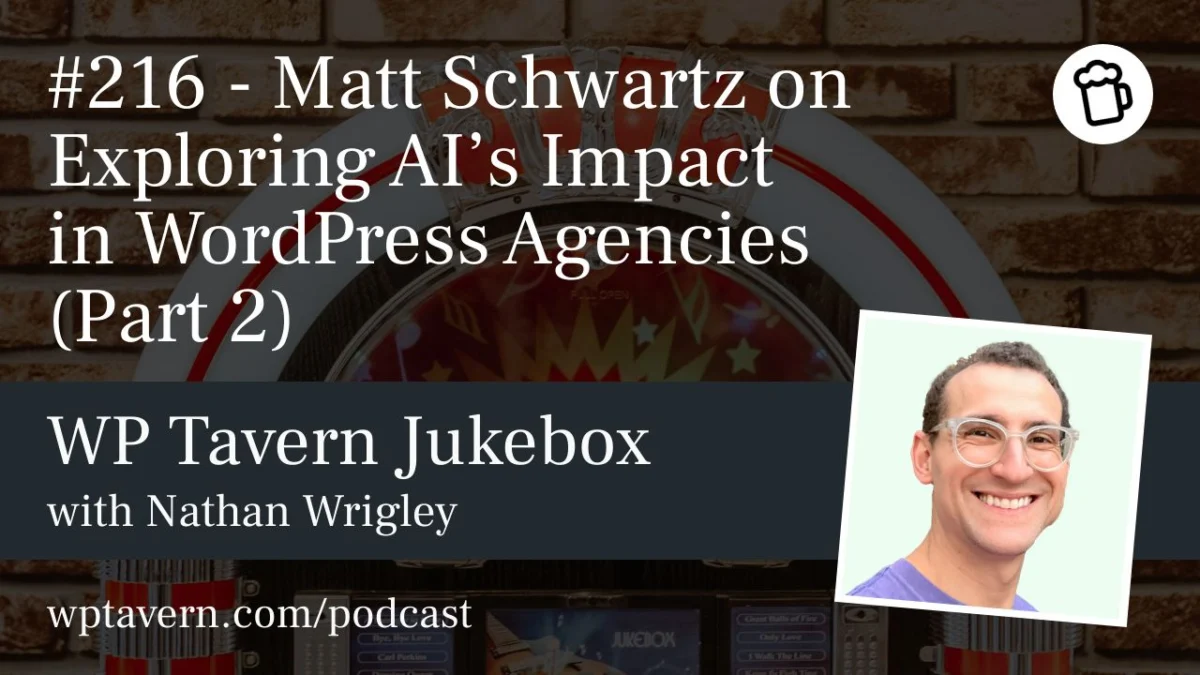
The landscape of the WordPress agency ecosystem is undergoing a tectonic shift. As artificial intelligence moves from a novelty to a fundamental operational component, agency owners are finding themselves at a critical crossroads: adapt with precision or risk obsolescence. In a wide-ranging, two-part deep dive on the WP Tavern Jukebox podcast, agency owner and software developer Matt Schwartz joined host Nathan Wrigley to outline a comprehensive framework for incorporating AI into agency workflows—not just for the sake of speed, but for long-term sustainability and security.
This report synthesizes the strategies, risks, and forward-looking projections discussed during their conversation, providing a roadmap for agencies looking to navigate the AI era with eyes wide open.
The Strategic Imperative: Integrating AI into the Agency Brain
The conversation began with a pragmatic approach to AI integration: treating the technology not as a standalone tool, but as a centralized "brain" for the organization. Schwartz argues that the most effective way to utilize AI is to connect it to the agency’s existing intellectual property—its wikis, project management tools, and standard operating procedures (SOPs).
Leveraging Internal Data
Instead of relying on general-purpose AI models that may "hallucinate" or provide generic guidance, agencies are increasingly using techniques to ground AI in their own data. By connecting chatbots to platforms like ClickUp or Asana, agencies can ensure that when an AI answers a query, it references the specific, up-to-date documentation of that agency. This creates a "single source of truth" that prevents the AI from guessing, effectively turning an agency’s entire history of projects and SOPs into a searchable, intelligent knowledge base.
Chronology of Adoption: From Basic Chatbots to MCPs
The progression of agency AI usage has moved from simple text generation to complex system integration.
- Phase One: The Content Era. Initial adoption focused on drafting emails, generating blog posts, and basic coding assistance.
- Phase Two: The Integration Era. Agencies began connecting AI to APIs to perform specific tasks, such as generating tickets or modifying project data.
- Phase Three: The Model Context Protocol (MCP) Era. This is the current frontier. MCP, an open-source standard, acts as a secure "bridge" between AI agents and internal systems. Rather than managing complex, insecure API keys for every employee, an agency can build a single, centralized MCP that acts as a secure, gated proxy. This allows team members to interact with complex systems—like hosting environments or help desks—without needing direct, potentially dangerous, administrative access.
Supporting Data: Risk Assessment and Operational Security
A central theme of the discussion was the necessity of "guardrails." As Schwartz emphasized, the ease of access to AI tools is both a "blessing and a curse."
The Danger of "Vibe Coding"
The term "vibe coding" refers to the practice of using AI to generate code or tools without deep technical oversight. While effective for low-risk, internal-only dashboards or one-off reporting tasks, it becomes a liability when applied to mission-critical infrastructure.
- Risk Mitigation: Agencies must conduct manual code reviews for any AI-generated tools.
- The "Delete" Scenario: Without proper guardrails, a simple prompt could inadvertently trigger catastrophic actions, such as deleting entire server file structures or wiping client databases.
- Cost Realities: The current "gold rush" of affordable AI tools is subsidized by massive venture capital. Agencies should be prepared for significant price hikes as vendors transition toward profitability, necessitating a strategy that allows for operational flexibility should AI costs increase tenfold.
Official Perspectives: The Impact on the WordPress Plugin Market
The rise of AI has triggered a ripple effect within the WordPress developer community. There is an observable tension between the convenience of AI and the health of the open-source ecosystem.
The Erosion of Small Utilities
Many plugin developers are reporting a decline in sales for smaller, "utility-style" plugins. Why purchase a plugin for $20 when an AI can generate the code snippet in seconds? While this might seem like a win for the agency’s bottom line, it creates a long-term problem:
- Community Attrition: Small plugins have traditionally been the entry point for new developers into the WordPress ecosystem. If these "entry-level" products disappear, the pipeline of contributors who maintain the community spirit—hosting events, contributing to core, and providing support—begins to dry up.
- Raising the Bar: The market for plugins is shifting. Simple, one-trick-pony plugins are losing value. Developers are now forced to build more complex, platform-grade solutions that offer security, reliability, and support that AI—at its current stage—cannot reliably replicate.
Implications: The Future of the Agency Business Model
Looking toward 2026 and beyond, the role of the agency is set to evolve. The consensus between Schwartz and Wrigley is that the agency of the future will be less focused on "execution" and more focused on "management and strategy."
1. The Shift in Hiring
As AI handles the heavy lifting of routine development, the need for junior-level roles dedicated solely to execution is likely to decrease. Instead, agencies will prioritize senior-level "AI Managers"—professionals capable of orchestrating AI agents, verifying output, and focusing on high-level strategy that requires human nuance.
2. Productized Services
Agencies will likely move toward highly specialized, productized offerings. By using AI to automate the "plumbing" of a project, agencies can focus on niche verticals (e.g., specific solutions for the plumbing or medical industries). The AI handles the generic requirements, while the agency provides the domain-specific expertise that adds the actual value.
3. The Human-in-the-Loop Necessity
Despite the advancements, the "human-in-the-loop" model remains non-negotiable for critical tasks. Whether it is verifying that a site is indexed correctly or ensuring that an automated deployment doesn’t break a production site, the ultimate accountability rests with the human owner.
Conclusion: A Measured Approach
The final takeaway for agency owners is clear: be curious, but be cautious.
The goal is not to automate every facet of the business, but to identify the "sweet spot"—those tasks that were previously neglected due to time constraints or limited resources, which AI can now handle efficiently. By documenting processes, implementing rigorous error handling, and prioritizing data security, agencies can thrive as the industry evolves.
"Don’t be reckless," Schwartz concluded. "Document it all out ahead of time. If you approach this with a strategy rather than just reacting to the latest trend, you can leverage AI to create a more profitable, more effective, and more resilient agency."
Summary of Key Recommendations:
- Centralize Knowledge: Use AI memory features to connect to your existing project management tools (ClickUp, Asana, etc.).
- Adopt MCPs: Explore Model Context Protocol as a secure way to manage AI access to your agency’s internal systems.
- Test and Monitor: If you build internal tools, treat them like software products. Include logging, error handling, and manual validation.
- Mind the Data: Assume that anything put into a public AI chat is public record. Keep sensitive client data out of these pipelines.
- Diversify Infrastructure: Do not become so dependent on a single AI vendor that your business ceases to function if their pricing changes or service goes down.