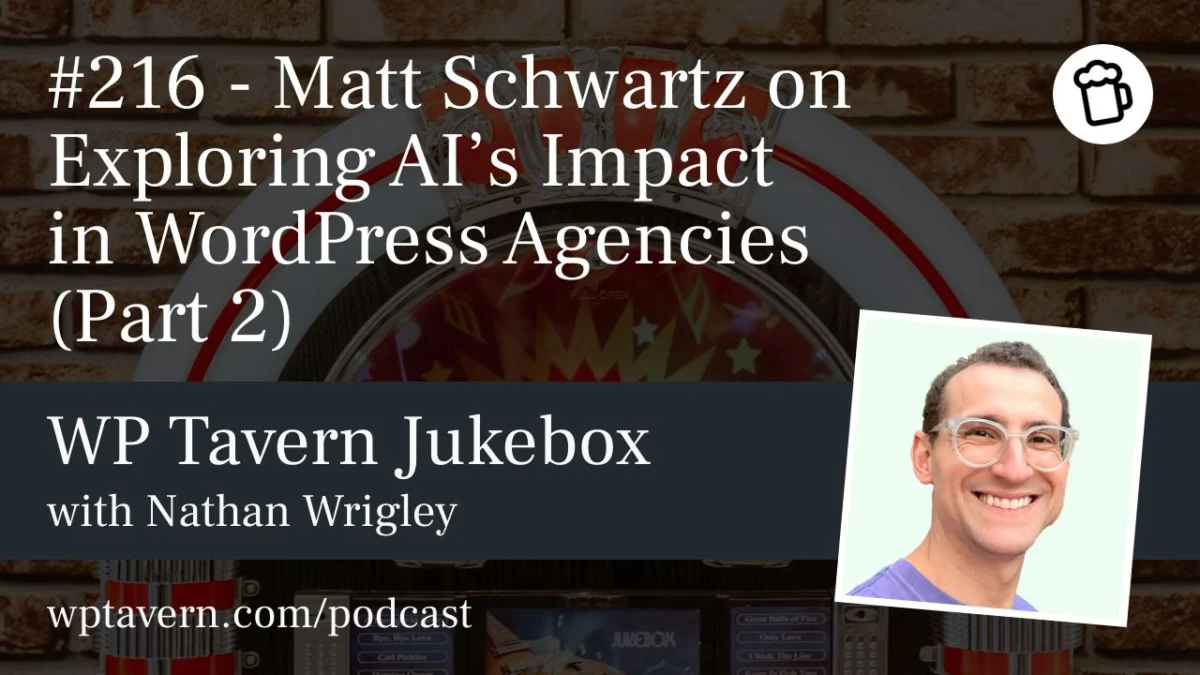
The integration of artificial intelligence into the daily workflows of WordPress agencies has shifted rapidly from experimental novelty to core operational strategy. In the concluding installment of a two-part special on the WP Tavern Jukebox podcast, host Nathan Wrigley sat down once again with Matt Schwartz, an Atlanta-based agency owner and developer of the WordPress form and checkout QA tool CheckView.
Picking up from a wide-ranging discussion on initial AI wins, Schwartz and Wrigley dove deeper into the advanced methodologies, hidden operational pitfalls, economic shifts, and long-term community impacts that define modern agency operations in the era of AI.
Main Facts: Practical AI Integration and Advanced Workflows
As agencies move past basic content generation and rudimentary prompt engineering, advanced operators are discovering sophisticated ways to hardwire AI directly into their operational fabrics.
- The Agency “Brain” Approach: Agencies are moving beyond simple chatbots by training AI assistants to cross-reference internal project management platforms—such as ClickUp or Asana—and internal wikis. This effectively anchors the AI to a verified corpus of Standard Operating Procedures (SOPs) and client histories, drastically reducing hallucinations.
- Model Context Protocol (MCP): A breakthrough for technical agencies, MCP allows secure, modular connections between AI agents and diverse internal systems without the need for complex, bespoke, and potentially insecure API configurations.
- Internal vs. Public-Facing Tools: Agencies are increasingly “vibe coding” internal reporting dashboards, profitability calculators, and low-risk QA scripts. However, experts caution against deploying autonomous AI tools for public-facing or mission-critical server management without strict human oversight.
Chronology: The Maturation of Agency AI Adoption
The conversation highlights a clear developmental timeline for how WordPress professionals have approached emerging technologies over the past decade:
- The Traditional Era (Pre-2023): Agencies relied heavily on manual code writing, traditional third-party SaaS management tools, and junior staff to handle high-volume, low-margin execution tasks.
- The Superficial Wave (2023–2024): The initial rush of generative AI led to widespread, often undisciplined adoption primarily focused on copywriting, basic troubleshooting, and isolated code snippets.
- The Systems Integration Phase (2025–2026): Agencies are now structuring comprehensive AI visions, implementing internal MCP layers, automating low-risk quality assurance checks, and evaluating the long-term sustainability of vendor dependencies.
Supporting Data and Technical Architecture
Schwartz emphasized that while the barriers to entry for software creation have plummeted, the technical and financial realities of maintaining AI infrastructure require disciplined oversight.
The Power and Peril of Model Context Protocols (MCP)
Developed as an open-source standard to bridge AI models with external data sources, MCP acts as a secure gatekeeper. Instead of individual team members managing dozens of disparate API keys—which presents a massive surface area for security breaches—an agency can route queries through a centralized, secure MCP proxy. This ensures that the AI only interacts with approved data structures under strict guardrails.
Automated QA and Skill Integration
Utilizing advanced features like Claude’s custom "skills," agencies are automating repetitive launch checklists and onboarding processes. While binary checks (such as verifying whether a staging site’s no-index tag is active) can be safely delegated to automated routines, complex strategic evaluations still require human-in-the-loop validation.
Cost Realities of AI Dependency
A critical warning emerged regarding the financial sustainability of current AI tooling. As major AI providers begin rolling back developer-tier allowances and shifting toward enterprise pricing models, agencies that rely entirely on heavy AI integrations risk sudden margin compression if vendor costs spike by orders of magnitude.
Industry Responses and Ecosystem Implications
The conversation tackled the broader economic shockwaves rippling through the WordPress ecosystem, particularly concerning plugin developers and community cohesion.
The Plugin Market Squeeze
Independent developers building small, single-purpose utility plugins are reporting noticeable dips in sales. Because agencies and developers can now instantly generate bespoke code snippets or custom utility plugins via AI, the market for low-end, commodity plugins is contracting. Larger plugin shops are consequently shifting focus toward unreplicable enterprise platforms and robust ecosystems.
The Threat to Community Engagement
Perhaps the most poignant concern raised during the podcast is the gradual erosion of community spirit. As developers and agency owners increasingly turn to automated LLMs for problem-solving rather than engaging in community forums, peer groups, and local WordCamps, organic touchpoints are diminishing.
"That’s why a lot of us are in WordPress—for the community," Schwartz noted. "If those smaller guys go away… a little bit of the WordPress spirit is lost for sure."
Implications for the Future of Freelancers and Agencies
Looking forward, the maturation of AI is forcing a structural reevaluation of agency business models.
Evolving Hiring Strategies
Hiring pipelines for non-specialist execution roles have begun to slow as automation handles routine tasks. However, this may be a cyclical trend; if software subscription and AI token costs continue to rise, the economic calculus could swing back toward utilizing human junior developers for specific operational tasks.
Hyper-Niche Productized Services
Armed with AI tools, agencies can now scale hyper-targeted, vertical-specific service offerings—such as automated digital packages tailored specifically to plumbers or real estate agents—with unprecedented speed.
The Managerial Shift
Ultimately, the role of the agency owner and developer is shifting from direct execution to orchestration. As Schwartz advised, agencies must approach AI adoption with "eyes wide open," balancing the undeniable efficiency gains against the sobering realities of data security, API costs, and the absolute necessity of maintaining human oversight.
For those looking to dive deeper into Matt Schwartz’s insights, both parts of this special agency series are available via the WP Tavern Jukebox podcast feed, complete with extensive show notes and resource documents at wptavern.com/podcast.