By Michael Stelzner
Published in collaboration with Social Media Examiner
Main Facts: The New Baseline for AI in Business
The artificial intelligence ecosystem has reached a historic turning point. In what can only be described as a seismic week for software development, marketing automation, and creative workflows, major tech giants have simultaneously rolled out infrastructure updates that fundamentally redefine how professionals operate. From Anthropic’s hyper-efficient Claude Sonnet 5.5 to OpenAI’s sweeping DevDay 2026 announcements and Google’s expansive Gemini 3.8 suite, the barrier to entry for enterprise-grade AI execution has dropped significantly.
At the core of this week’s developments is a shift away from isolated, chat-based interfaces toward interconnected, platform-agnostic, and deeply multimodal systems. Marketers, developers, and enterprise leaders are no longer tasked with merely generating text; they are orchestrating persistent AI agents, deploying real-time visual avatars, building cross-platform workflows, and generating broadcast-quality video and audio assets with minimal technical friction.
Key developments shaping the industry include:
- Anthropic’s Claude Sonnet 5.5: Delivering faster, highly cost-efficient performance for professional coding, content generation, and complex analytics.
- OpenAI’s DevDay 2026 & GPT-6 Expansion: Introducing persistent agents ("Dots"), cloud-based Codex workflows, a dedicated marketplace for 1.2 billion weekly users, and the cost-effective GPT-6 Sol and Luna models.
- Google’s Gemini 3.8 Ecosystem: Launching real-time visual avatars (Live Avatar), deep third-party app integrations (Airtable, Adobe, Squarespace), and high-fidelity text-to-speech models with voice replication.
- Practical Workflow Convergence: Emerging techniques allowing creators to seamlessly merge platforms—such as prototyping print designs in ChatGPT before refining them via Canva, or building portable AI workflows that function across disparate LLMs.
Chronology of Releases: A Week That Changed the Software Landscape
The sheer velocity of deployment over the past seven days has left industry analysts scrambling to update their roadmaps. Here is how the announcements unfolded across the major AI laboratories:
Monday: Anthropic Sets a New Efficiency Standard
Anthropic kicked off the week by releasing Claude Sonnet 5.5. Designed to bridge the gap between high-volume, low-cost operations and high-end reasoning, Sonnet 5.5 drastically outperformed its predecessor while consuming roughly 30% fewer tokens per task. Operating speeds outpaced previous benchmarks by over 30%, making it immediately attractive to development teams and enterprise content workflows requiring high-frequency API calls.
Tuesday: Google Expands Multimodal Horizons
Google pushed out a dual-wave update focusing on operational integration and audio-visual creation. First came Gemini 3.8 Live with Live Avatar, bringing expressive, real-time animated personas to enterprise applications across 97 languages. Simultaneously, Google rolled out Gemini 3.8 Flash TTS and Flash-Lite TTS, giving creators unprecedented control over synthetic voice generation, replication, and multi-speaker dialogue direction.
Wednesday: OpenAI’s DevDay 2026 Redefines the Agentic Era
OpenAI dominated mid-week news cycles with more than 20 major announcements at DevDay 2026. Transforming ChatGPT from a conversational utility into an expansive developer and agent platform, OpenAI introduced always-on "Dots" agents, cloud-based Codex workflows, and the ChatGPT Space for collaborative team environments. To support this massive scaling, OpenAI also debuted the GPT-6 Sol and Luna models, cutting API costs by 50% while improving factual reliability and computer-use capabilities.
Thursday & Friday: Practical Workflow Integration and Creative Tooling
As the dust settled on foundational models, creators and strategists pivoted toward implementation. Industry practitioners highlighted cross-platform resiliency—demonstrating how to seamlessly migrate live prompts from Claude to ChatGPT when outages occur—and practical methods for leveraging tools like Google’s Gemini Omni for professional video production without a traditional film crew.
Supporting Data & Ecosystem Metrics
To understand the weight of these updates, one must examine the macroeconomic and technical indicators driving them:
- 1.2 Billion Weekly Users: OpenAI’s expanding ecosystem, punctuated by the introduction of Sign in with ChatGPT and a new third-party marketplace, now targets a user base exceeding one billion active weekly participants.
- 30% Efficiency Gains: Anthropic’s Sonnet 5.5 benchmark evaluations highlight a nearly one-third reduction in token consumption per complex programming and content task, drastically lowering operational expenditures for businesses running automated pipelines.
- 50% API Cost Reductions: OpenAI’s introduction of the GPT-6 Sol and Luna models halves the cost of developer integration compared to previous architectures, enabling smaller enterprises to deploy autonomous agents at scale.
- 97 Languages Supported: Google’s Gemini 3.8 Live Avatar deployment scales enterprise customer service and digital workforce capabilities globally, bridging linguistic divides with real-time multimodal translation and visual synchronization.
Official Responses and Industry Reactions
The reception from enterprise leaders, developers, and independent practitioners has been overwhelmingly focused on the transition from "novelty" to "infrastructure."
Industry observers note that the rapid commoditization of foundational intelligence is forcing software companies to compete on ecosystem stickiness rather than raw model capability alone. By opening up deeper integrations—such as Google connecting Gemini directly to Airtable, Linear, monday.com, Adobe, Squarespace, and Webflow—tech giants are effectively reducing the "context switching" tax that has historically plagued knowledge workers.
Meanwhile, security and compliance advocates have closely monitored Google and OpenAI’s rollout of audio replication controls and consent verification mechanisms. As synthetic voices and real-time avatars approach human-indistinguishable fidelity, the inclusion of cryptographic content credentials and explicit consent verification frameworks has been widely praised as a necessary safeguard against malicious deepfakes.
Implications for Marketers, Developers, and Enterprises
What do these rapid developments mean for day-to-day operations? The convergence of these technologies points toward several definitive shifts in business strategy:
1. The Death of the Single-Tool Dependency
As demonstrated by live demonstrations where workflows transitioned effortlessly from Claude to ChatGPT mid-session, professionals can no longer afford rigid, single-platform operating models. Building portable, platform-agnostic prompt systems and JSON-based workflow structures is now essential for business continuity.

2. Democratization of High-End Creative Production
Small business owners and lean marketing teams no longer require expensive production crews to execute multi-channel campaigns. By combining:
- ChatGPT and Canva (Magic Layers): Generating precise, client-briefed print designs and breaking them down into fully editable typographic and visual layers.
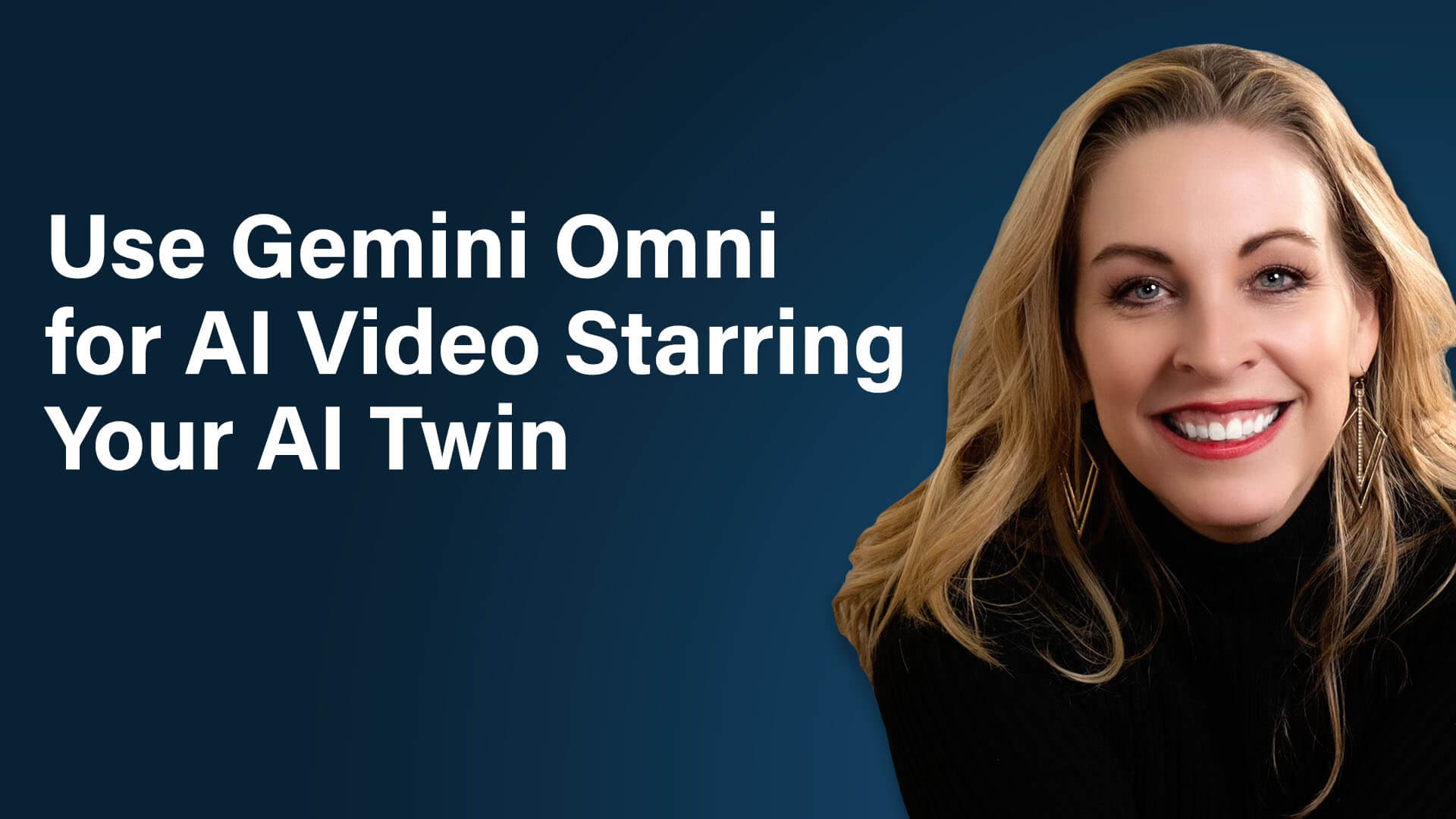
- Gemini Omni: Generating scroll-stopping video hooks, digital AI twins, and editing background environments, clothing, and motion graphics on pre-recorded footage using natural-language instructions.
- Gemini 3.8 TTS: Producing broadcast-quality, localized voiceovers with precise emotional direction without stepping into a recording booth.
…lean organizations can now achieve output volumes previously reserved for enterprise-level marketing agencies.
3. The Shift to Autonomous Agentic Workflows
With OpenAI’s introduction of persistent "Dots" agents and Google’s live enterprise avatars, the paradigm of human-computer interaction is moving from chatting with an assistant to managing a digital workforce. Businesses must begin structuring their internal standard operating procedures (SOPs) to accommodate autonomous agents capable of executing background tasks, updating databases across connected apps (such as Airtable and Webflow), and handling customer interactions round-the-clock.

Looking Ahead
As we close out the week, the message to business leaders is clear: the technology will continue to evolve at a breakneck pace, but your operational systems must remain resilient. Whether you are attending hands-on implementation events like AI Business World or building modular, cross-platform workflows within the AI Business Society, the key to thriving in this new era is continuous adaptation without losing sight of foundational business goals.
Tools will change. Your systems shouldn’t.