In the rapidly evolving landscape of web development, few technologies have caused as much disruption—and excitement—as artificial intelligence. For seasoned developers who cut their teeth in the late 1990s, the shift from hand-coding HTML tables to orchestrating AI-driven workflows represents one of the most significant paradigm shifts in the history of the internet.
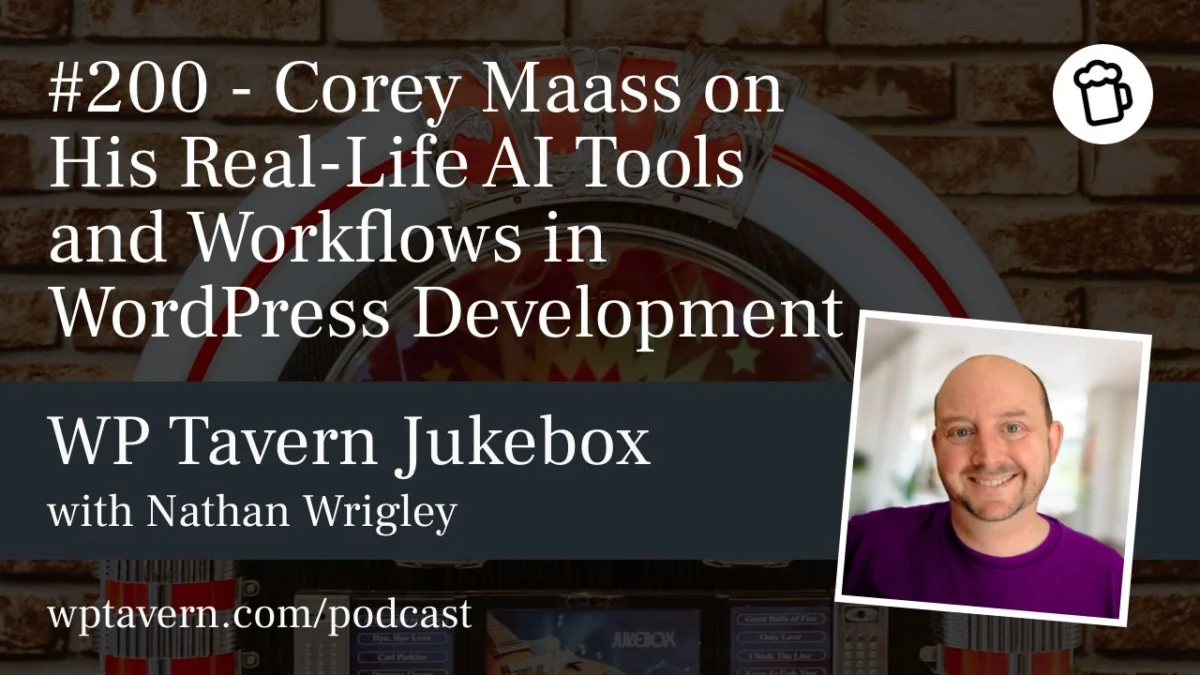
In a recent episode of the Jukebox Podcast from WP Tavern, host Nathan Wrigley sat down with veteran developer Corey Maass to discuss how AI is not just changing the speed of development, but fundamentally altering the philosophy of software creation. From the mundane task of code generation to the complex, creative application of AI in music production and client-facing SaaS projects, the conversation offers a pragmatic roadmap for navigating the AI era.
The Evolution of the Tech Stack
Corey Maass, a developer with nearly three decades of experience, has seen every iteration of the web, from the early days of Photoshop-sliced designs to the rise of PHP and the eventual dominance of WordPress in 2010. Today, his workflow has been transformed by a suite of AI-powered tools that he describes as essential, yet pragmatic.
As of late 2025, Maass’s stack is centered around Cursor, an AI-native code editor. However, his approach is nuanced; he does not rely solely on the built-in AI features of his IDE. Instead, he utilizes a combination of specialized tools:
- Claude Code: A terminal-based interface he uses for the heavy lifting of code generation.
- GitHub Copilot: Employed as an autonomous "code reviewer" to ensure quality and adherence to standards.
- Git Integration: A return to rigorous pull-request processes, even for individual projects, to maintain robustness.
"I am using Cursor as an IDE, but I am not using the AI in Cursor at all," Maass explained. "I am opening Terminal inside Cursor and using Claude Code almost exclusively. Then, I’ve got GitHub’s Copilot checking the code. I’ve got Claude writing the code, and then I’ve got Copilot checking the code."
Chronology of Adoption: From Time-Saver to Creative Partner
The journey for Maass began in earnest in early 2024, during a trip to Thailand. With time on his hands and a desire to experiment, he began rebuilding Timerdoro, a productivity timer app he had developed years earlier. This project served as his sandbox.
Phase 1: The Efficiency Gains
Initially, the adoption of AI was purely functional. The goal was to reduce the time spent on repetitive tasks. Maass noted that a year ago, the AI was "more of a dumb typing companion." It was helpful for boilerplate code and email drafts, but it lacked the architectural depth required for complex applications. He was often too "granular" in his prompts, acting as a human typist rather than an architect.
Phase 2: The Shift to Conceptualization
Over the last 18 months, the capabilities of the models have expanded significantly. Maass moved from asking the AI to "write this function" to asking it to "conceptualize an entire authentication system." This shift allowed him to step back into the role of a product manager and architect, rather than a line-by-line coder.
Phase 3: The Creativity Frontier
Perhaps the most surprising evolution is the use of AI as a sounding board for creativity. Maass, who is also a music producer, discovered that AI could provide technical insights that would otherwise take years to master—such as frequency balancing and mastering advice for dance music. He uses AI to introduce "randomness" into his creative process, a concept akin to Brian Eno’s "Oblique Strategies" cards, which force artists to look at their work from unconventional angles.
Supporting Data: Real-World Efficiency and Outcomes
The impact on client work has been tangible. Maass recounted a project where he was tasked with building software for a client who had exhausted her original budget on a failed development attempt.
"I looked at it and was like, I can’t really maintain this," Maass said. "I went back to her and said, I think we’re to the point now that I can build it for probably half the cost." By leveraging AI to automate the development process, Maass was able to deliver a robust, functional product within the client’s limited budget.
This leads to a critical question regarding the future of the developer’s role: If the time required to build a feature is reduced by 50% or more, how does the developer maintain value? Maass argues that the value has shifted away from the act of typing code. The developer is now a Product Architect, a Code Reviewer, and a System Integrator. The client does not care who wrote the code, provided it works, is performant, and is maintainable.
The Philosophical Implications: Authenticity and "The Point"
A central theme of the discussion was the philosophical "point" of a project. Maass makes a clear distinction between the utility of software and the soul of artistic endeavors.
- Software Development: The end goal is functional. If the code works and the user can achieve their objective, the involvement of AI is largely irrelevant. The "authenticity" of the code is secondary to its performance.
- Artistic Endeavors: Here, the process matters. For Maass, making music is about the human experience. While AI can assist with the technical aspects of mastering a track, the creative spark must come from the human behind the machine.
This distinction is crucial as we move toward an era where AI can generate content that is nearly indistinguishable from human-made work. The challenge for society will be to determine which domains demand "human-only" effort and which domains are improved by the efficiency of AI.
The Future of WordPress and AI
When it comes to the WordPress ecosystem, Maass is optimistic. While WordPress is currently a "click-heavy" platform, he envisions a future where AI agents have deeper integration with plugins and themes.
He highlighted the "Abilities API" and the potential for plugins like Beaver Builder or Meta Box to expose their data structures to AI. If these tools become "AI-friendly," site creators will be able to perform complex administrative tasks through natural language commands rather than navigating deep menus.
"Shortly, there’ll be a little chat bot where you’ll say, look at this website… and you’ll say, okay, we need to change the homepage to say the following things," Maass predicted.
Conclusion: Embracing the Shift
The transition to an AI-augmented workflow is not without its risks. There is the liability of the final product, the danger of "hallucinations" (though these have decreased significantly), and the existential question of what happens to the junior developer role when senior developers can do the work of a team of five.
However, for Maass, the excitement of being able to build things he never thought possible outweighs the fear of obsolescence. He encourages his peers to stop viewing AI as a competitor and start viewing it as a partner. By maintaining a human-in-the-loop approach—using AI to generate, but using human experience to review, architect, and validate—developers can navigate the coming years with confidence.
As he told his fellow developers, the future isn’t about being replaced by AI; it’s about being "unlocked" by it. In an increasingly automated world, the developer’s role is evolving into something more creative, more strategic, and ultimately, more influential than ever before.