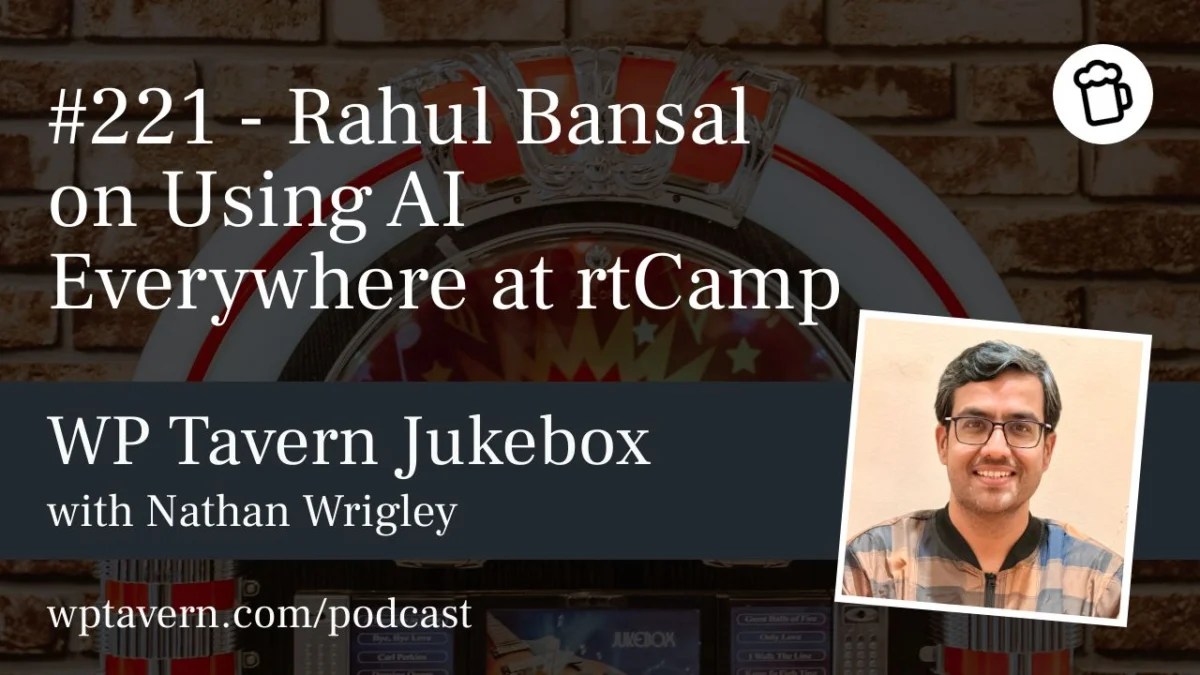
In the fast-evolving landscape of digital transformation, few names resonate as strongly within the WordPress ecosystem as rtCamp. Founded 17 years ago by Rahul Bansal, the agency has evolved from a scrappy, blog-focused startup into a global powerhouse, managing complex enterprise projects for industry titans like Google and various Fortune 500 companies. However, as the industry faces the seismic shift of artificial intelligence, rtCamp is not merely adapting; it is radically re-engineering its operational DNA.
In a recent appearance on the WP Tavern Jukebox podcast, Bansal shared candid insights into the future of agency life, the necessity of niche specialization, and why rtCamp has decided that if a process can be handled by AI, it will be.
The Evolution of an Enterprise Powerhouse
The journey of rtCamp is a study in adaptability. When Bansal launched the company in 2009, WordPress was primarily viewed as a blogging platform. At a time when the Indian outsourcing market was dominated by generic PHP development and cost-cutting measures, Bansal made a strategic, albeit risky, bet: to focus exclusively on WordPress.
"It wasn’t an ideological decision," Bansal explained. "We were running a media company—a blog network—that was built on WordPress. We needed to solve scale and performance issues for our own traffic. We realized that customizing WordPress for ourselves was making us more money than the blogging itself. So, we pivoted."
That pivot led to a 17-year tenure of growth, scaling to hundreds of employees. Today, rtCamp’s portfolio spans large-scale website builds, SaaS connectors, and sophisticated Chrome extensions. Yet, looking back, Bansal is quick to demystify his success. "There was a bit of luck involved," he admits. "We happened to choose a platform that would eventually become the backbone of the web. It could have easily gone the way of Joomla or other platforms that were market leaders at the time."
The "Complementary Set" Philosophy
Central to Bansal’s management style is a hiring philosophy derived from set theory—the concept of the "complementary set." When scaling an agency, most founders are tempted to hire people who mirror their own strengths. Bansal argues this is a fatal flaw.
"When I started, I was strong at engineering but weak in sales and communication," Bansal noted. "Instead of looking for another engineer, I looked for people who were the opposite of me. My co-founder was sales-heavy; others brought skills I didn’t possess. By building a team of complementary strengths, we were able to cover each other’s weaknesses."
This philosophy extends beyond human capital into client acquisition. Bansal advises agencies to avoid "commoditized" clients who already understand WordPress intimately. Instead, he suggests targeting clients who lack internal WordPress expertise. "When you work with clients who need your expertise to solve a problem they can’t handle themselves, you become a premium partner, not just a service provider."
Specialization: The Key to Standing Out in 2026
If starting an agency in 2006 required only a commitment to WordPress, the market of 2026 demands significantly more. The barrier to entry has lowered, but the barrier to excellence has soared.
"Today, saying you are a ‘WordPress agency’ is not enough," Bansal warned. "There are tens of thousands of them. You must drill down into niches within niches. Whether it’s payment gateway integration, subscription-based ERPs, or specific WooCommerce workflows, you must position yourself as the definitive expert in that narrow vertical."
This transition from generalist to specialist is not just a marketing tactic; it is a defensive strategy against the encroaching tide of automation. As general tasks become automated, the value of deep, domain-specific knowledge will command the highest premiums.
The AI Mandate: Operational Backbone vs. Bolt-on Feature
The most provocative aspect of rtCamp’s current strategy is its full-throated embrace of artificial intelligence. While many agencies are experimenting with AI as a peripheral tool—using it for occasional blog posts or basic code snippets—rtCamp has designated AI as its operational backbone.
"If something in rtCamp can be done by AI, it will be," Bansal stated. This mandate is supported by a unified technology stack. Several years ago, the agency invested heavily in Frappe ERPNext, an open-source platform that integrates accounting, project management, and CRM data into a single source of truth.
This preparation proved serendipitous. Because rtCamp had already centralized its data, they were uniquely positioned to feed that data into AI models without the friction of siloed software. The results have been transformative:
- Reduced Cost of Sale: Sales proposals that once took days are now generated in a fraction of the time.
- Pre-sale Prototyping: Instead of static Figma designs, the team now uses AI to build functional WordPress demo sites to pitch to clients.
- Operational Efficiency: AI now handles initial lead qualification, technical documentation, and even routine QA testing, effectively removing the need for manual intervention in entry-level workflows.
Implications for the Workforce
The shift toward an AI-first agency has profound implications for staffing. For the first time in its history, rtCamp has slowed its engineering hiring. Bansal acknowledges the friction this causes but remains optimistic about the agency’s future.
"We don’t want to lay people off," Bansal clarified. "We are retraining our team. We are shifting our focus from ‘coders’ to ‘growth engineers’ and AI consultants. The role of the developer is evolving into a role of ‘context engineering’—understanding the business problem, prompting the AI correctly, and executing the vision."
Bansal predicts that within two years, a significant percentage of his workforce will be focused on sales, marketing, and AI orchestration rather than traditional coding. This creates a virtuous cycle: as operational costs plummet, the agency can lower its prices, making enterprise-grade migrations accessible to a broader pool of clients. This, in turn, expands the total addressable market for WordPress.
A Realistic Outlook for Agencies
For agency owners feeling rudderless in the current climate, Bansal’s message is one of pragmatic optimism. He urges peers to avoid the temptation to "reinvent the wheel" or attempt to build proprietary AI algorithms.
"We are consumers and consultants of AI, not inventors," he noted. "Our job is to apply existing AI technology to solve boring, repetitive problems more efficiently. If you can make a complex migration 50% faster and 30% cheaper, you don’t need to invent a new AI model to win; you just need to be the most efficient mover of data."
The future, according to Bansal, belongs to those who view AI as a force multiplier for human intent. While the fear of "AI taking jobs" is prevalent, the reality is that the demand for high-quality digital solutions is growing faster than the supply. By automating the "boring" 80% of business operations, agencies can free up their teams to focus on high-value creative and strategic work.
As the industry moves toward 2026, rtCamp stands as a blueprint for the modern agency: one that respects its history, embraces the volatility of technology, and maintains a relentless focus on the value provided to the client. For those willing to adapt, the AI revolution is not a threat—it is the greatest opportunity to scale that the agency world has ever seen.