Main Facts
The landscape of website translation has undergone a seismic shift. Once a laborious, expensive endeavor requiring specialized human agencies, translating a WordPress site into multiple languages is now nearly instantaneous and costs mere cents.
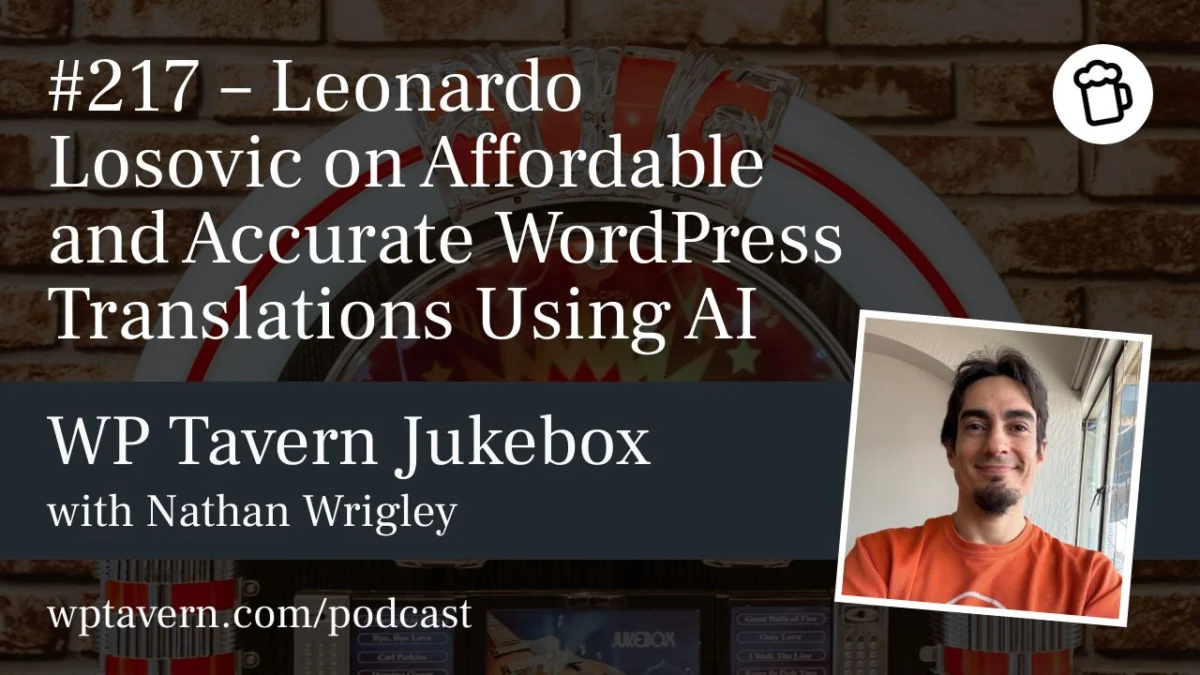
At the center of this transformation is Leonardo Losoviz, a seasoned WordPress developer and creator of Gato AI Translations for Polylang. Speaking on a recent episode of the WP Tavern Jukebox podcast hosted by Nathan Wrigley, Losoviz explored the shifting dynamics of multilingual websites, touching upon his recent presentation at WordCamp Asia, entitled "The Invisible Gotchas of WP Translation."
Key highlights of this technological pivot include:
- Cost Collapse: Traditional human translation could cost hundreds of dollars per blog post. AI translation models (leveraging providers like OpenAI, Anthropic, and Gemini) reduce these variable costs to a fraction of a cent per token.
- Accuracy Leap: Modern AI models deliver an estimated 99% accuracy rate for standard textual content, though specialized technical domains still benefit from human polish.
- WordPress Integration: Developers are increasingly relying on tools that connect natively to the WordPress ecosystem—such as pairing AI translation scripts with standard management plugins like Polylang.
- The "Arms Race" Reality: Because translation has become so cheap and accessible, it is shifting from an elite enterprise marketing strategy to an operational baseline. Businesses must adopt AI translation simply to keep pace with competitors.
Chronology of Website Localization: From Manual Friction to Instant Execution
To understand the magnitude of the current shift, one must look at how translation infrastructure has evolved over the past decade.
The Pre-AI Era (circa 2014–2022)
Ten years ago, taking a WordPress site global was a high-friction operation. Site owners faced a complex sequence of roadblocks:
- Auditing: Manually identifying which hardcoded strings, custom fields, and blog posts required translation.
- Procurement: Sourcing human translators—often through third-party agencies—and negotiating hourly rates ranging anywhere from $50 to over $100 per hour.
- Logistics: Exporting text into intermediate file formats (like XLIFF), waiting days or weeks for turnaround, and manually re-importing translated text into custom meta boxes or secondary pages.
- Maintenance: Every subsequent edit to the origin text triggered an expensive, time-consuming re-translation cycle.
The Machine Translation Intermediary
Before generative AI dominated the conversation, services like Google Translate and DeepL offered machine-powered alternatives. While faster, these tools often yielded stilted, unnatural phrasing that damaged user experience and brand credibility, particularly for nuance-heavy or creative content.
The Generative AI Era (2024–Present)
With the maturity of Large Language Models (LLMs), translation has transitioned into a native software workflow. Plugins like Gato AI Translations for Polylang allow administrators to initiate bulk translations directly from the WordPress post list table. With a single click, an English post can be dynamically mirrored and translated into French, Spanish, Japanese, and dozens of other languages simultaneously, complete with taxonomy, tags, and featured image metadata.
Supporting Data and Technical Infrastructure
The mechanical execution of AI translation inside WordPress relies heavily on structured data handling and architectural optimization.
Database Strategies: Static Duplication vs. Dynamic Rendering
Different multilingual plugins handle translated content in distinct ways:
- Polylang Approach (Statically Created Entries): Losoviz’s plugin leverages Polylang to generate separate, parallel posts for each target language. While this multiplies database post counts, it provides significant performance benefits. Pages can be statically cached, and runtime translation overhead is entirely eliminated. Furthermore, standard WordPress caching rules and static export tools function seamlessly.
- Alternative Approaches (Runtime Translation): Other systems, such as WPML or proxy-based solutions, maintain a single primary post and translate strings dynamically on the fly. While this reduces database clutter, runtime string matching for large documents can introduce computational overhead.
SEO and URL Structure
For a multilingual strategy to succeed, search engines must understand the relationships between localized pages. Professional workflows rely on standard compliance mechanisms:
- Hreflang Tags: Plugins automatically inject
hreflangmeta tags, signaling to engines like Google that a French URL is a direct translation of an English original rather than duplicate content. - URL Routing: Site administrators can configure language mapping via subdirectories (
mysite.com/fr/post-slug) or subdomains (fr.mysite.com/post-slug), preserving local search discoverability.
Official Insights and Expert Perspectives
Leonardo Losoviz’s presentation at WordCamp Asia focused heavily on eliminating hidden pitfalls. He stresses that while executing an AI translation takes mere seconds, the preparation phase requires rigorous discipline.
"Before you do that [translate], you need to make sure that the post is final. That means no typos. That means all the headers are the right header. That means that all images are correct… All of these things are common sense, and you don’t think about them until you see the error happening time and again."
Losoviz strongly advises against haphazardly translating works-in-progress, noting that executing iterative translations repeatedly drains token budgets and complicates asset management.
When discussing the necessity of human oversight, Losoviz maintains a pragmatic stance:
"I will not tell you to not engage a professional translator if you don’t speak the language… Mostly when we’re talking about technical terms, or when they refer to some industry that your website is targeting. Otherwise, the quality is just excellent."
Rather than employing a translator for 100% of a document, modern workflows reserve human capital for a 30-minute review session to verify complex technical acronyms and industry-specific jargon.
Implications: The Multilingual Arms Race
The democratization of translation technology carries profound strategic implications for content creators, agencies, and enterprise businesses alike.
The Death of Geographic Isolation
Historically, language barriers served as natural moats protecting localized businesses from international competition. Today, a regional blog or boutique e-commerce store in the United Kingdom can instantly project a localized presence into Asian, South American, and European markets with minimal capital outlay.
The "Running in Place" Phenomenon
Paradoxically, when a tool becomes universally accessible, its relative competitive advantage diminishes. Losoviz points out a sobering truth regarding the AI landscape:
"Because it’s easy to you, it’s easy to everybody. And if everybody does the same, once again, you are not ahead of them. You’re on the same place… In a way, unfortunately, it becomes a situation in which you need to do it just to not fall behind."
This turns multilingual publishing into an operational baseline. Failing to translate no longer merely limits growth; it actively cedes international market share to competitors who leverage automated localization workflows.
Future Horizons: WordPress 7.0 and Collaborative AI
Looking forward, the evolution of WordPress core will likely intertwine localization with editorial workflows. With Phase 3 of Gutenberg introducing Google Docs-style collaborative editing, the boundary between human and machine communication is blurring.
Future iterations of the block editor could allow an AI agent to flag translation ambiguities directly within inline comment threads, creating a symbiotic review loop where content managers converse with language models inside the post interface.
Conclusion
The convergence of affordable generative AI tokens and sophisticated WordPress wrapper plugins has permanently altered what it means to run a global website. As technical barriers dissolve, the question facing site owners is no longer can they afford to translate their content, but whether they can afford not to.