
Sales and marketing misalignment rarely presents itself as a singular, catastrophic event. It is a slow-motion collision—a "silent killer" of growth that often masquerades as standard operational friction. It manifests as "qualified" leads that sales teams treat with skepticism, marketing campaigns that land on deaf ears, and a pipeline that looks deceptively robust until the moment closed-won revenue begins to plateau.
To diagnose the health of modern Go-To-Market (GTM) teams, Unbounce conducted an extensive survey of over 500 SMB GTM professionals. The findings reveal a striking disconnect: while 87% of teams identify improved sales and marketing alignment as the primary driver for future performance, only 56% claim to be "highly aligned." This gap between expectation and reality suggests that many organizations are stuck in a cycle of surface-level coordination that fails to address the structural decay of their sales funnels.
The Anatomy of the Misalignment Crisis
The data suggests that the "56% alignment" figure is a vanity metric. When teams claim to be aligned, they are often referring to the existence of a meeting cadence—regular syncs where sales and marketing exchange pleasantries and updates. However, true alignment requires more than a recurring calendar invite; it requires a shared operating model.
The Perception Gap
Perhaps the most alarming finding in the Unbounce report is the dissonance between leadership and the front lines. Approximately 69% of executives report that their organization enjoys strong alignment, whereas only 47% of non-executives agree.

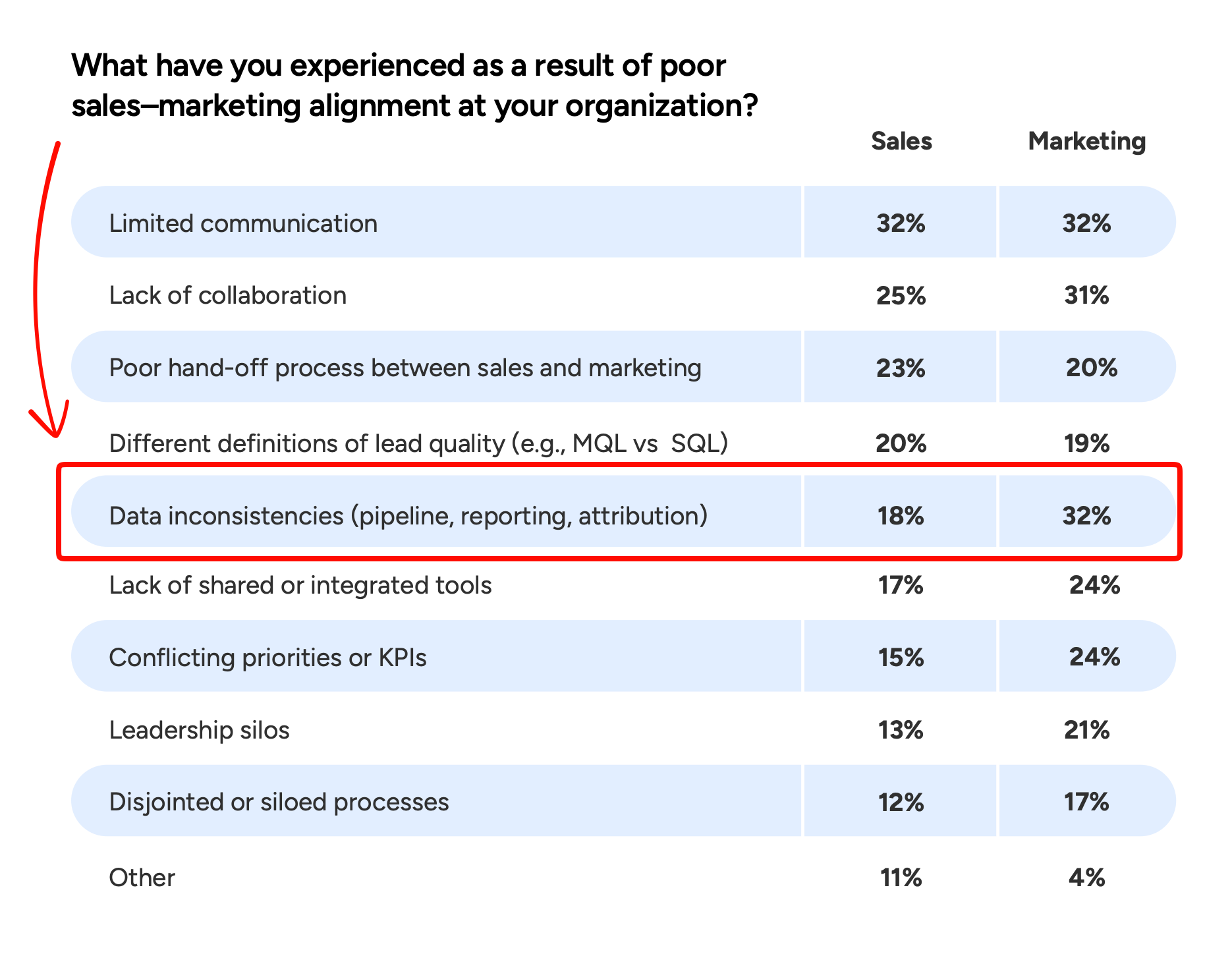
This "executive blind spot" occurs because leadership views alignment through the lens of strategy decks and organizational charts, while the front lines experience the reality of data inconsistencies, siloed communication, and the physical struggle of working with fragmented tools. This structural information lag ensures that as an organization scales, the cracks in the foundation widen, leaving those closest to the customer to bridge the gap without the necessary resources.
Chronology of a Failed Lead: From Handoff to Stagnation
To understand why misalignment persists, one must look at the life cycle of a lead within a fractured GTM organization.
- The Definition Phase: Marketing generates leads based on their own criteria, often prioritizing volume to meet high-level KPIs. Simultaneously, sales is working from a separate set of qualification standards. Because these definitions are not unified, the handoff is compromised from the start.
- The Handoff Friction: The lead is passed to sales. Because there is no agreed-upon Service Level Agreement (SLA) regarding follow-up speed or the quality of information provided, the lead sits in the CRM.
- The Feedback Vacuum: Sales fails to convert the lead, citing "poor quality." Marketing, lacking visibility into why the lead failed, continues to generate similar traffic, assuming the issue lies with sales’ closing techniques.
- The Revenue Plateau: The pipeline remains "healthy" in terms of volume, but conversion rates plummet. By the time the quarterly revenue report is published, the blame game begins, with each department pointing to the other’s failure as the root cause.
Supporting Data: The Cost of Disconnection
The financial and operational costs of this misalignment are compounding. According to the report, 29% of GTM professionals cite employee frustration as the primary outcome of poor alignment, followed closely by tangible revenue losses.
- Delayed Follow-up: 32% of marketing teams report that their leads are not followed up on in a timely manner, compared to only 22% of sales teams who admit to the delay. This discrepancy highlights a fundamental lack of visibility into the lead lifecycle.
- The Tech Sprawl: 56% of professionals report that "tool bloat" is a significant barrier. Worse, 60% of teams utilize less than half of their available software stack. The instinct to "buy" one’s way out of an alignment problem—by adding a new CRM module or automation tool—often backfires, creating more data silos and maintenance overhead.
- Goal Inconsistency: 43% of teams cite conflicting goals as a root cause. Marketers are often incentivized by lead volume, while sales reps are compensated solely on closed revenue. Without a shared KPI (such as Customer Acquisition Cost or Pipeline Velocity), the two departments are effectively working for different masters.
Official Perspectives: Shifting from Communication to Operation
The prevailing industry sentiment, as reflected by the survey, is that increasing the frequency of meetings is the solution. However, 54% of GTM teams are currently doubling down on this approach, yet failing to see results. The expert consensus suggests that meetings are merely a broadcast mechanism; they cannot fix a broken operating model.

"Alignment is not a meeting; it is an infrastructure," notes the report. High-performing teams—those that truly fall into the ‘highly aligned’ category—do not necessarily talk more; they share more. They are 3.5 times more likely to have strong cross-functional data sharing, ensuring that both sales and marketing are looking at a single source of truth regarding customer behavior and pipeline health.
The Path to Resolution: Actionable Strategies
To bridge the divide, organizations must move beyond the "communication-first" mentality and adopt three structural changes:
1. Unified Persona Architecture
Buyer personas should not be a marketing-led project. They must be a joint artifact. Sales teams possess the granular, on-the-ground objections that marketers never hear. By involving sales in the creation of personas before a campaign is launched, teams can ensure that marketing messaging directly addresses the actual obstacles the sales team faces in discovery calls.
2. The Standardized Handoff
A successful handoff is defined by the "Three Pillars":
- Data Consistency: What information must accompany a lead?
- SLA Compliance: Within what time frame must the lead be contacted?
- Feedback Loop: How is the "win/loss" data returned to the marketing team to optimize future lead generation?
3. Tech Stack Consolidation
The data is clear: leaner is better. Teams that consolidated their tech stacks reported a 55% "excellent" rating for lead quality, compared to just 20% for those with bloated, underutilized stacks. By focusing on a smaller set of tools that both departments actually adopt, organizations can eliminate the data discrepancies that fuel inter-departmental mistrust.
Implications for the Future of SMB Growth
The implications of these findings are profound. In an economic climate where efficiency is the primary currency, SMBs cannot afford the "tax" imposed by misaligned GTM teams. The cost of misalignment is not just the wasted marketing budget; it is the erosion of the customer experience. When a lead is promised one outcome by a marketing campaign and met with a completely different reality in a discovery call, the prospect’s trust is permanently damaged.
As we look toward 2026 and beyond, the competitive advantage will go to those who treat alignment as an operational discipline rather than a culture-building exercise. By synchronizing incentives, unifying data sources, and committing to a leaner, more intentional technology stack, SMBs can turn their GTM teams from a source of internal conflict into a unified engine for scalable revenue growth.
The data from the Unbounce report serves as both a warning and a roadmap. The "alignment paradox"—where teams expect growth but maintain silos—can only be resolved by the courage to audit one’s own internal processes. For those willing to break the cycle, the path forward is clear: integrate, consolidate, and align.