SAN FRANCISCO — In the high-stakes arena of business-to-business (B2B) software and artificial intelligence, a quiet psychological barrier holds back thousands of high-growth companies. According to industry veterans and veteran investors, most B2B founders are fundamentally wired as "Builders" rather than "Killers."
This distinction is more than just semantic; it shapes corporate strategy, resource allocation, and, ultimately, market dominance. While the conventional wisdom of the startup ecosystem often preaches coexistence—arguing that a rising tide lifts all boats and that securing the #2 or #3 spot in a lucrative category is a viable path to a billion-dollar exit—a more aggressive school of thought argues that true generational wealth and market safety belong only to those who actively seek to eliminate their top rivals.
To understand the modern B2B landscape, one must examine the psychological makeup of the modern chief executive, the structural dynamics of market equilibrium, and the strategic imperative of decisive competitive elimination.
Main Facts: The Psychology of the Founder vs. The Market Reality
At its core, the daily life of a B2B founder and Chief Executive Officer demands two distinct, psychologically demanding skill sets.
- The Strategic Visionary: At a macro level, founders must envision a positive future where their company is 100 times larger than it is today. This requires intense internal focus: assembling the right organizational pieces, securing capital, aligning product roadmaps, and fostering an internal culture of innovation and collaboration.
- The Tactical Leader: At a micro level, the CEO must act as a unifier. They must build, manage, and motivate a team through the trenches of product development, market uncertainty, and financial pressure.
Because of this inward and collaborative focus, most founders naturally lean toward a philosophy of "take the hill, win the war, be good to our customers, and protect the team." Total destruction of a rival is rarely the primary emotional driver. Instead, founders tend to categorize their market standing into comfortable mental buckets:
- The #1 Spot: If a company is leading its category and growing steadily, the operational mindset is additive. We have more money, more resources, more customers. Success breeds success. We stay #1, the market grows, and our lead compounds.
- The #2 Spot: If a company is the runner-up, the mindset shifts to scrappy insurgency. We have the better product for a specific subset of customers. We have a clear target in the market leader. It’s fun to beat #1 in our designated zone, and we will keep knocking it out of the park.
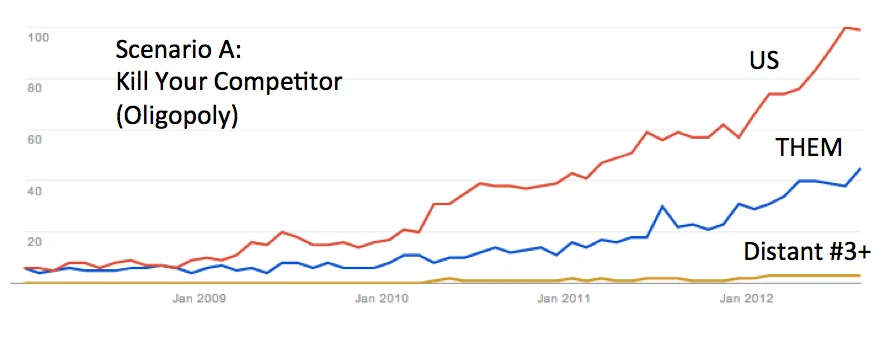
In many historical and contemporary markets, this cozy equilibrium works. Multiple players can carve out profitable niches. Consider comparisons like Replit versus Lovable, or Claude versus Codex. In the current era—fueled by venture capital dynamics and what industry observers dub the "Postmates Effect"—the sheer scale of modern markets means that even a #3 player in an AI-driven category can achieve a multi-billion-dollar valuation, evolving into a "decacorn" rather than a mere unicorn.
Yet, industry analysts argue that settling for a comfortable oligopoly leaves massive amounts of value on the table. In most B2B categories, surviving is not enough; dominance is required to capture disproportionate economic returns.
Chronology of Market Domination: The Shift from Coexistence to Consolidation
The philosophy of competitive elimination is not new, but its execution has evolved significantly across different technological eras.
The Enterprise Software Era (Late 2000s – 2010s)
During the rise of cloud computing and Software-as-a-Service (SaaS), market consolidation became the defining playbook for hyper-growth companies.
- Zoom vs. WebEx: When Eric Yuan founded Zoom in 2011, Cisco’s WebEx was the entrenched enterprise standard. Rather than carving out a niche for smaller meetings, Zoom relentlessly targeted WebEx’s core value proposition—reliability and ease of use—until it effectively marginalized the legacy giant in modern remote work.
- Slack vs. HipChat: In team communication, Atlassian’s HipChat was an early favorite among developers. Slack entered a crowded market, focused heavily on user experience and integrations, and systematically drained HipChat’s user base until Atlassian conceded defeat, sunsetting HipChat in favor of adopting Slack (before eventually acquiring rival-turned-ally tools).
- Datadog vs. New Relic: In cloud monitoring and observability, Datadog executed a land-and-expand strategy that systematically squeezed New Relic out of its dominant market-share position, completely altering the valuation trajectories of both firms.
The Modern AI Era (2020s and Beyond)
As artificial intelligence compresses product lifecycles and accelerates market maturation, the window to eliminate competitors is shrinking, yet the rewards for doing so are larger than ever. Today’s AI leaders—companies specializing in voice synthesis, legal tech, and enterprise automation—are racing to achieve insurmountable network effects before fast-followers can establish a permanent foothold.

Supporting Data: The Power of First-Mover Scale and the "Killer Instinct"
While the temptation to coexist is strong, scaling a business to block out new entrants requires recognizing the compounding advantages of being first to secure massive scale.
Industry veterans frequently point out the formidable list of hurdles faced by true category creators—hurdles that, once overcome, transform into unassailable moats against future competition:
- The First-Mover Advantage Stack:
- Operating with no established roadmap.
- Navigating a tiny initial market (TAM).
- Convincing early customers who are inherently skeptical.
- Operating with limited market legitimacy and no pre-allocated customer budgets.
- Managing skeptical venture capitalists and internal corporate vice presidents who fail to see the vision.
- Overcoming the constant market refrain: "If this was so important, why wasn’t it done already?"
Once a company successfully fights through this gauntlet and scales—as seen with category-defining firms like Eleven Labs, Harvey, Legora, or Sierra—the sheer mass of their accumulated technology, brand equity, and customer data makes them nearly impossible to unseat.
Therefore, striking down an emerging rival before they achieve that scale is a matter of long-term survival. If a company allows its primary rival to mature unmolested, that rival will eventually cross the threshold into institutional permanence.
Official Responses and Strategic Perspectives
Opinions among venture capitalists and seasoned operators remain divided on how aggressively founders should pursue competitor elimination.
Proponents of the "Killer Strategy" argue that the execution must be balanced. Spending half of a startup’s scarce capital and mental energy on malicious or legally aggressive tactics—such as frivolous lawsuits, public intimidation, or scorched-earth sales practices—often backfires. These tactics drain internal morale and consume resources that should be spent on product innovation.
Conversely, the most common strategic failure observed by investors is that founders develop the "Killer Instinct" too late. By the time leadership realizes their primary competitor is an existential threat, that competitor has already raised massive rounds of capital, locked down key enterprise accounts, and built a defensible engineering machine.
Market experts suggest a middle ground: founders should regularly challenge their executive teams to evaluate whether their market segment can support an outright winner-take-all dynamic. If so, direct, decisive moves to out-innovate, out-market, and capture the competitor’s talent and pipeline are not just acceptable—they are financially and strategically mandatory.
Implications for the Future of B2B and AI Startups
As the B2B ecosystem matures under the influence of generative AI and globalized software distribution, the implications of this builder-versus-killer dynamic are profound.
- The Myth of Infinite Niches: While the "Postmates Effect" proves that #3 players can still secure billion-dollar outcomes in massive global markets, reliance on this phenomenon is risky. In tighter, more specialized B2B verticals, there is rarely room for three sustainable giants.
- Timing the Aggression: Founders must learn to recognize inflection points. In the early days, survival and product-market fit require a builder’s heart. But as a company transitions from a startup to a scale-up in an oligopolistic market, leadership must pivot toward active market consolidation.
- Preventing the "Weed" Effect: A common concern among founders is: "If I kill my top competitor, won’t another just pop up like a weed?" The answer lies in insurmountable scale. While new entrants will always emerge, building an enterprise with deep proprietary data, massive distribution channels, and entrenched workflows ensures that new weeds can never choke out the incumbent forest.
Ultimately, the most successful B2B CEOs are those who can reconcile these two opposing forces. They maintain the empathy, vision, and collaborative spirit needed to build a world-class team and serve their customers, while retaining the sharp, decisive clarity required to clear the battlefield when the opportunity for total market leadership presents itself.