SAN FRANCISCO — In a move that signals a monumental paradigm shift in how digital storefronts are constructed and navigated, e-commerce titan Shopify and frontend cloud provider Vercel have announced a deeply integrated collaboration. The initiative is engineered to build e-commerce ecosystems tailored not just for human consumers, but for the autonomous artificial intelligence agents that will soon shop on their behalf.
The partnership was thrust into the global spotlight on October 15 during Vercel’s flagship Ship 26 conference in San Francisco. Sharing the main stage, Shopify CEO Tobi Lütke and Vercel CEO Guillermo Rauch delivered a vision for the future of "agentic commerce."
At the core of this joint venture are two major technological rollouts: Shopify’s completely rebuilt Hydrogen software development kit (SDK) and Vercel’s newly minted, AI-enabled open-source storefront template, aptly named Vercel Shop. Together, these tools merge Shopify’s bulletproof, decades-in-the-making checkout and inventory infrastructure with Vercel’s cutting-edge web development framework and AI gateway capabilities.
Main Facts: What is the Shopify-Vercel Collaboration?
The partnership bridges the gap between deep back-end e-commerce logistics and ultra-modern, flexible front-end development. Building custom e-commerce experiences has traditionally been an arduous, expensive, and technically fragmented endeavor. Developers must painstakingly wire catalog databases to inventory metrics, synchronize carts with real-time pricing, and stitch together secure checkout systems that comply with global financial regulations.
Through their renewed collaboration, Shopify and Vercel are radically simplifying this process through a three-pronged technical synergy:
- The Rebuilt Hydrogen SDK: Shopify’s Hydrogen organizes common e-commerce functions into reusable, modular tools. Rather than building a storefront from scratch, developers can leverage these tools across a wide variety of JavaScript frameworks and runtimes.
- Vercel Shop Template: This open-source boilerplate leverages Hydrogen to produce a fully functional, customizable e-commerce storefront right out of the box. Crucially, it is structured to present data in a way that is instantly readable by autonomous AI systems.
- Dual-Agent Architecture: Vercel Shop introduces a dual-layered AI approach. It features an internal store assistant to help human visitors navigate catalogs and manage carts, alongside structured machine-readable parameters that allow external AI shoppers to transact on behalf of their human users without ever needing to parse traditional HTML or view visual web pages.
Chronology of a Partnership: From Summer Foundations to October AI Integration
While the October 15 unveiling at Ship 26 captured the industry’s imagination, the collaborative foundation between Shopify and Vercel was laid months prior, reflecting a methodical march toward agentic web architecture.
- June 30: Vercel and Shopify formally released the ground-up rebuild of the Hydrogen SDK. This initial phase focused on developer liberation, granting engineers the freedom to deploy Shopify’s powerful storefront tools across virtually any modern JavaScript framework without sacrificing backend stability.
- October 15: Taking the stage at the Ship 26 conference in San Francisco, Tobi Lütke and Guillermo Rauch unveiled the next logical evolution of the June update: the Vercel Shop template.
- Post-Launch (Present): Developers globally are actively testing the open-source template, utilizing Vercel’s official merchandise store (
vercel.store) as a live, production-grade blueprint for how human-AI hybrid commerce can function in the wild.
Supporting Data: Under the Hood of Hydrogen and Vercel Shop
To understand why this collaboration is causing ripples throughout the software engineering and retail communities, one must examine the technical hurdles of custom storefront development.
According to platform metrics, checkout conversion rates are notoriously fragile. A millisecond of latency, a broken cart synchronization, or a poorly designed payment gateway can cost merchants millions in abandoned carts.
[Shopify Backend Infrastructure] (Inventory, Pricing, Global Checkout)
       │
       ▼
[Rebuilt Hydrogen SDK] (Reusable JavaScript / Framework Agnostic Tools)
       │
       ▼
[Vercel Shop Template] ──┬──► [Human Shoppers] (Visual Storefront + AI Chat Assistant)
                         │
                         └──► [External AI Agents] (Machine-Readable Endpoints & Parameters)
The Vercel Shop template addresses these pain points by abstracting the terrifying complexity of secure transactions while leaving the presentation layer entirely open to creative engineering.
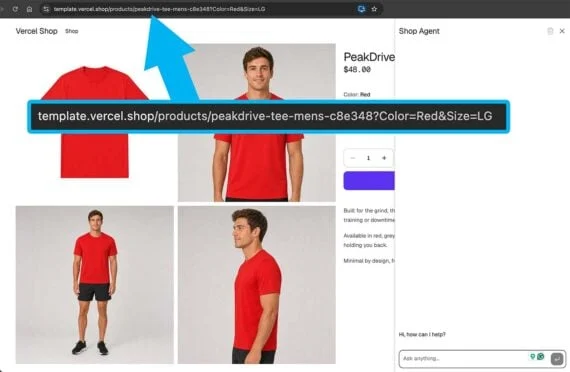
For human users, a product page—such as the template’s showcase PeakDrive men’s tee—renders a traditional, high-conversion visual layout complete with high-resolution imagery, size selectors, and color variants. However, a closer look at the browser’s address bar reveals structured URL parameters (template.vercel.shop/products/peakdrive-tee-mens-c8e348?Color=Red&Size=LG) that hint at a deeper, machine-readable data layer.
For external AI agents—software programs deployed by consumers to compare prices, source items, and execute purchases—this structured design is a goldmine. Instead of wasting computational power parsing complex HTML, executing JavaScript to render dynamic elements, or processing visual screenshots, an external AI agent can instantly query product specs, verify inventory, and build a cart through clean, programmatic endpoints.
Official Responses: What the CEOs are Saying
The leadership teams behind Shopify and Vercel have been vocal about the philosophical and architectural necessity of opening up their platforms to AI integration.

During their joint keynote at Ship 26, Shopify CEO Tobi Lütke addressed the elephant in the room regarding why developers should rely on Shopify’s infrastructure rather than rolling their own checkouts:
"Checkouts are ridiculously hard to get right," Lütke told the audience. "It’s one of those pieces of software that actually does need 20 years of tinkering with. And Shopify has always been very open, and so we invite people to remix pieces from our checkout just as much as you want. Basically taking all the infrastructure that Shopify built, and you can build whatever you want with it."
By removing the friction of building secure checkout flows, Shopify empowers developers to pour their creative energy into reimagining product discovery and user interaction models.
Guillermo Rauch, CEO of Vercel, echoed these sentiments, emphasizing that the modern web is no longer designed strictly for human eyes viewing screens through web browsers. The proliferation of large language models (LLMs) and autonomous agents means that storefronts must be engineered with dual audiences in mind: carbon-based humans and silicon-based agents.
Implications: The Future of E-Commerce in an Age of AI Agents
The Shopify and Vercel partnership is far more than a routine software update; it represents a foundational shift in how the internet will transact commerce over the next decade. Several critical implications emerge from this collaboration:
1. The Rise of Headless and Agent-Optimized Retail
For years, the e-commerce buzzword has been "headless commerce"—decoupling the front-end user experience from the back-end commerce engine. Shopify and Vercel are pushing this concept into its natural next phase: agent-ready headless commerce. Merchants can no longer afford to design storefronts that are legible only to human eyes. If an AI agent cannot read a product catalog, verify sizing, or manipulate a cart programmatically, that merchant will become invisible to a rapidly growing segment of automated consumers.
2. Dual-Layered AI: Internal Assistants vs. External Shoppers
Vercel Shop introduces two distinct modalities of AI interaction:
- The Store Assistant: Built directly into the user interface (reminiscent of enterprise tools like Walmart’s Sparky or Amazon’s Alexa for Shopping), this optional chat-based assistant helps human visitors navigate variants, query store policies, and manipulate their shopping carts. Importantly, this assistant syncs in real-time with the visual storefront. If a human drops a jacket into their cart manually, the AI assistant knows about it and can suggest matching accessories.
- External Agents: These are autonomous programs working independently on behalf of users. Because Vercel Shop exposes clean, structured data models, an external agent can interface directly with a merchant’s domain without needing a graphical user interface (GUI).
3. Preserving Security Through Boundaries
Despite the heavy integration of artificial intelligence, both Shopify and Vercel have drawn a hard line regarding financial transactions. AI assistants and external agents are strictly sandboxed regarding payments.
While an AI agent or store assistant can help discover products, check availability, modify sizes, and manage items in a shared Shopify cart, neither the internal assistant nor external agents are permitted to place orders or process payments. Final checkouts must always revert to Shopify’s battle-tested, secure payment flows, protecting consumers from autonomous AI hallucinations or accidental credit card charges.
4. A New Sandbox for Developers
By keeping the Vercel Shop template entirely open-source and customizable, the collaboration invites a massive wave of experimentation. Developers are no longer restricted to rigid templates dictated by monolithic platforms. They can mix and match Shopify’s world-class inventory and checkout machinery with Vercel’s elite frontend speed and AI Gateway capabilities, crafting hyper-personalized shopping experiences that were previously out of reach for independent merchants.
Conclusion
As the boundary between human intent and automated execution continues to blur, the collaboration between Shopify and Vercel establishes the gold standard for modern web architecture. By building stores designed equally for the human eye and the agentic algorithm, Shopify and Vercel are ensuring that the future of commerce remains open, flexible, and ready for whatever intelligence—human or artificial—comes knocking at the digital door.