In the modern corporate landscape, a curious paradox persists: organizations are drowning in data yet starving for actionable wisdom. Despite multi-million dollar investments in cloud-based business intelligence platforms, clean rooms, and unified customer views, businesses continue to fail, often blind to the very trends that threaten their existence.
The culprit, according to industry veterans like digital marketing pioneer Avinash Kaushik, is not a lack of information. It is "insights latency"—the dangerous gap between data collection and meaningful action. For years, the industry has relied on the HiPPO (Highest Paid Person’s Opinion) model, where strategic direction is handed down from the top, often ignoring the rich, complex narratives buried within the company’s own metrics.
The traditional, linear workflow—report generation, manual segmentation, insight extraction, and the "last-mile" barrier of executive adoption—is no longer fit for purpose. It is time for a paradigm shift: handing the reins of marketing analytics over to Artificial Intelligence.
The Flawed Architecture of Traditional Analytics
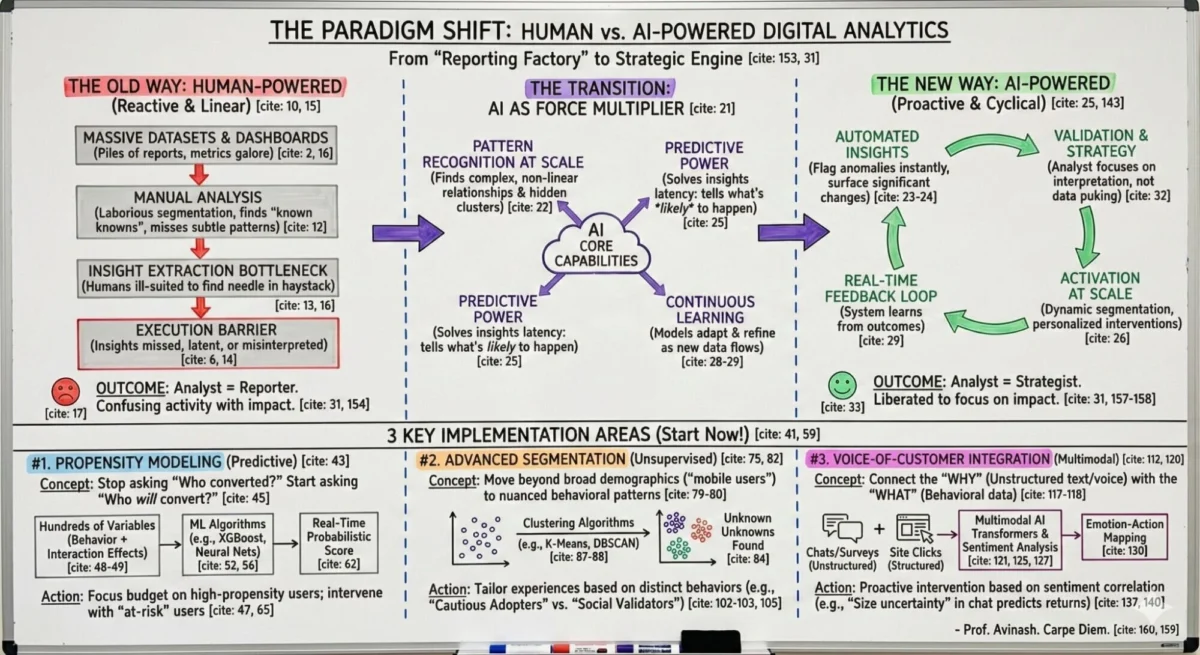
For decades, the standard operating procedure for marketing analytics has been reactive, manual, and fundamentally flawed. The typical workflow is a four-step process that often collapses under the weight of modern data complexity:
- Report Generation: Analysts spend hours producing static dashboards that summarize the past.
- Manual Analysis: Teams attempt to segment data using "known knowns," often missing subtle, non-intuitive patterns that define high-dimensionality datasets.
- Insight Extraction: The laborious process of identifying "the findings" and translating them into presentations for Finance, Marketing, and Senior Leadership.
- The Last-Mile Barrier: Even when insights are found, they often die in the boardroom, competing with other priorities, suffering from misinterpretation, or proving too abstract to translate into direct action.
This process is inherently ill-suited for the modern digital era. Humans are simply not capable of scanning hundreds of variables per user engagement to identify "needles in the haystack." When businesses attempt to force this manual model onto massive datasets, they miss the non-linear patterns that actually drive customer behavior.
The AI Force Multiplier: A New Era of Intelligence
The transition to AI-powered analytics is not merely an upgrade; it is a fundamental transformation of the analyst’s role from a "reporter" to a "strategist." By leveraging machine learning, companies can move beyond historical reporting into the realm of predictive intelligence.
Pattern Recognition at Scale
Machine Learning (ML) algorithms excel where humans fail. They can navigate massive, high-dimensionality datasets to identify complex, non-linear relationships and hidden clusters that would remain invisible to even the most seasoned analyst.
Automating the Mundane
Much like the utility of LLMs such as ChatGPT or Qwen, AI can automate the extraction of insights from routine data. It can flag anomalies in real-time, surfacing statistically significant changes that demand immediate attention, allowing human teams to focus on strategy rather than data entry.
The Power of Prediction
Perhaps the most profound shift is the movement from "what happened?" to "what is likely to happen?" AI provides the capability for dynamic segmentation and personalized experiences at a scale that was previously impossible. It can predict, with startling accuracy, the future behavior of individual users, enabling a proactive rather than a reactive stance.
Continuous Learning
The real superpower of AI is its capacity for continuous improvement. As new data flows through the system, models adapt and refine their understanding of user behavior. This creates a self-optimizing ecosystem where the "analyst" effectively gains the equivalent of a new degree every few weeks.
Redefining the 10/90 Rule
Twenty years ago, the "10/90 Rule of Analytics" became a mantra for the industry: invest $10 in tools and $90 in the humans who analyze the data. Today, that rule has been rendered obsolete by the speed and precision of machine learning.
The new 10/90 rule for the AI era is starkly different: Invest $10 in brilliant human analytical strategists, and invest $90 in AI activation.
Over time, this investment ratio is likely to become even more efficient—perhaps dropping to $80 or $70 total—as the quality of decisions and the scale of automation increase exponentially. The goal is to maximize the speed of insight, reducing the "insights latency" that has historically paralyzed decision-making.
Implementing the Future: Three Pillars of AI Analytics
To transition to an AI-driven model, organizations must focus on three core implementation strategies.
1. Propensity Modeling: Who Will Convert?
Traditional analytics tells us who did convert. Propensity modeling tells us who will convert. By analyzing hundreds of behavioral features—from scroll depth to product views—ML algorithms can identify the exact probability that a specific user will upgrade, churn, or purchase in the coming days.
- Algorithms to Watch: Gradient Boosting (the current gold standard for tabular data), Random Forests (for understanding feature importance), and Deep Learning (for complex, non-linear relationships).
- The Outcome: Businesses have seen 35% to 60% improvements in conversion rates and a significant reduction in customer acquisition costs by focusing resources only on high-propensity users.
2. Advanced Customer Segmentation
Most companies segment by broad demographics, which is a legacy practice that misses the nuances of modern consumer behavior. Unsupervised learning algorithms can process dozens of behavioral dimensions simultaneously to identify "natural clusters" in data.
- The Advantage: This bypasses human bias and discovers "unknown unknowns." For example, instead of a generic "free trial" segment, an AI might identify four distinct personas based on usage patterns, allowing for hyper-personalized onboarding that drastically improves activation rates.
3. Voice-of-Customer Integration
For years, the "Trinity Model" of analytics (combining behavioral data with outcome and intent) was hampered by silos. Behavioral data, support tickets, and chat transcripts lived in different systems.
- The AI Leap: Multi-modal AI can now process structured behavioral data alongside unstructured text, voice, and video. By using advanced embedding techniques, companies can connect the why (sentiment) with the what (behavior), leading to dramatic improvements in Net Promoter Scores (NPS) and a massive reduction in friction points like cart abandonment.
Implications for the Workforce
The integration of AI into analytics is the most significant shift since the field’s inception. It carries profound implications for the human workforce.
The traditional "Analyst" role, defined by report generation and manual data cleaning, is rapidly approaching obsolescence. Within the next 18 to 24 months, the market will likely phase out the manual-reporting analyst entirely. In their place will rise the "Analytical Strategist"—a professional who understands how to orchestrate AI, interpret complex algorithmic outputs, and translate those insights into business strategy.
Conclusion: The Path Forward
The organizations that thrive in the next decade will not be those with the largest data lakes or the biggest budgets. They will be the ones that minimize insights latency.
AI-powered analytics is no longer a futuristic concept; it is an immediate competitive necessity. While the journey toward full integration requires human grit, intelligence, and a willingness to embrace imperfection, the potential payoff is immense. By moving from reactive reporting to predictive intelligence, companies can finally stop guessing and start leading.
As the industry stands on the precipice of this change, the call to action is clear: Carpe diem. The era of the HiPPO is over; the era of AI-driven, data-informed strategy has begun.