By the Global Tech & Enterprise Insights Desk
Published: July 2026
Main Facts: The Structural Shift in B2B Contracting
The foundational playbook of B2B SaaS—securing predictable, multi-year annual recurring revenue (ARR) upfront through aggressive discounting and multi-year contract (MYC) incentives—is officially breaking down. In the rapidly evolving landscape defined by generative artificial intelligence, automation, and hyper-agile software cycles, technology buyers are fundamentally rejecting long-term commitments.
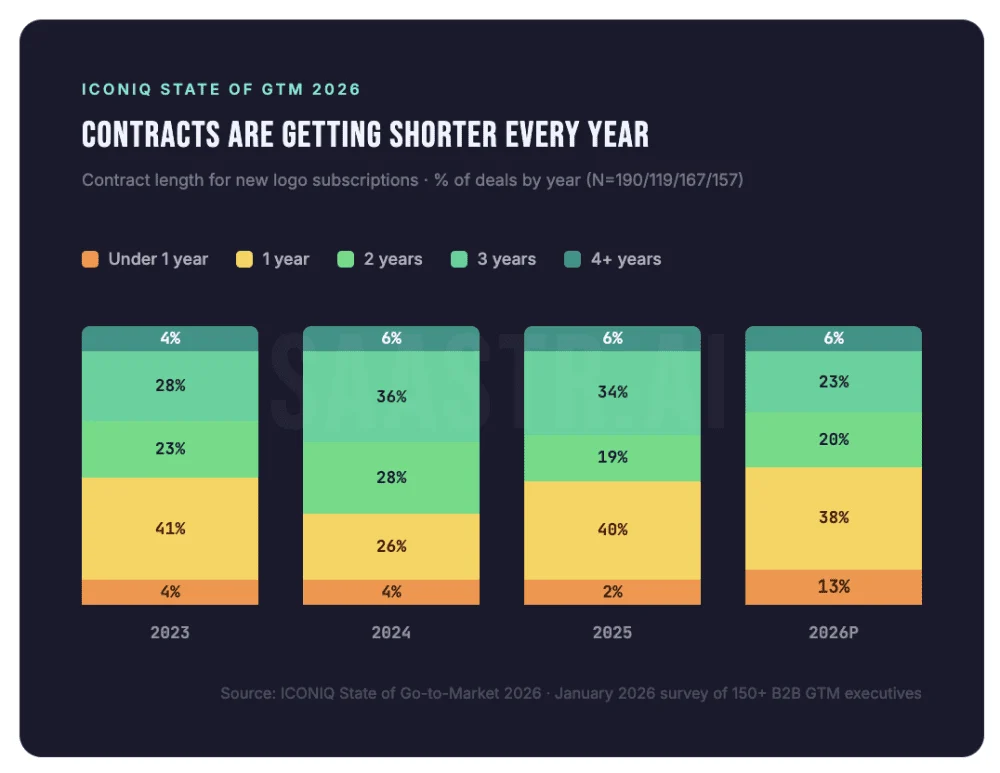
According to fresh enterprise benchmark data released by ICONIQ in 2026, the era of the default three-year agreement is giving way to a buyer-driven preference for shorter, more flexible terms. The data highlights a stark decline in the popularity of three-year deals for new logos, plummeting from 28% in 2023 to just 23% in 2026. Conversely, sub-one-year agreements have surged from 4% to 13% over the same triennial window.
For founders, revenue leaders, and venture capitalists, the message from the market is unambiguous: stop pushing for multi-year contracts. In the modern Age of AI, fighting consumer and enterprise behavior to force artificial long-term commitments costs emerging tech companies more in stalled deals, friction, and goodwill than any theoretical revenue security could ever yield.
+-----------------------------------------------------------------+
|              ICONIQ NEW LOGO CONTRACT LENGTH TRENDS             |
+-----------------------------------------------------------------+
|  Contract Type       |        2023        |        2026        |
+-----------------------------------------------------------------+
|  3-Year Agreements   |        28%         |        23%         |
|  Sub-1-Year Deals    |         4%         |        13%         |
+-----------------------------------------------------------------+
Rather than treating these shorter durations as a temporary market anomaly or a hesitant negotiating tactic, industry analysts emphasize that this is entirely rational buyer behavior. AI capabilities and software replacement cycles now compress every 12 to 18 months. An enterprise that locks itself into a rigid three-year software agreement today runs the risk of funding a product category that is functionally obsolete by year two, anchored to a vendor that lost its market leadership within its first twelve months.
Chronology: How the AI Boom Upended Traditional SaaS Sales
To understand how the B2B sales cycle arrived at this pivotal crossroads, it is helpful to trace the evolution of enterprise purchasing habits over the past half-decade:
- 2020–2022 (The Post-Pandemic SaaS Expansion): Multi-year contracts reigned supreme. Propelled by low interest rates and a "growth-at-all-costs" mentality, enterprise buyers routinely signed 3- to 5-year software agreements, locking in pricing and ensuring vendor stability. SaaS startups prioritized land-grab strategies, using steep discounts as bait to secure long-term ARR commitments.
- 2023 (The Macroeconomic Correction): As inflation rose and capital grew expensive, Chief Information Officers (CIOs) began scrutinizing software budgets. Redundancies were culled, and procurement teams started pushing back against automatic price escalators. However, multi-year contracts still represented more than a quarter of all new software logos.
- 2024–2025 (The Generative AI Gold Rush): The mass commercialization of foundation models and domain-specific AI agents drastically accelerated software innovation. Enterprise tech stacks began shifting overnight. Companies realized that tools purchased in early 2024 were frequently outperformed by newer, native-AI architectures by late 2025.
- 2026 (The Paradigm Shift): The friction between traditional software sales motions and modern AI development velocities reaches a breaking point. With sub-one-year contracts jumping to 13% of all new deals, the market forces a reckoning. Sales leaders discover that trying to force multi-year terms through discounting only serves to elongate deal cycles and poison customer relationships from inception.
Supporting Data and Market Analysis: The Economics of Agility
The underlying mechanics driving this shift are rooted in risk management and the acceleration of technological obsolescence. Enterprise buyers are no longer willing to underwrite a vendor’s long-term product roadmap using their own balance sheets as collateral.
The 18-Month Innovation Cycle
In legacy enterprise software (e.g., ERP systems, relational databases, legacy CRM), feature updates were incremental, arriving in annual or quarterly release trains. Today, foundational AI models evolve continuously. An AI application layer startup that dominates its niche in January can find itself out-competed by an open-source model or a platform-native feature release by the following winter. Buyers evaluating these solutions recognize that a 36-month commitment creates an asymmetric risk profile: all the downside risk of obsolescence sits squarely with the customer.
The Myth of the Discounted Multi-Year Deal
Many early-stage revenue teams attempt to bypass buyer hesitation by offering aggressive financial incentives—such as 15% to 20% discounts—in exchange for a multi-year signature. Industry data suggests this strategy is deeply flawed. Not only does it compress gross margins during a time when compute and LLM token costs require careful management, but it also fails to solve the root problem.
When a buyer is forced into a multi-year commitment they did not organically want, resentment often builds. By month 18—long before the contract is up for natural renewal—the customer frequently becomes disengaged, fails to adopt new features, and churns aggressively at the earliest contractual exit point. Worse, the immediate sales velocity slows down to a crawl as procurement legal teams labor over termination clauses and usage down-scaling rights.
The Elite Exception: Exceptional ROI and NRR
Of course, multi-year contracts have not entirely vanished from the B2B landscape. However, the companies successfully securing them are operating in an entirely different financial and operational tier.
Top-quartile software and AI companies—such as Datadog, Figma, Databricks, and Snowflake—consistently maintain Net Revenue Retention (NRR) rates between 110% and 123%. Crucially, these market leaders are not closing three-year deals on the strength of a slide deck or a clever discount. They secure multi-year commitments because their customers have already experienced undeniable, quantifiable Return on Investment (ROI) before the formal renewal conversation even begins. Their expansion revenue is pull-driven, not push-driven.
Official Responses and Expert Perspectives
As the discourse surrounding modern Go-To-Market (GTM) strategies intensifies, prominent investors and B2B operators have weighed in on how startups must adapt their sales philosophies.
Venture capital analysts point out that the traditional obsession with initial contract length is a lagging indicator of business health. In conversations with portfolio companies, revenue advisors are explicitly counseling founders to decouple sales compensation from multi-year incentives.
"If your product delivers true, mission-critical value in the Age of AI, customers will happily stay with you for years—they just want the flexibility to prove it first," notes a leading enterprise tech investor. "Trying to handcuff a buyer to a multi-year agreement before they’ve realized sustained value is a symptom of a weak product-market fit, not a sign of strong enterprise sales execution."
Furthermore, customer success leaders emphasize that shortening the initial contract window fundamentally alters the psychological contract between vendor and buyer. When a customer signs a 6- or 12-month agreement, the accountability shifts entirely back to the vendor. Every single quarter becomes an active audition, forcing product and engineering teams to continuously earn the right to exist within the customer’s tech stack.
Implications: The New GTM Playbook for B2B and AI Startups
For founders and revenue architects plotting their growth strategies, navigating this market reality requires a complete overhaul of post-sale execution, sales compensation, and cash-flow forecasting.
1. Optimize for NRR and Renewal Quality, Not Initial Duration
For startups—particularly those aiming for healthy metrics by their Series B round—a target Net Revenue Retention (NRR) of 120% should serve as the true North Star. When your NRR is robust, short initial contracts cease to be an existential threat. Instead, they act as functional feedback loops. If your product is sticky, customers will renew and expand naturally, yielding high-quality, compounding ARR over time without the friction of forced long-term lock-ins.
2. Double Down on Forward Deployed Engineers (FDEs) and Time-to-Value
If multi-year contracts cannot be bought with discounts, they must be earned through rapid execution. Modern AI and SaaS startups are shifting capital away from bloated enterprise sales development representative (SDR) pods and reinvesting those dollars into:
- Forward Deployed Engineers (FDEs): Technical resources dedicated to bespoke integrations and proof-of-concept deployments.
- Accelerated Onboarding: Streamlining implementation so that enterprise customers achieve measurable ROI within 60 to 90 days.
When a customer sees operational efficiency or revenue acceleration within their first two months of deployment, the renewal conversation transforms from a tense negotiation into an administrative formality.
3. Redefine Financial Forecasting and Cash Management
Venture capitalists and financial controllers must also adjust their expectations regarding cash flow predictability. While the predictability of multi-year upfront payments was a hallmark of 2010s-era SaaS, the modern AI economy demands dynamic forecasting. Startups must build their financial models around resilient cohort retention and gross margin health rather than assuming artificial longevity built on discounted contracts.
Conclusion
The market has rendered its verdict. In the Age of AI, rigidity is a liability and flexibility is a competitive advantage. By abandoning the outdated crusade for multi-year lock-ins and redirecting those resources toward rapid deployment, unmatched product utility, and relentless customer success, B2B startups can build resilient, high-retention businesses primed for the realities of the modern enterprise market.