In the traditional playbook of public relations, success was measured in column inches, relationship-building, and the art of the perfect pitch. For decades, PR professionals acted as the gatekeepers between brands and the media, crafting narratives designed to capture the attention of journalists. However, as the digital landscape undergoes its most radical transformation since the dawn of the internet, those traditional tactics are losing their potency.
Today, a brand’s visibility is no longer solely dictated by a human editor at a major publication. It is increasingly determined by the cold, calculated logic of large language models (LLMs) like ChatGPT, Gemini, and Google’s AI Overviews. When a potential buyer asks an AI for a product recommendation or industry insight, the "traditional pitch" is invisible.
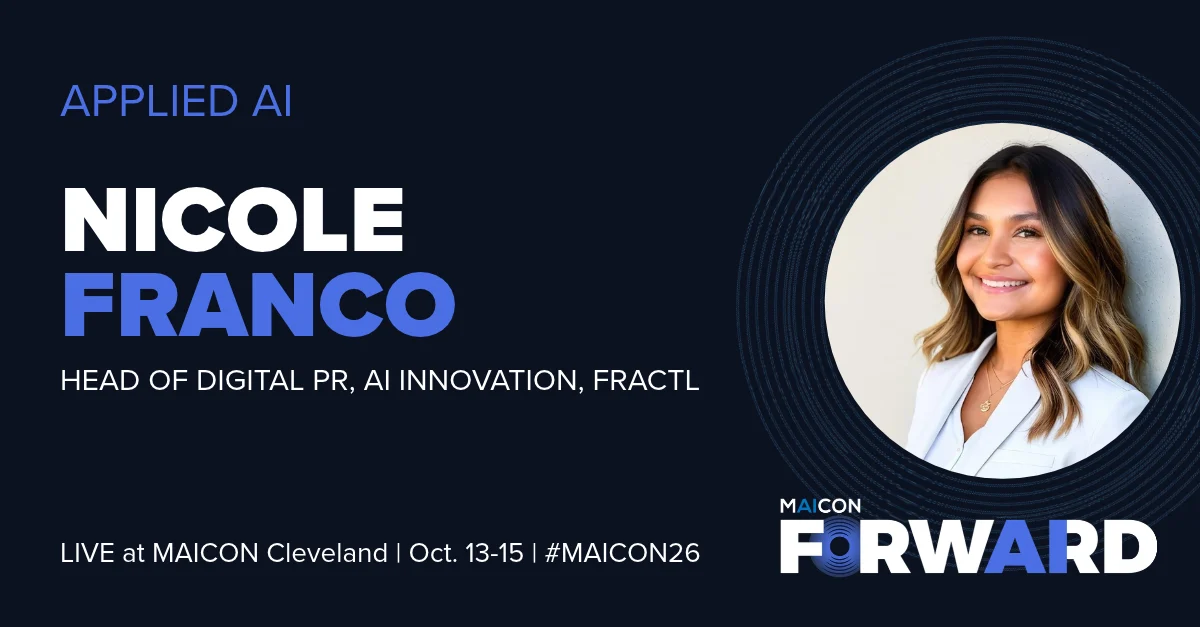
To bridge this gap, Nicole Franco, Head of Digital PR and AI Innovation at Fractl, is spearheading a movement to redefine the discipline. At MAICON 2026, Franco will unveil her framework for "Entity-Led Digital PR," a strategy that treats a brand’s authority not as a collection of clippings, but as a structured, engine-driven data system.
The Paradigm Shift: From Storytelling to Entity Management
The core of the issue is that AI models do not "read" PR pitches in the way journalists do. Instead, they ingest, categorize, and cross-reference "entities"—people, products, brands, and concepts.
"Traditional PR taught us to pitch stories and build relationships," says Franco. "That work still matters for brand awareness, but it no longer decides whether a brand shows up when a buyer asks an AI for a recommendation."
Franco’s approach reframes PR as an "Entity Engine." Instead of chasing disparate media placements, she argues that marketing teams must identify the cohesive metrics across their entities—subject matter experts (SMEs), proprietary data, and product categories—and create a unified ecosystem.
Under this model, a LinkedIn post, a high-authority byline, and a snippet of expert commentary are not siloed activities. They are synchronized components of a single engine designed to build authority across three distinct but overlapping pillars: social media, organic search, and AI-generated responses.
The Contextual Authority Myth: Why "Big" Isn’t Always Better
One of the most persistent myths in public relations is the obsession with "big-name" media. The belief that a placement in a massive business publication automatically translates to authority is, in the age of AI, increasingly outdated.
Franco’s team at Fractl has utilized proprietary data to track which publishers actually influence AI visibility, and the results are often counterintuitive. According to Franco, "High-authority media is great, but only in the context of your brand."
For instance, a food brand seeking to dominate LLM recommendations should prioritize a feature in All Recipes over a general-interest business magazine, regardless of the latter’s massive domain authority. The logic is simple: when an AI model is trained on a massive corpus of data, it looks for the sources that are most contextually relevant to the specific query. If the model is answering a question about cooking techniques, it is mathematically more likely to cite a culinary publication than a general finance outlet.
"The publication that wins in the LLMs depends on where the brand’s audience already lives and which sources the models cite for that vertical," Franco explains. This requires PR teams to shift their strategy from a "spray and pray" approach to a precision-based model where contextual relevance is the primary KPI.
Structuring Commentary as a Data Asset
Perhaps the most significant change in the PR workflow is the treatment of expert commentary. Traditionally, PR professionals provided polished, sanitized quotes that were often ignored by journalists in favor of more "human" insights. In an era dominated by AI, "polished" often reads like "AI slop."
Franco advocates for "scaling commentary as a structured data asset." This means treating expert quotes as raw, granular inputs rather than PR filler.
"Think of quotes like data points, sound bites, or clips a journalist will use in their story," she says. "They don’t want the same commentary or AI slop that many PRs might be sharing. They want raw, uncut, candid sound bites that will add substance to their stories."
By shifting the internal workflow to prioritize the production of emotionally compelling, surprising, and unique commentary, brands become more than just noise. They become essential, high-quality sources for both human journalists and the web-crawling algorithms that feed AI models. This creates a feedback loop: when a journalist uses a quote, that piece of content is published, indexed, and eventually ingested by an LLM, further solidifying the expert’s authority.
The MAICON 2026 Roadmap
At the upcoming Marketing Artificial Intelligence Conference (MAICON) in 2026, Franco will translate these concepts into a actionable playbook for PR and marketing leaders. The session, titled "Entity-Led Digital PR Workflows: Using Commentary, AI Prompts, and Media Partnerships to Build SME Authority in Search," is designed for professionals who are ready to move beyond outdated tactics.
Key Objectives of the Session:
- The Entity-Led Framework: Attendees will learn how to map their brand’s internal assets—SMEs, data, and products—into a structure that AI models can easily ingest and categorize.
- AI-Influenced Media Strategy: Franco will share Fractl’s proprietary research on how to identify the specific publishers that move the needle in AI search results, rather than just chasing generic high-traffic sites.
- The Commentary Workflow: A deep dive into the process of creating "data-ready" quotes that journalists and AI scrapers prioritize.
- Modernizing Measurement: Moving away from outdated vanity metrics toward tracking "Entity Authority" and "AI Visibility" as core business outcomes.
Implications for the Future of Communications
The implications of this shift are profound for the communications industry. As AI models continue to integrate into the daily search habits of consumers, the visibility of a brand will be increasingly binary: you are either an "entity of authority" that the model recognizes, or you are invisible.
For PR practitioners, this means the job is becoming more technical. It requires a fundamental understanding of how search, AI, and content marketing intersect. The traditional "PR person" must evolve into a "Digital Strategist" who understands not just how to talk to people, but how to ensure that the machine-readable web accurately reflects their brand’s expertise.
"We are moving into an era where authority is contextual," says Franco. "Chasing the biggest logo isn’t the same as chasing the placement that will actually show up when a buyer asks an AI model for a recommendation."
Join the Conversation at MAICON 2026
The transition to an entity-led strategy is not a luxury; it is a necessity for brands that want to remain relevant in an AI-first world. MAICON 2026 represents a critical gathering point for leaders looking to navigate this transition.
By joining Nicole Franco and the rest of the expert lineup at the conference, attendees will gain access to the data, strategies, and workflows necessary to transform their PR departments from traditional support functions into powerhouses of digital authority.
As the landscape shifts, the brands that thrive will be those that stop pitching stories and start building systems. The future of PR is not in the next press release—it is in the architecture of your brand’s digital identity.
Register for MAICON 2026 today to secure your place in the future of AI-driven marketing.