The marketing industry is currently undergoing a structural metamorphosis more profound than the transition from traditional media to digital. Driven by the relentless march of platform intelligence and agentic automation, the traditional agency model—once defined by the "execution army"—is facing an existential inflection point. For marketing leaders, this represents a unique opportunity to shed the inefficiencies of the past and renegotiate contracts that align with an AI-first future.
The Paradigm Shift: Why "Kansas" is Long Gone
For decades, the standard marketing agency business model relied on a "labor-arbitrage" logic. Clients paid for hours spent on manual campaign builds, keyword research, audience segmentation, and daily reporting. This was the "hamster wheel" of the digital age: constant micro-optimization, frequent status meetings, and an endless stream of manual adjustments that were often counterproductive to the very platforms they aimed to manage.
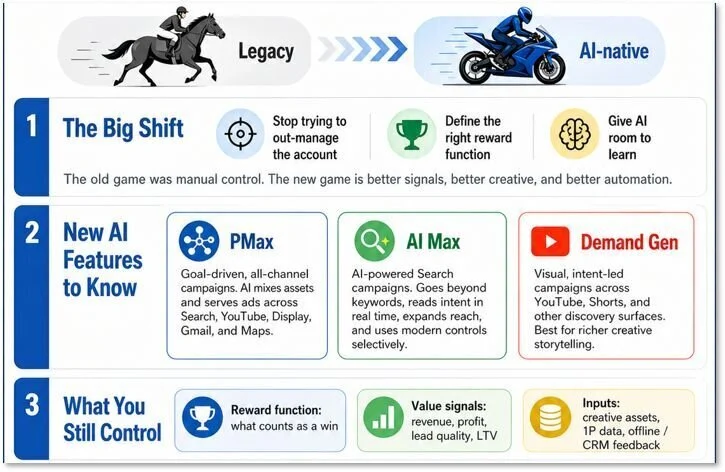
Today, the revolution of AI-driven platforms—from Google’s PMax and Meta’s Advantage+ to emerging agentic frameworks—has rendered the manual "execution" model obsolete. Algorithms now handle bidding, placement, audience discovery, and creative assembly with a speed and nuance that far exceeds human capability.
The strategic realization is simple: If an agency is "touching" your account on a daily basis to perform manual optimizations, they are likely interfering with the machine’s learning cycle, effectively degrading performance. The agency of the future is no longer a factory of laborers; it is a center of strategic judgment, governance, and high-level innovation.
Chronology of Transformation: From Manual to Autonomous
The transition from a manual-heavy workflow to an AI-orchestrated environment is not a distant possibility—it is the current reality.
- 2020–2023 (The Era of Hybridization): Agencies began incorporating AI tools into their workflows, but the fundamental contract structure remained tied to manual labor. "Percent of Media Spend" became the industry standard, incentivizing agencies to keep budgets high and activities complex.
- 2024–2025 (The Algorithmic Tipping Point): Platforms introduced sophisticated, end-to-end automation. The necessity for manual bid adjustments, day-parting, and granular audience sculpting evaporated.
- 2026 and Beyond (The Age of Outcomes): As we move toward July 2026 and beyond, the "old-world" Statement of Work (SOW) is officially a liability. The focus has shifted from "doing" to "deciding," with contracts increasingly reflecting the value of outcomes rather than the volume of labor.
Supporting Data: Where the Fees Go
The fiscal implications of this shift are material. By systematically identifying areas where platform AI has replaced human intervention, organizations can expect significant reductions in legacy agency fees, while simultaneously increasing investment in higher-value strategic services.
The Five Clusters of Disruption
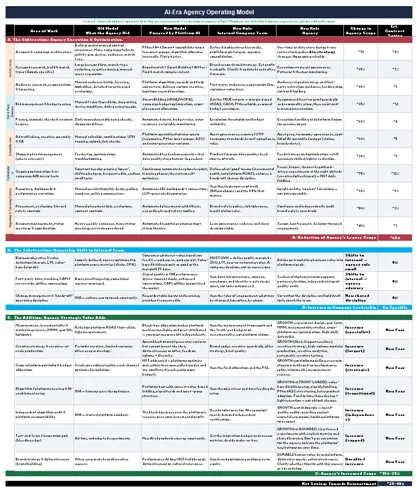
Analysis of agency contracts reveals that roughly 65% of typical fee structures are tied to activities now largely handled by AI.
- Agency Activity Army (22% of cost): Architecture, keyword research, and manual targeting. These tasks are now subsumed by algorithmic asset groups. Expected effort reduction: ~78%.
- The Bid & Pace Dancers (14% of cost): Manual bidding, pacing, and anomaly checks. Modern AI performs this continuously. Expected effort reduction: ~73%.
- The Assembly Line (12% of cost): Trafficking, ad builds, and QA. Generative AI now assembles variations at scale. Expected effort reduction: ~45%.
- The Optimization Theater (16% of cost): A/B testing and "daily rituals" of shifting budgets. These are now native functions of platform explore-exploit cycles. Expected effort reduction: ~75%.
- The Reporting & Servicing Factory (30% of cost): Manual decks and constant check-ins. Automated data lakes and real-time dashboards make these redundant. Expected effort reduction: ~60%.
Official Perspectives: The Need for Contract Renegotiation
Industry experts, including seasoned practitioners like Avinash Kaushik, argue that the goal of auditing these fees is not merely cost-cutting—it is the alignment of incentives. A contract based on "Percent of Media Spend" is inherently anti-AI; it rewards the agency for spending more and doing more, even when "doing less" would produce better results.
To survive and thrive, the agency-client contract must migrate toward a three-tiered model:
- Lean Base Retainer (40–50%): Dedicated to governance, strategic steering, and high-level data engineering.
- Project Fees (30–40%): Focused on creative conceptualization, pre-testing, and complex, multi-platform portfolio strategy.
- Outcome Incentives (15–25%): Tied directly to incremental profit or verified business lift, moving away from vanity metrics like platform-reported ROAS.
Strategic Implications: A New Operating Model
For the modern CMO, the imperative is to stop buying "hours" and start buying "outcomes."
For the Client: Avoiding the Hostage Situation
The shift to an AI-led model requires total control over one’s data infrastructure. Organizations must ensure they have direct, unencumbered ownership of ad accounts, pixels, and data feeds. Relying on an agency to "host" your data is a strategic risk that must be eliminated immediately. Furthermore, internal leadership—Marketing Managers and Directors—must be retrained to oversee algorithmic outcomes rather than managing agency "execution" tasks.
For the Agency: The Rise of the Strategic Partner
For agencies, this transformation is not a death knell; it is a liberation. By moving away from low-value, $50/hour execution tasks, agencies can pivot to high-value, $500+/hour strategic work. This shift allows agencies to hire superior talent—experts in psychology, data storytelling, and brand strategy—rather than junior employees focused on trafficking and reporting.
The "modern agency" of 2027 will be defined by its ability to:
- Navigate the Agentic Universe: Managing the "guardrails" within which AI platforms operate.
- Creative Innovation: Focusing on the "why" and "what" of creative, while AI handles the "how."
- Outcome-Centricity: Aligning their revenue directly with the client’s bottom line, proving their worth through incremental business impact rather than spreadsheet volume.
Conclusion: Embracing the Future
The "we are not in Kansas anymore" realization is, for the prepared, a massive opportunity. The traditional agency model, characterized by bloated SOWs and manual drudgery, is collapsing under the weight of its own inefficiency.
The path forward is clear: Renegotiate contracts to kill the "Percent of Media Spend" model, eliminate the manual "theatre of work," and demand a partnership focused on high-level strategy and measurable business outcomes. The agencies that embrace this change will become indispensable partners, while those clinging to the "execution army" model will likely find themselves obsolete.
As the industry pivots toward this new operating model, the winners will be those who recognize that while the tasks of marketing are being automated, the value of the human agency—in judgment, taste, and strategic courage—has never been higher. The time to restructure is now; the future of marketing is not about doing more, it’s about doing what matters.