The narrative of the last few years has been dominated by the "great dispersion"—a tale of tech workers trading San Francisco’s fog for the sun of Austin, the tax benefits of Miami, or the remote-first lifestyle of the digital nomad. Yet, as the dust settles on the mid-2026 venture capital landscape, the data reveals a starkly different reality: the center of the technological universe has not shifted; it has, in fact, tightened its grip.
According to the latest Startup Ecosystem Leaderboard released by Carta, which tracks $124 billion in venture capital invested between July 2025 and June 2026, the Bay Area remains the undisputed epicenter of global innovation. Despite the rise of distributed workforces and the proliferation of regional tech hubs, capital is flowing to the Bay Area with a level of concentration that mirrors the power-law distributions found in the most successful venture funds themselves.
The State of the Ecosystem: A Multi-Billion Dollar Reality Check
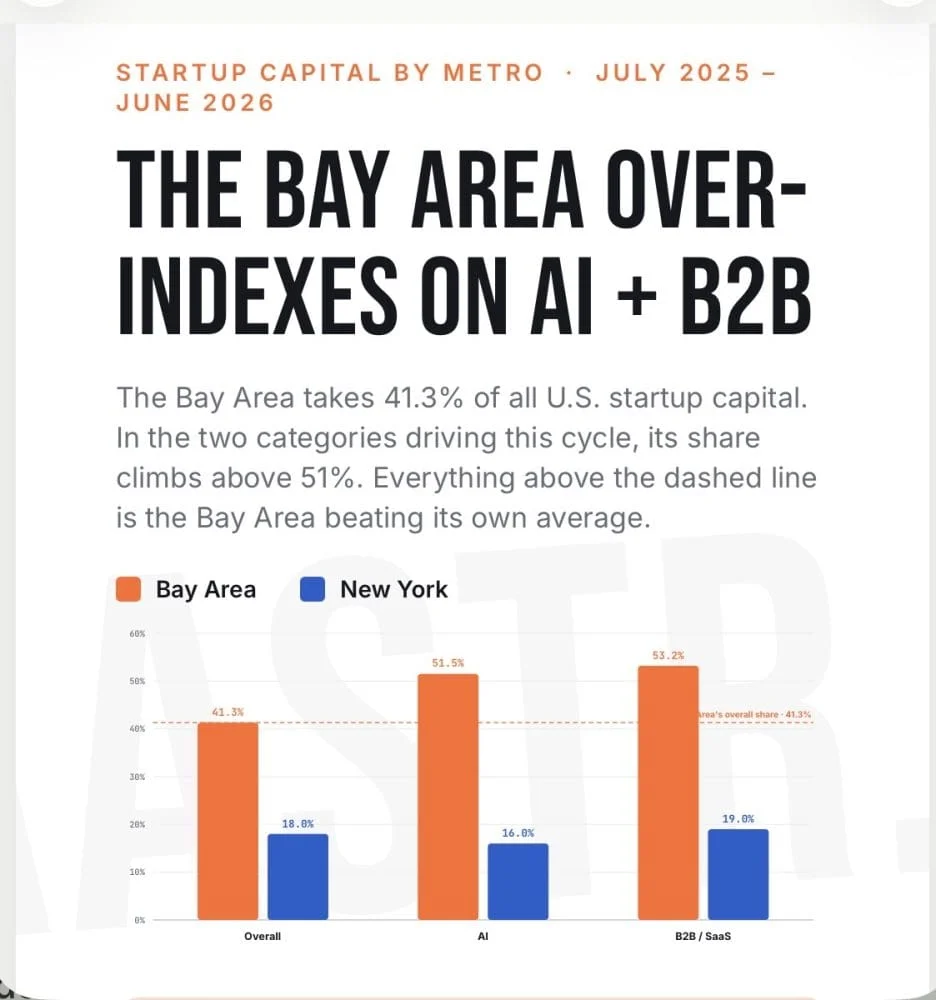
The numbers released by Carta are definitive. During the 12-month period ending in June 2026, the Bay Area secured 41.3% of all venture capital invested globally on the platform—an staggering $51.3 billion flowing into a single metropolitan area.
To put this in perspective, New York, the second-ranked city, captured 18.0% of the total, followed by Boston at 8.7%. The Bay Area’s lead is not merely a margin; it is a chasm. The region commands nearly 2.5 times the capital of the entire New York ecosystem across every sector combined. For founders and investors alike, this suggests that while the narrative of "geography-agnostic" investing gained popularity during the pandemic, the reality of where the "smart money" lands remains firmly tethered to historical hubs.
Chronology of Concentration: From Dispersion to Re-aggregation
The journey to this current state of hyper-concentration was not linear.
- 2020–2022 (The Great Dispersion): Following the onset of the global pandemic, a combination of remote work mandates and rising urban costs fueled a rapid exodus of talent. During this window, "secondary" cities like Austin, Miami, and Denver saw unprecedented growth in venture activity as founders sought lower overhead and higher quality of life.
- 2023–2024 (The Plateau): As the initial hype of remote-only operations collided with the complexities of building high-performance AI models, the limitations of distributed teams began to surface. Companies realized that "tacit knowledge"—the informal, high-bandwidth communication that drives rapid iteration—was significantly harder to scale via Zoom.
- 2025–2026 (The AI-Driven Re-aggregation): The massive surge in generative AI and complex B2B infrastructure projects necessitated a return to physical proximity. By the start of the current data cycle in July 2025, the "return to the office" wasn’t just a corporate mandate; it was an organic reaction to the demands of a new technical frontier. The data shows that as the complexity of the technology increased, so did the necessity for geographical density.
Deep Dive: The AI and B2B Hegemony
While the Bay Area’s 41.3% overall share is impressive, it understates the region’s true dominance in the sectors that define the current cycle: Artificial Intelligence and B2B software.
When isolating AI and B2B capital, the concentration shifts from dominant to extreme. More than 50% of every dollar invested in AI startups during this period landed in the Bay Area. The same holds true for B2B infrastructure. When you combine the top two metros—the Bay Area and New York—they command roughly 70% of all B2B venture dollars in the United States.
Boston maintains a steady, albeit distant, third place, capturing approximately 8.3% to 8.4% of these specific markets. Below the top three, the "cliff" becomes apparent: the remaining cities, including Austin and Los Angeles, are left to fight over low single-digit slices of the remaining capital pie. This is not a market of diverse, regional competition; it is a winner-take-all landscape that favors established density.
The Fintech Exception: Why New York Still Reigns Supreme
The only significant outlier in this data is the fintech sector, which reveals a different side of the geographic coin. In fintech, New York dominates with a 58.9% share, while the Bay Area captures 20.8%.
This is the "proximity exception." Fintech is not solely a product-development business; it is a business of capital markets, regulatory navigation, and banking relationships. Because the infrastructure for these industries is physically entrenched in Manhattan, the capital and the talent naturally gravitate there. This serves as a vital lesson: capital does not flow to where the rent is cheapest; it flows to where the customers, the regulators, and the specialized talent reside.
Implications for Founders and Investors
The data provided by Carta offers a set of practical, if somewhat uncomfortable, truths for the startup ecosystem.
For Founders: The Geography Tax
If you are building a competitive, venture-backed AI or B2B company, geography is a variable that cannot be ignored. While remote work is perfectly viable for operational execution, it remains a headwind for high-stakes fundraising. The density of Series A and Series B investors who possess the conviction to lead large rounds is not evenly distributed. When the time comes to secure the capital needed to compete in the AI arms race, being "in the room" remains a significant tactical advantage.
For Distributed Companies
The distributed, no-HQ model is excellent for building products and managing costs, but it remains weaker for fundraising signaling. Founders choosing this path must be aware that they are intentionally stepping away from the capital-dense epicenters, which may require a more aggressive, intentional strategy to ensure they remain on the radar of top-tier investors.
For LPs and Emerging Managers
The common refrain of "we invest everywhere" is increasingly looking like a strategic liability rather than a sign of healthy diversification. In the current market, outcomes are tightly correlated with density. Spreading a portfolio thin across 15 different cities to satisfy a "diversified" thesis often results in a failure to capture the outsized returns generated by the top 1% of companies—which are, almost exclusively, located within the established hubs.
Conclusion: Challenging the Narrative
For years, the industry narrative was built on the premise that the "tech center" was a legacy concept, rendered obsolete by the internet. We measured this via office vacancy rates, U-Haul statistics, and cost-of-living indices. We were measuring the wrong things.
Venture capital is not a measure of where people want to live; it is a measure of where capital chases the highest probability of outsized outcomes. By that metric, the Bay Area has not lost its lead—it has re-asserted it. The talent did not disperse; it re-concentrated to solve the hardest problems in the most complex fields. As we look toward the remainder of 2026, the data is clear: the narrative got ahead of the numbers, and the numbers have now arrived to reclaim the throne.