In the lifecycle of disruptive technology, there is a pivotal threshold: the transition from "competitive advantage" to "existential necessity." For the world of B2B marketing, that threshold has officially been crossed.
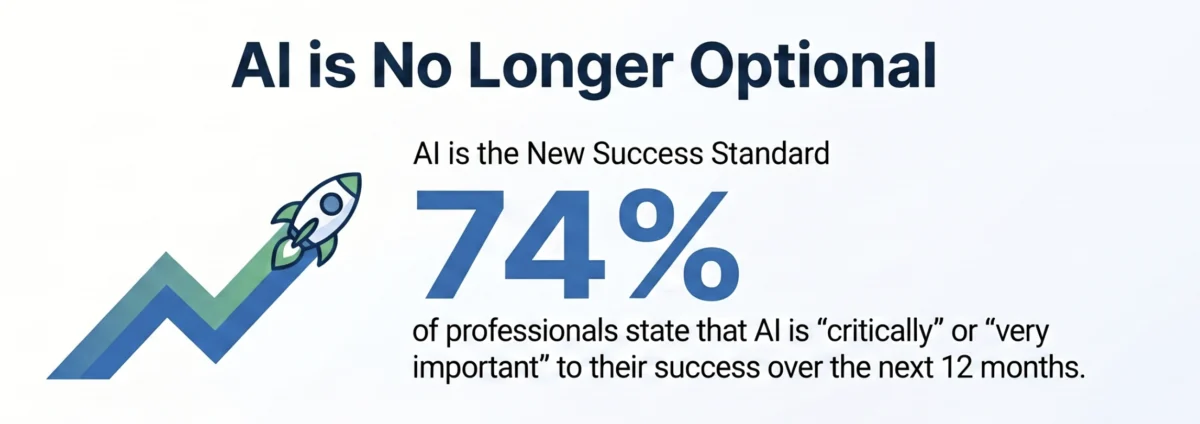
According to the newly released 2026 State of AI for Business Report, artificial intelligence is no longer a sandbox experiment for the tech-savvy few. It has graduated to the bedrock of modern marketing operations. With 74% of surveyed professionals labeling AI as "critically" or "very important" to their professional success over the coming year, the industry is signaling a definitive end to the era of AI skepticism.
Yet, as the data reveals, this consensus comes with a catch. While individual practitioners are sprinting toward integration, the organizations they work for remain anchored in legacy processes. This "institutional lag" is rapidly becoming the defining challenge for B2B leaders in 2026.
The Chronology of Adoption: From Novelty to Necessity
To understand the current state of the industry, one must look at the rapid maturation of AI adoption over the past three years.
Phase 1: The Pilot Era (2023–2024)
During this period, AI was primarily viewed as a novelty. It was the tool you "played with" on the side. Marketing teams utilized generative AI to draft quick social media copy or brainstorm headlines, but these efforts were largely siloed, uncoordinated, and absent from formal business strategy.
Phase 2: The Integration Surge (2025)
By last year, the utility of AI became undeniable. Knowledge workers began embedding tools into their daily workflows—using AI for complex data analysis, customer segmentation, and personalized outreach. The conversation shifted from "What can this tool do?" to "How can I do my job faster?"
Phase 3: The Expectation Cusp (2026)
The current year marks a crescendo. AI has reached a state of professional ubiquity. It is now a core requirement for career advancement and operational efficiency. Leadership teams are no longer asking if their staff should use AI; they are increasingly setting expectations that AI be the primary driver of output. As Paul Roetzer, CEO of SmarterX and the Marketing AI Institute, notes, we are witnessing a fundamental shift in sentiment among the most AI-forward practitioners—those on the front lines who see the impact in real-time.
Supporting Data: The Anatomy of a Consensus
The 2026 State of AI for Business Report surveyed more than 2,100 professionals, with 84% hailing from the B2B sector. The data provides a granular look at the disconnect currently plaguing the industry.
- The Criticality Metric: 74% of respondents state that AI is essential to their success over the next 12 months. Taylor Radey, Director of Research at SmarterX, describes this as "nearing about as close to a consensus on a survey question as you can get."
- The Maturity Gap: A staggering 53% of individual professionals report that they have already reached the "Integration" or "Transformation" phases of AI adoption—meaning they have fundamentally rewritten their daily workflows or job descriptions to revolve around AI.
- The Institutional Failure: Conversely, only 25% of the organizations represented in the survey have reached the "Scaling" phase. Even more alarming is that nearly half (47%) of all companies are still trapped in "Pilot Mode," lacking the governance, budget, or strategic vision to push AI beyond the experimental stage.
This data paints a clear picture: the workforce is ready, but the infrastructure is not.
Official Perspectives: The "Knowledge Gap" Fallacy
During the May webinar launching the report, industry leaders were quick to debunk the common misconception that the lack of organizational progress is due to a lack of talent or knowledge.
"This is not a knowledge gap," argued Taylor Radey. "The people inside these organizations know what AI can do. They are already using it. They are already seeing the efficiency gains. But the organizations themselves haven’t built the infrastructure to operationalize AI and take full advantage of what their own employees are already doing on their own."
This sentiment is echoed by institutional experts who point to a "governance vacuum." While employees are experimenting with various tools, many companies lack a centralized strategy for data security, ethical guidelines, or technical training. Without these, the individual progress made by employees remains fragmented, inconsistent, and—in some cases—a compliance risk.
The Implications: A Strategic Imperative for B2B Leaders
For the B2B marketing leader, the implications are stark. The current dynamic is one of misaligned incentives. The team is often ahead of the organization, and while the CEO may be pushing for innovation, the middle management layer is often stuck in bureaucratic stasis.
The Cost of Inaction
Organizations that fail to bridge this gap risk more than just lower productivity. They face:
- Talent Attrition: Top-tier marketing talent will naturally gravitate toward organizations that provide the tools and support to leverage AI, rather than those that restrict it through red tape.
- Strategic Drift: If a marketing team is using AI to drive efficiency but the broader company lacks a unified data strategy, the output will inevitably fail to integrate with sales and product, leading to "siloed innovation."
- Competitive Disadvantage: In a market where speed-to-market is everything, organizations stuck in "pilot mode" will simply be out-competed by leaner, AI-integrated competitors who can iterate on messaging and strategy in hours rather than weeks.
Bridging the Divide: A Roadmap for Action
So, how can B2B marketers and leadership teams move from the "Pilot" phase to the "Scaling" phase? The transition requires moving from individual experimentation to systemic integration.
1. Establish an AI Governance Framework
The primary reason companies stay in pilot mode is fear. By establishing clear guidelines on data privacy, copyright, and ethical usage, leadership can provide the "safe space" required for teams to experiment without the looming threat of compliance issues.
2. Move Toward Centralized Infrastructure
Individual adoption is great, but organizational scale requires centralized access to tools. Procurement teams must pivot from buying individual licenses to vetting and deploying enterprise-grade AI suites that allow for collaboration and secure data sharing across departments.
3. Dedicated Training and Upskilling
It is not enough to provide the tools; leaders must provide the training. This means moving beyond generic "AI 101" workshops and toward role-specific training that teaches marketers how to refine prompts, audit AI outputs for accuracy, and integrate AI into CRM workflows.
4. Create an AI Roadmap
AI should not be treated as a "project." It must be embedded into the company’s quarterly and annual strategic planning. If AI is not explicitly mentioned in the roadmap, it will be treated as an extracurricular activity, destined to remain a pilot.
Conclusion: The Workplace Transition
The shift we are witnessing in 2026 feels less like a traditional technology trend—like the adoption of mobile or social media—and more like a fundamental, irreversible workplace transition.
For the B2B marketer, the question is no longer "Will AI change how I do my job?" That has already been answered with a resounding "Yes." The question has now become, "Will my organization evolve fast enough to let me do my job at the speed the market now demands?"
The data suggests that the technology is ready, the employees are ready, and the industry is ready. The final, and perhaps most difficult, piece of the puzzle is the organization itself. Leaders who recognize this shift today will define the market of tomorrow. Those who wait for the "right time" to scale will find themselves obsolete in a world that no longer rewards the traditional pace of business.
To explore the full findings of the 2026 State of AI for Business Report, visit stateofbusiness.ai. For those looking to dive deeper into these strategies, register for the upcoming AI for B2B Marketers Summit.