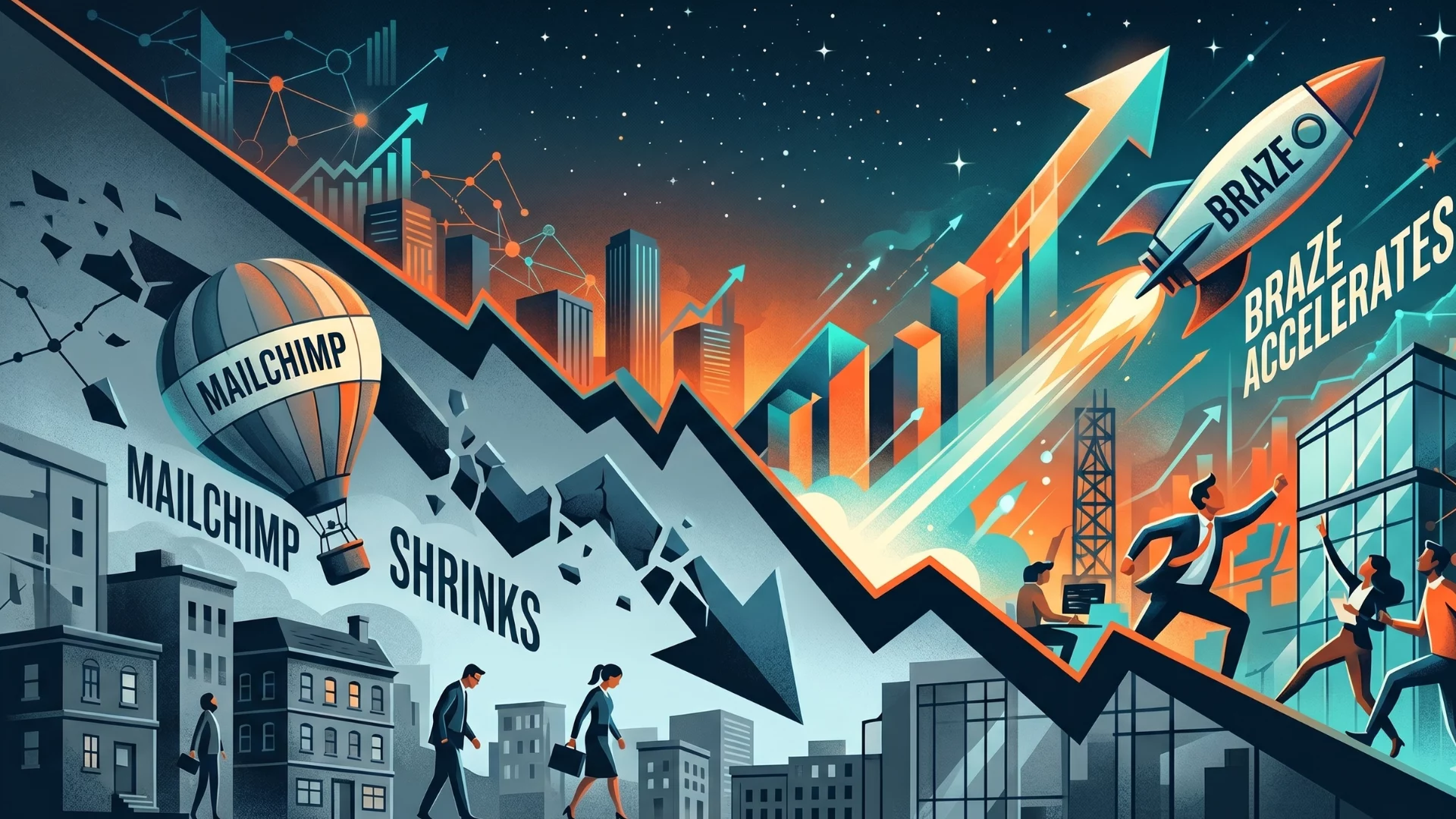
The recent fiscal first-quarter earnings report from Braze, released on May 27, paints a picture of a company firing on all cylinders. With a 30% surge in total revenue—reaching $211 million—and a streak of four consecutive quarters of accelerating organic growth, Braze appears to be thriving in a challenging macroeconomic climate. However, when juxtaposed against the simultaneous decline of legacy giants like Mailchimp, a broader, more profound narrative emerges: the monolithic "email and engagement" market has officially fractured.
For years, industry analysts treated customer engagement platforms as a singular category, assuming that when budgets tightened, all platforms would contract in unison. Today, that assumption is being dismantled. As Braze and its peer Klaviyo ascend, platforms focused on simple, transactional messaging are facing an existential crisis.
Main Facts: A Tale of Two Trajectories
Braze’s latest financials highlight a robust "land-and-expand" enterprise machine. Subscription revenue climbed to $195.2 million, up significantly from $154.9 million in the previous year. The company’s customer count expanded from 2,342 to 2,713, and, perhaps most tellingly, its Remaining Performance Obligations (RPO) have officially crossed the billion-dollar threshold, settling at $1.08 billion.
In sharp contrast, Intuit recently announced a massive 17% workforce reduction, a decision driven in part by declining revenues within its Mailchimp unit. While Braze is accelerating, Mailchimp is shrinking. This divergence is not merely a quirk of corporate performance; it is a fundamental shift in what the market values. The "email and engagement" sector has split into two distinct ecosystems: the commoditized, high-volume "send-and-forget" market and the high-complexity, data-driven orchestration market.
Chronology of the Shift
The transformation of this landscape has been a multi-year process that reached a fever pitch in the early months of 2026.
- 2024-2025: The rise of "native" integrations. Website builders (like Wix and Squarespace) and commerce platforms (like Shopify) began bundling email marketing tools into their core offerings, essentially commoditizing the act of sending a newsletter.
- Late 2025: As AI-assisted content creation became ubiquitous, the value of a standalone "template-based" email tool plummeted. Small businesses found they could generate and deploy messages through their existing site management software.
- April 30, 2026: The close of Braze’s fiscal quarter. During this period, the company solidified its strategy around the OfferFit acquisition, pivoting toward AI-powered decisioning.
- May 2026: The announcement of Intuit’s restructuring, marking a clear inflection point where the market recognized that legacy email service providers (ESPs) could no longer compete with the "all-in-one" bundles or the high-end orchestration platforms.
- May 27, 2026: Braze reports its quarterly results, confirming that enterprise clients are doubling down on sophisticated, data-rich engagement strategies despite the broader tech industry’s belt-tightening.
Supporting Data: Why Orchestration Wins
The secret to Braze’s success lies in the complexity of the "job" it performs. While a small business simply needs to send an email, an enterprise needs to orchestrate a cross-channel journey involving push notifications, in-app messaging, SMS, and email, all triggered by real-time customer behavior.
Financial Performance Metrics (Q1 2027)
- Revenue Growth: 30% (27% organic).
- Customer Growth: 16% year-over-year.
- Net Revenue Retention (NRR): 110% (Trailing twelve-month).
- RPO: $1.08 billion.
The math is clear: with customer growth at 16% and total revenue growth at 30%, Braze is successfully extracting more value from its existing base. The 110% NRR figure confirms that as these enterprise clients grow, their reliance on Braze’s infrastructure increases. They aren’t just sending more emails; they are integrating more data points and utilizing more advanced AI decisioning, which makes the platform "stickier" and more indispensable.
The Cost of the AI Era: A Hidden Trade-off
While the growth numbers are impressive, investors and industry observers should be wary of the internal pressures caused by the pivot to AI. Braze’s GAAP gross margin fell to 65.7% from 68.6% a year earlier. Simultaneously, professional services revenue more than doubled, jumping from $7.2 million to $15.8 million.
This reveals a critical, often ignored reality: AI-powered engagement is expensive to deliver. Inference compute—the heavy lifting required for real-time AI decisioning—is resource-intensive. Furthermore, the reliance on professional services to implement these complex AI deployments suggests that enterprise clients still require significant human intervention to make the technology work.
Braze is growing faster, but it is earning a thinner margin on every dollar of revenue. This creates a looming question for the entire SaaS sector: when the costs of AI integration continue to rise, who bears the burden? The answer, inevitably, will appear in the next round of renewal quotes. Customers should expect the "AI premium" to manifest as price hikes in the coming fiscal years.
Official Responses and Strategic Commentary
During the earnings call, CEO Bill Magnuson emphasized that the momentum is driven by demand for "AI-powered customer engagement." He points to the successful integration of OfferFit as a catalyst for the company’s ability to help clients optimize their messaging journeys.
However, the sentiment among analysts remains cautious regarding the "middle-market" squeeze. The industry is currently bifurcating:
- The Low End: Being swallowed by commerce platforms. If your primary goal is to send a newsletter, you no longer need a dedicated ESP; you need a button on your existing storefront dashboard.
- The High End: Consolidating around orchestration giants. Organizations with $1.08 billion in RPO represent a "lock-in" effect that provides a massive moat against competition.
Implications for Professionals and the Industry
The "Great Divergence" carries significant weight for those working in the marketing and CRM space.
If You Work in Email Marketing:
Your career path is now binary. If your role is focused purely on "campaign sending," your position is increasingly vulnerable to automation, AI-generated content, and platform bundling. You are on the "Mailchimp side" of the chart.
If, however, your role is focused on lifecycle messaging logic, data quality, and cross-channel strategy, your value is skyrocketing. The market is shifting from "volume-based" sending to "logic-based" orchestration. The professionals who can map user journeys, manage data silos, and leverage AI to predict customer behavior are the ones who will define the future of the industry.
For the Vendor Landscape:
The middle is the most dangerous place to be. Mid-market ESPs that lack the enterprise-grade orchestration capabilities of a Braze and the simplicity of a commerce-bundled tool are facing an uncomfortable strategic pivot. They must either scale up into the enterprise space—a path requiring massive R&D and capital—or consolidate to survive.
The billion-dollar commitment represented by Braze’s RPO indicates that the "Enterprise" has already picked its winner. Large organizations are moving away from fragmented, low-cost email tools and toward consolidated, high-cost orchestration platforms. As we look ahead, the gap between the "senders" and the "orchestrators" will only widen, and the winners will be those who can provide the most intelligence, not just the most volume.
The message from the Q1 2027 results is clear: the era of the generic email platform is ending. In its place, we are seeing the rise of the "engagement operating system"—a platform that doesn’t just send, but thinks.