By Global Tech & Venture Desk
Published: September 2026
Main Facts
In a stunning consolidation of the software industry, Italian tech rollup powerhouse Bending Spoons has announced a definitive agreement to acquire visual collaboration giant Miro at an enterprise value of $1.355 billion. This blockbuster deal arrives mere weeks after Bending Spoons completed its acquisition of workplace platform Airtable at an enterprise value of $1.285 billion.
Together, these back-to-back transactions bring two of the most iconic, category-defining B2B software brands of the last decade under the direct ownership of a single Milan-based acquirer. Yet, beneath the staggering top-line numbers lies a stark realization for the broader venture ecosystem: despite sitting on fortresses of cash, achieving profitability, and executing massive technological pivots, neither company could command a premium valuation.
Key financial takeaways from the transactions reveal a sobering dynamic:
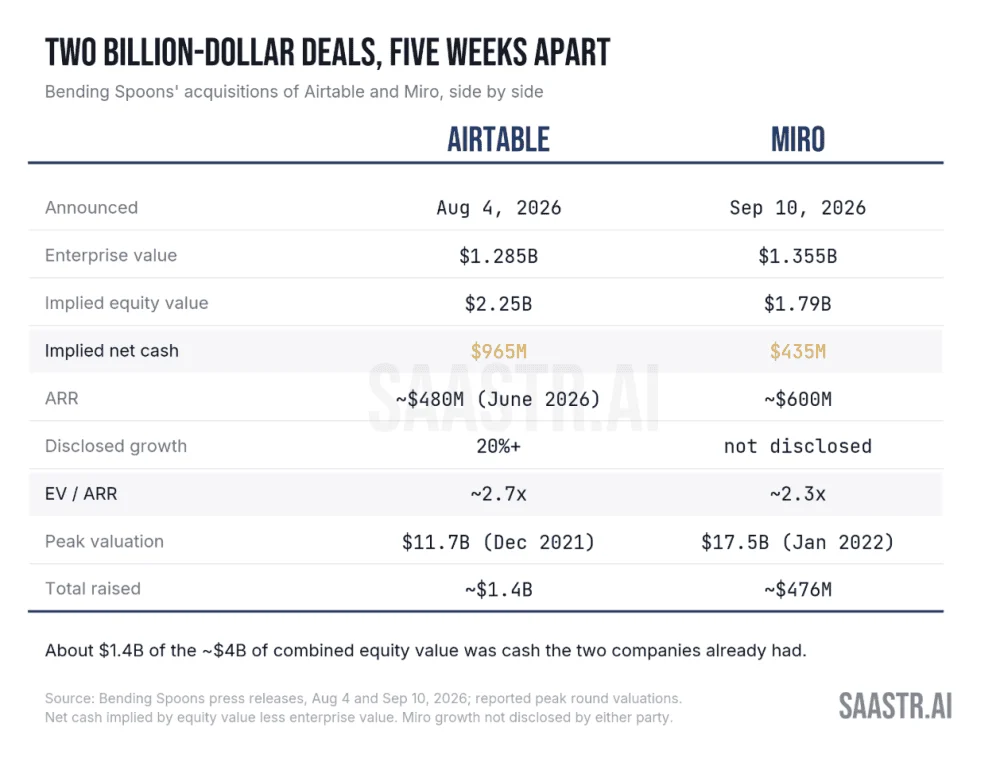
- The Cash Discount: A staggering portion of both purchase prices was funded entirely by the targets’ own accumulated reserves. Out of Airtable’s roughly $2.25 billion equity value, $965 million was its own cash (43% of the deal). For Miro, $435 million of its $1.79 billion equity value sat in its bank accounts (24% of the deal).
- Valuation Multiples: Both deals cleared at depressed valuation multiples relative to historical SaaS peaks. Airtable traded at approximately 2.7x Annual Recurring Revenue (ARR) with 20% year-over-year growth, while Miro cleared at roughly 2.3x ARR against an estimated $600 million ARR base.
- Structural Concessions: Unlike the all-cash Airtable buyout, the Miro agreement includes a notable equity rollover: roughly $295 million of Miro’s transaction proceeds will be reinvested directly into newly issued Bending Spoons equity, forcing major stakeholders to absorb the buyer’s paper.
Chronology of a Mega-Rollup
The rapid succession of these two acquisitions marks a watershed moment in European and American tech M&A, illustrating how macroeconomic pressures and the rise of AI-native disruptors have flattened valuation curves for legacy SaaS titans.
- Pre-2022 (The Golden Era): Miro scales aggressively, reaching profitability as early as 2020 before capitalizing on pandemic-era tailwinds to raise a massive $400 million Series C round at a peak valuation of $17.5 billion in January 2022. Simultaneously, Airtable raises close to $1.4 billion in total venture funding, building a massive enterprise footprint.
- 2023–2024 (The Correction): As market dynamics shift, both companies are forced to streamline operations. Miro implements workforce reductions in February 2023 and October 2024. Airtable similarly undergoes painful structural retrenchments, executing two rounds of layoffs totaling 491 employees.
- June 2025 (The Refounding): Airtable CEO Howie Liu publicly declares a "refounding" of the company, embarking on a high-stakes, wartime AI rebuild. This includes launching conversational front-doors like Omni, execution layers like Field Agents, acquiring AI startup DeepSky in October 2025, and deploying standalone agent products in early 2026.
- July 2026: Bending Spoons pulls off a massive $1.68 billion IPO, establishing itself as an aggressive, cash-generative global rollup machine with immense balance-sheet firepower.
- August 2026: Bending Spoons announces the definitive agreement to acquire Airtable at a $1.285 billion enterprise value ($2.25 billion equity value). The deal closes rapidly within weeks.
- September 2026: Bending Spoons strikes again, announcing a definitive agreement to acquire Miro at a $1.355 billion enterprise value ($1.79 billion equity value), with the transaction expected to close formally in Q4 2026.
Supporting Data & Financial Breakdown
To truly understand the Bending Spoons playbook, one must analyze the anatomy of these valuations. In traditional high-growth SaaS environments, companies growing at 50% to 60% year-over-year routinely command revenue multiples of 8x to 10x. However, companies trapped in the "mature growth" band face a brutal market reality.
1. The Balance Sheet Paradox
Buyers acquire companies based on Enterprise Value (EV) and return the target’s net cash dollar-for-dollar.
- Airtable: Equity Value = ~$2.25B | Enterprise Value = $1.285B | Cash Returned = $965M (43% of price).
- Miro: Equity Value = ~$1.79B | Enterprise Value = $1.355B | Cash Returned = $435M (24% of price).
Accumulated cash reserves earn a 1.0x multiple on the cap table. They do not compound, nor do they capture high-growth repricing. Having nearly a billion dollars sitting idle did nothing to inflate Airtable’s multiple; it merely served as an internal discount for the acquirer.

2. Growth Rates Dictate Terms
Bending Spoons disclosed that Airtable’s ARR was growing at over 20% year-over-year to approximately $480 million as of June 2026. Miro’s announcement highlighted robust underlying metrics—nearly $600 million in ARR (with 90% derived from business and enterprise clients), nearly 4 million paying users, and over 750 enterprise customers generating upwards of $100K in ARR—yet conspicuously omitted a year-over-year growth rate. Third-party estimates, such as those from Sacra, suggest Miro’s recent trajectory has settled into high-single-digit annual expansion.
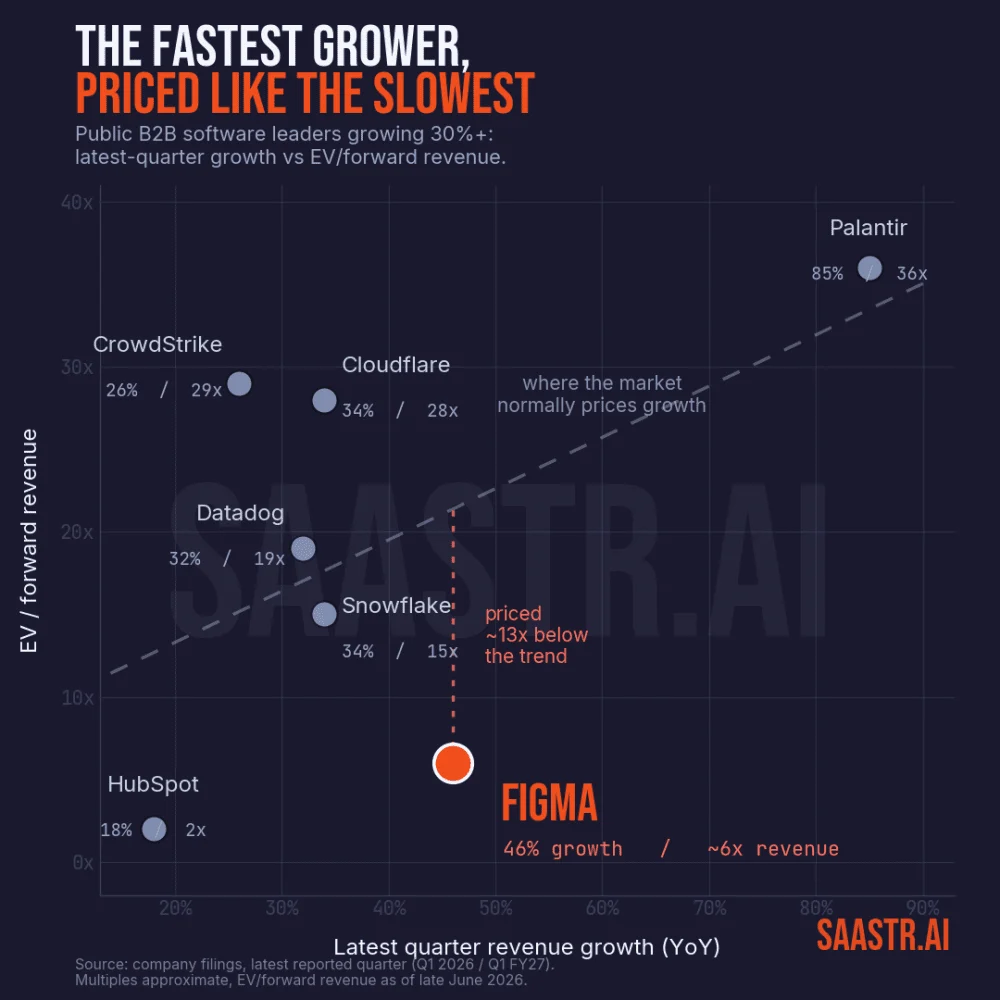
Despite their different profiles, both companies cleared within 40 basis points of one another on an ARR multiple basis (Airtable at 2.7x, Miro at 2.3x), aligning closely with public comps for moderate-growth enterprise software.
Official Responses and Strategic Perspectives
Leadership from both sides has framed these transactions as rational moves in a maturing tech landscape, though their broader philosophies on capital efficiency differ sharply.
- The Airtable Perspective: CEO Howie Liu’s aggressive pivot toward AI—highlighted by the integration of ChatGPT infrastructure alumni and the deployment of autonomous agents—proved that engineering excellence and product reinvention could successfully stabilize a company. However, Liu’s wartime leadership and meticulous cost discipline ultimately bought operational runway rather than a hyper-growth valuation re-rating.
- The Bending Spoons Playbook: Led by executives like CEO Luca Ferrari and corporate leadership, Bending Spoons has perfected a distinct operational model. Ferrari has publicly noted that roughly 90% of Bending Spoons’ code is now generated or assisted by AI, allowing the company to aggressively streamline operations post-acquisition. Furthermore, Bending Spoons has systematically integrated massive portfolios—absorbing legacy assets from AOL, Eventbrite, and Vimeo—while keeping overhead ruthlessly lean through heavy reliance on automated systems and restructured headcounts.
Broader Implications for the B2B SaaS Ecosystem
The absorption of Airtable and Miro by a single European rollup carries profound lessons for founders, venture capitalists, and enterprise operators navigating the post-zero-interest-rate policy era.
1. Default Alive is a Way Station, Not a Destination
Reaching cash-flow positive status is widely heralded as the ultimate protective shield for modern tech startups. While a fortress balance sheet successfully shielded Airtable and Miro from hostile market liquidations and allowed them to dictate their own exit timelines, it did not create strategic bidders. When a company settles into a 20% growth band, its buyer pool shrinks from aggressive strategic giants (like Microsoft, Salesforce, or Atlassian) to operational rollups focused entirely on cash-flow optimization.
2. The Illusion of Strategic Bidding
Neither Airtable nor Miro sparked a competitive bidding war among big tech incumbents. In today’s regulatory and market environment, well-capitalized, slow-growing B2B cash generators are treated as financial assets rather than strategic holy grails. Having a billion dollars in the bank allows a company to reject a bad offer, but it cannot force a market that lacks structural demand for legacy SaaS growth profiles to overpay.
3. The Human Cost of Rollup Consolidation
While founders and early equity holders will undoubtedly walk away with substantial payouts—especially for vested team members holding options granted before early valuation peaks—the rank-and-file workforce faces a harsher reality. SEC disclosures from Bending Spoons reveal heavy post-merger reorganization expenses following past acquisitions, with massive workforce reductions typically following within twelve months of closing. For all employees, the mathematical reality of modern rollups remains unchanged: the acquirer optimizes for earnings and efficiency, meaning the vast majority of product and engineering roles rarely survive the transition intact.
4. The Imperative of "Grow or Die"
Ultimately, these twin acquisitions serve as a cautionary tale for the next generation of software startups. Hoarding capital in low-yielding bank accounts instead of aggressively deploying it to accelerate top-line growth is a trap. If cash cannot be weaponized to leapfrog into high-velocity AI-native growth tiers exceeding 50%–100% year-over-year, it will eventually be harvested by financial buyers at historical baseline multiples. In the modern market, cash buys you time—but only growth buys you a future.