Main Facts
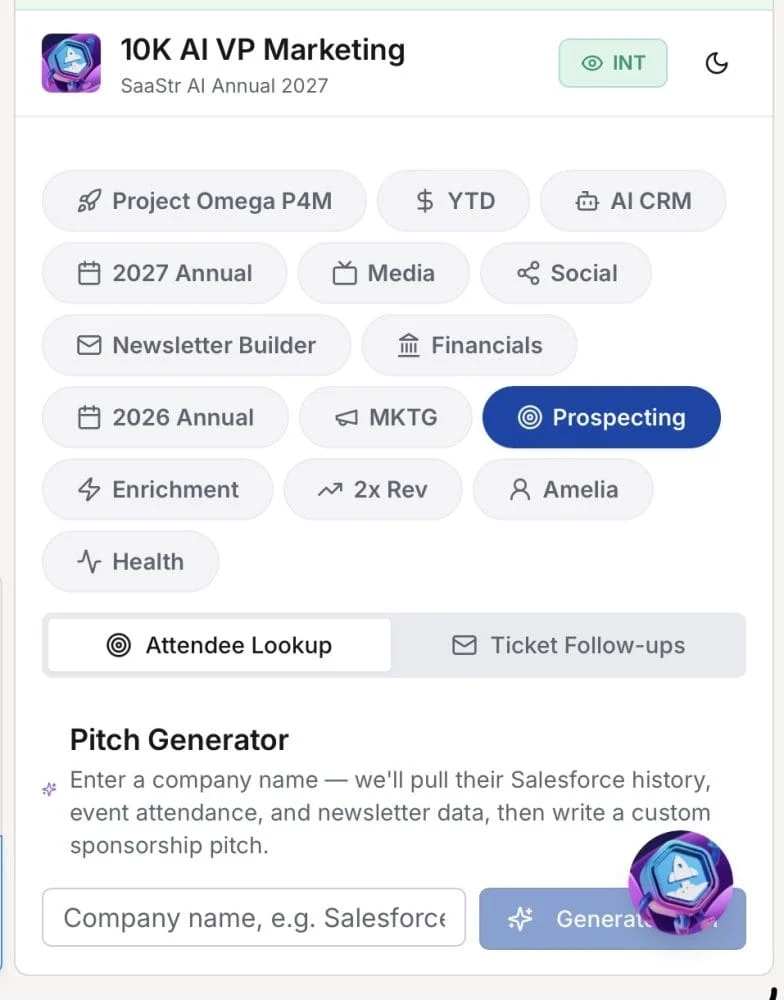
In the rapidly evolving landscape of B2B sales and marketing, artificial intelligence has ceased to be a mere experiment and has become the core operational engine for growth-focused organizations. At SaaStr AI, AI agents and automated tools are not just supplementary; they are driving massive outbound, inbound, and retention pipelines. However, a revealing strategic shift has emerged: while third-party vendors successfully manage roughly 90% of SaaStr AI’s broad-scale outbound volume, the company has chosen to custom-build its own hyper-personalized prospecting and renewal tools for high-value named accounts.
This hybrid model leverages the robust infrastructure of established AI platforms—such as Monaco for cold outbound, Artisan for warm outbound, Agentforce for win-back campaigns achieving 72% open rates, and Qualified for inbound agents that have closed over $2 million in the past year—while simultaneously filling a critical gap in first-party data utilization through an internally developed AI agent named 10K.
The core thesis driving SaaStr AI’s strategy is simple yet profound: commercial-grade vendors are unmatched when it comes to the complex engineering required for large-scale deliverability, domain protection, sequencing, and list hygiene. Building that infrastructure from scratch for a 450,000-contact database would be inefficient. However, off-the-shelf vendors inherently suffer from a narrow field of vision, typically relying on a fraction of a company’s CRM data. To achieve true hyper-personalization—integrating disparate data silos like event attendance, newsletter engagement, historical podcast archives, and un-synced CRM notes—enterprises must supplement commercial tools with bespoke, in-house AI logic.
Chronology
The Evolution Toward AI-First Operations
The integration of AI tools at SaaStr AI did not happen overnight; it was a methodical evolution driven by the need for efficiency and scale.
- Phase 1: Vendor Adoption for Scale. Recognizing that manual outbound was hitting a ceiling, the team deployed specialized AI vendors to handle distinct pipeline phases. Monaco took charge of cold outreach, Artisan managed warm introductions, Salesforce Agentforce was deployed to rescue stalled deals with win-back campaigns, and Qualified secured inbound traffic.
- Phase 2: The Data Silo Bottleneck. As these tools matured, leadership noticed a recurring limitation. While standard AI SDRs successfully connected to Salesforce to read basic contact and account histories, they remained blind to the vast ocean of proprietary data residing outside the CRM—such as WordPress interactions, social signals, specific webinar viewing history, and direct event participation metrics. Furthermore, anticipated API metering costs from major CRM providers made deep, repetitive queries by third-party vendors increasingly expensive.
- Phase 3: Building the In-House Renewal Agent. The breakthrough for proprietary tooling originated in retention. Built on top of the internal 10K system in roughly half a day, a custom renewal agent was deployed to automate and elevate contract renewals. Instead of limiting high-tier custom decks to a handful of massive enterprise sponsors, the agent scaled hyper-personalized pitch creation across dozens of accounts, drastically outperforming historical renewal benchmarks.
- Phase 4: Expanding to New-Logo Prospecting. Buoyed by the success of the renewal agent, SaaStr AI expanded the underlying philosophy into new-logo outbound. Today, the internal tool acts as an "AI ABM" (Account-Based Marketing) engine, running deep, multi-source research on a highly targeted set of named accounts while leaving the high-volume heavy lifting to the external vendor ecosystem.
Supporting Data
The operational metrics reported by SaaStr AI underline the immense efficacy of combining commercial AI infrastructure with bespoke, data-rich internal workflows:
- 90 / 10 Split: Approximately 90% of SaaStr AI’s overall outbound volume continues to run through established external vendor tools, proving that commercial solutions remain foundational for top-of-funnel scale.
- 72% Open Rates: Agentforce-driven win-back campaigns have achieved extraordinary engagement, demonstrating the power of timely, automated re-engagement logic.
- $2M+ Inbound Revenue: The Qualified inbound agent successfully closed over $2 million in new business over the past year.
- Massive API Usage: The internal 10K agent alone initiates approximately 35,000 Salesforce API calls per day, highlighting the sheer volume of data processing required for deep account intelligence.
- Exponential Deck Generation: Before deploying the renewal agent, the team produced true custom review decks for only about five "diamond" sponsors, leaving all other accounts with generic templates. With the agent operational, output scaled to 20 or 30 fully customized decks, resulting in significantly higher response rates from smaller silver sponsors who historically exhibited lower retention rates.
- Expanded Database Management: The infrastructure successfully orchestrates outreach and tracking across a massive database comprising 450,000 contacts.
Official Responses and Strategic Insights
Leadership at SaaStr AI has been vocal about the practical realities of deploying artificial intelligence in modern go-to-market strategies, emphasizing that buying everything off-the-shelf is no longer a viable competitive advantage for sophisticated buyers.
"We couldn’t get that from third-party services," notes Jason Lemkin, highlighting the necessity of deep data integration. SaaStr needed hyper-personalized outreach—delivering both the perfect email and the tailored pitch deck—that standard commercial AI tools simply could not piece together from fragmented data sources. "So they built it themselves. It just can’t, today, it can’t be bought."
This sentiment captures the core operational philosophy: commercial AI vendors provide exceptional utility for generalized sales execution, but true differentiation requires synthesizing proprietary enterprise data that third-party systems cannot access due to security, API limits, or architectural boundaries.
To manage the risks associated with fully autonomous generation, SaaStr AI established strict operational rules derived from their early renewal agent experiments:
- Human-in-the-Loop Narrative Approval: AI agents propose a strategic narrative, but a human operator must review and approve it before execution. For instance, when an agent incorrectly proposed a standard upgrade path for a company that had rapidly evolved out of stealth, a human operator quickly intervened to pivot the pitch toward a multi-tiered media-plus-content strategy.
- Asymmetrical Outreach Depth: The initial outreach touchpoint remains concise and lightweight, designed primarily to elicit a conversational reply rather than dump excessive data. Once a prospect responds, the deeper, fully customized asset—such as a bespoke pitch deck or data-rich proposal—is delivered in the follow-up phase.
Implications
The strategy pioneered by SaaStr AI signals a broader, highly anticipated shift in how B2B enterprises will leverage artificial intelligence over the coming decade. As the market becomes saturated with generalized, off-the-shelf AI sales tools, the competitive advantage of generic cold outreach is rapidly diminishing. When every prospective buyer is inundated with AI-generated emails that reference surface-level CRM data—such as recent funding rounds or generic company descriptions—prospects quickly learn to tune them out.
1. The Death of Superficial Personalization
Standard AI outbound tools are increasingly table stakes. Because third-party vendors are constrained to the subset of data exposed via standard CRM integrations, their outreach tends to converge on similar patterns. True differentiation now requires leveraging proprietary, first-party data silos that competitors and external vendors cannot easily scrape or integrate. Companies that successfully bridge their internal event data, product usage metrics, and historical customer interactions into their AI workflows will achieve conversion rates that generic vendor tools can never touch.
2. The Rise of the Hybrid GTM Architecture
The paradigm of "buy versus build" is being replaced by an integrated hybrid model. Organizations will no longer need to choose between enterprise SaaS vendors and custom internal engineering. Instead, the winning playbook will involve:
- Renting infrastructure for operational scale, deliverability protection, domain safety, and high-volume sequencing.
- Building custom orchestration layers that sit on top of proprietary data stores to drive hyper-targeted Account-Based Marketing (ABM) for high-value named accounts.
3. Economic Pressures on CRM Integrations
As platforms like Salesforce move toward metered API pricing structures (such as Flex Credits), the cost for third-party vendors to perform deep, continuous reads on enterprise data will rise. This economic friction will further incentivize sophisticated sales organizations to build proprietary caching and summarization agents internally—like SaaStr AI’s 10K system—minimizing expensive external API calls while maximizing local intelligence.
Ultimately, SaaStr AI’s blueprint demonstrates that artificial intelligence is most potent when it acts as an amplifier of unique institutional knowledge rather than a replacement for strategic human oversight. By pairing vendor-driven scale with bespoke, data-rich account intelligence, modern sales teams can achieve unprecedented levels of relevance, efficiency, and revenue growth.