In the rapidly evolving landscape of digital commerce, the concept of "intent" has long served as the cornerstone of marketing strategy. For decades, marketers have meticulously mapped out consumer journeys based on "purchase intent" or "informational intent," targeting prospects based on the apparent needs they expressed through keywords. However, the rise of generative AI (genAI) in search and shopping is fundamentally altering this dynamic. We are witnessing a shift from simple keyword-based matching to a nuanced, context-driven discovery process that rewards brands capable of speaking the language of AI.
The Evolution of Search: From Keywords to Conversations
To understand the shift, one must compare the traditional search experience with the modern AI-assisted shopping journey. When a consumer searches for a "coffee grinder" on a legacy search engine, the query is often terse—typically averaging around four words. The search engine responds with a list of links, forcing the user to do the heavy lifting of evaluation and comparison.
In contrast, interactions with LLM-powered interfaces like Claude, Gemini, or ChatGPT are markedly different. According to 2026 data from Semrush, queries directed at AI chatbots are significantly more complex, often spanning upwards of 23 words. The difference is not just in length; it is in the depth of context.
Consider an apartment dweller seeking a specific appliance. A traditional search query might be: "small simple coffee grinder." An AI-driven query, however, is far more granular: "a quiet coffee grinder for a small apartment that works for pour-over and does not make a mess." While both queries point to a conical burr grinder as the ideal solution, the second query provides a wealth of metadata that the AI can use to filter, rank, and recommend products with surgical precision. This is the new frontier of ecommerce: the ability to satisfy the high-context demands of AI-driven consumer discovery.
The Anatomy of the Product Intent Cluster
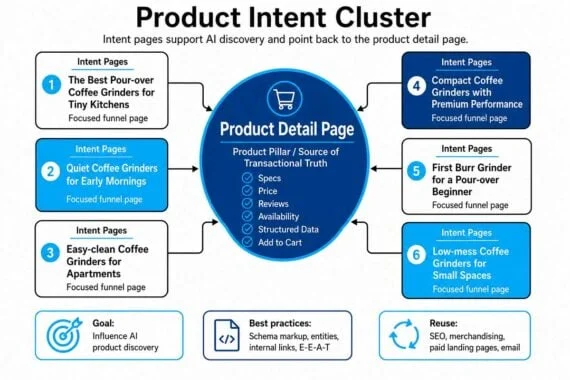
As AI models process these long-form, descriptive inputs, they actively seek out authoritative sources that map product performance to specific consumer scenarios. This has given rise to a new architectural framework in ecommerce: the "Product Intent Cluster."
A Hub-and-Spoke Strategy
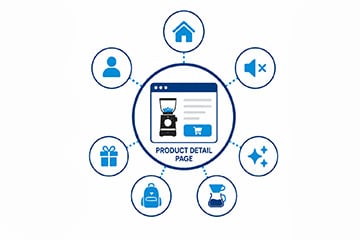
Product intent clusters mirror the familiar "topic cluster" model long used in SEO, but with a sharper focus on granular use cases. At the center of the cluster sits the Product Detail Page (PDP), acting as the "source of truth." This page contains the non-negotiable data points: pricing, specifications, shipping availability, user reviews, and technical structured data.
Radiating outward from this central hub are multiple "intent pages"—specialized content pieces that tackle specific customer scenarios. Rather than competing for broad, high-volume keywords, these pages target long-tail, hyper-specific problems.
Why Intent Pages Matter
- Contextual Alignment: They provide the AI with the data it needs to solve a specific, complex problem for the user.
- Entity Recognition: By utilizing proper Schema.org markup, these pages help AI bots understand the relationship between the product and its specific use cases.
- Conversion Priming: These pages are not just informational; they are designed to lead the user toward a purchase by demonstrating that the product is the perfect solution for their unique situation.
The Chronology of Shift: From Manual Labor to AI Automation
Historically, the strategy of creating dozens of hyper-focused intent pages was prohibitive. A marketing team would have needed to conduct extensive research, draft the content, optimize it, and maintain it for pages targeting narrow queries like "best pour-over coffee grinders for tiny kitchens." The labor costs were simply too high, and the potential ROI was deemed too speculative.
The Timeline of Transformation:
- The SEO Era (2010–2020): Marketers focused on high-volume, head-term keywords. Content was often generic to capture the largest possible audience.
- The Emergence of AI (2023–2025): Early experimentation with LLMs began. Marketers realized that AI could interpret natural language, but they lacked the content depth to feed the models.
- The Generative AI Breakthrough (2026–Present): The integration of automated content generation and intent-mapping tools has reduced the cost of creating highly targeted content to near zero.
Today, automation and genAI allow teams to produce and maintain an endless stream of quality intent pages. By feeding raw data—such as customer support tickets, product reviews, and returns data—into a genAI platform, companies can identify the exact "pain points" their customers are facing and generate content that addresses those specific issues in real-time.
Implications for Modern Ecommerce Teams
The shift toward AI-centric discovery requires a fundamental change in how marketing teams operate. The goal is no longer just to rank on the first page of Google; it is to be the authoritative entity that an AI model selects when a user asks a complex question.
Best Practices for Implementation
- Leverage Structured Data: Use Schema markup to ensure that AI can easily parse product features, pricing, and availability. Without this, even the best content remains "invisible" to the underlying LLM models.
- Focus on E-E-A-T: Experience, Expertise, Authoritativeness, and Trustworthiness remain critical. AI models are increasingly trained to favor content that displays deep product knowledge and real-world usage data.
- Maintain the PDP Integrity: Do not dilute the Product Detail Page. Keep it focused on the sale, while using the surrounding "spoke" pages to handle the heavy lifting of education and scenario-matching.
- Utilize Internal Linking: Ensure that all intent pages flow logically back to the central product page, creating a cohesive map for crawlers and AI agents.
Official Industry Perspectives
Marketing experts and search analysts have observed that the "Product Intent Cluster" is rapidly becoming a standard for competitive ecommerce brands. According to recent white papers on the intersection of Search Generative Experience (SGE) and ecommerce, the brands that win in the coming years will be those that view their website as a "knowledge base" rather than a simple digital storefront.
One industry analyst noted: "The AI doesn’t care about your keyword density. It cares about whether your content provides a definitive answer to the user’s specific problem. If you can explain why your product solves a tiny kitchen owner’s noise-level concern, the AI will reward you with a referral."
Future-Proofing Your Brand
The implications for retailers are clear: the shopper who does not know exactly what they want is the greatest opportunity for growth. When a customer enters a prompt into an AI assistant, they are expressing an intent to solve a problem, not just an intent to browse a catalog.
By building product intent clusters, marketers can ensure that their products are the inevitable answer to those queries. This involves:
- Auditing current search data: Look for the long-tail questions in your search logs.
- Developing an automated content pipeline: Use genAI to create high-quality, specific landing pages for each discovered "scenario."
- Continuous refinement: Monitor which scenarios lead to the highest conversion rates and double down on those clusters.
In conclusion, we have moved past the era of "keyword stuffing" and entered the era of "contextual authority." The winners in this new environment will be the brands that provide the most comprehensive, helpful, and technically structured answers to the nuanced questions posed by consumers. By investing in intent-driven content today, ecommerce businesses can ensure they remain relevant in the AI-powered discovery landscape of tomorrow.