The digital marketing landscape is currently undergoing its most significant shift since the advent of the search engine. As generative AI becomes the primary interface through which users interact with the web, the traditional metrics of "organic search" are failing to capture the full scope of how content is discovered, cited, and consumed. For search engine optimizers (SEOs) and digital publishers, the move toward AI-driven answers has created a "black box" effect, where visibility in an AI response remains largely unmeasurable through standard tools.
However, a pivotal shift is occurring. While industry giants like Google remain somewhat opaque, combining AI Overviews (AIO) with traditional search data in Google Search Console, Microsoft’s Bing has taken a definitive step toward transparency. By refining its "AI Performance Report" within Bing Webmaster Tools, Microsoft is setting a new standard for how platforms should communicate with content creators in the age of generative AI.
The Visibility Crisis: Why AI Changed the Rules
For two decades, the "blue link" was the gold standard of web traffic. SEO strategies were built around ranking for specific keywords to drive click-through rates. Today, the rise of Large Language Models (LLMs) and conversational search has fundamentally altered this journey. Users are increasingly receiving synthesized answers—paragraphs of text generated by AI—that negate the need to click through to a website at all.
This shift has left marketers in a state of measurement paralysis. In Google’s ecosystem, the "Performance" section of Search Console aggregates traditional organic listings and AI Overviews, making it nearly impossible for site owners to isolate the impact of generative AI on their traffic. Similarly, ChatGPT restricts detailed performance metrics to only those publishers who have formal, licensed content partnerships with OpenAI. This leaves the vast majority of the web in the dark regarding their AI footprint.
Chronology of a Search Revolution
The path to the current state of AI reporting has been rapid, marked by a constant tug-of-war between technological deployment and publisher demand for transparency:

- Early 2023: The "AI Race" intensifies. Microsoft integrates GPT-4 into Bing, while Google begins testing Search Generative Experience (SGE).
- Late 2023/Early 2024: Publishers express growing alarm over "zero-click" searches. The industry begins calling for "AEO" (Answer Engine Optimization) to replace traditional SEO.
- Mid-2024: Bing publishes its landmark "Guide to AEO and GEO (Generative Engine Optimization)," acknowledging that creators need guidance on how to structure content for machine consumption.
- Late 2024: Bing launches the initial iteration of the AI Performance Report in Webmaster Tools, providing the first peek into how sites are being cited in AI responses.
- Mid-2025 (Current): Bing significantly upgrades this report, expanding metrics and adding granular sorting capabilities, officially turning a experimental feature into an essential tool for digital strategy.
Anatomy of the Upgraded AI Performance Report
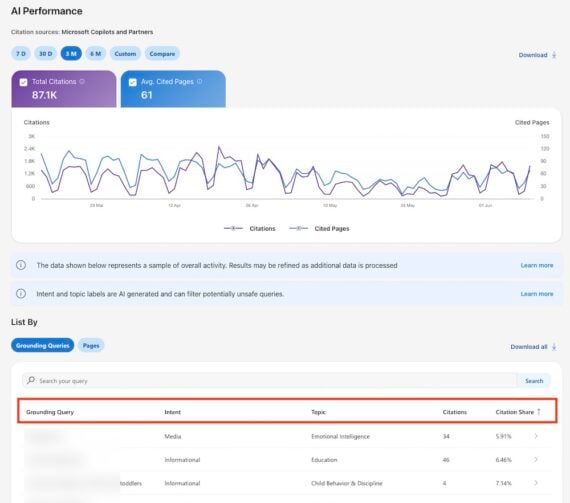
The latest iteration of the Bing AI Performance Report is designed to provide actionable intelligence rather than just vanity metrics. The report tracks citations across three distinct pillars: Microsoft Copilot, Bing’s AI-generated summaries, and a curated list of select AI partner integrations.
Key Data Dimensions
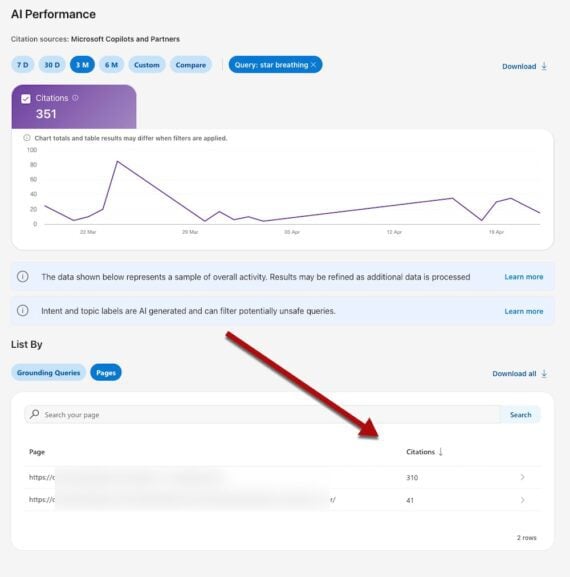
The report is bifurcated into two primary sections: Grounding Queries and Pages.
The "Grounding Queries" section is the heart of the report. It allows publishers to see exactly what users are asking that triggers a response containing their content. Crucially, the report now includes sophisticated sorting features, allowing users to rank data by:
- Intent: Identifying whether the user was seeking information, navigation, or transactional support.
- Topic: Grouping queries by subject matter to see which content verticals are performing best in AI environments.
- Citations: Tracking the raw volume of mentions.
- Citation Share: A competitive metric indicating how often a specific site is cited compared to the total number of AI responses for a given query.
The "Pages" section offers a complementary view. By clicking on a specific URL, a publisher can see the inverse of the data: which queries resulted in that specific page being cited as a source. While the tool does not yet provide direct "click" or "view" counts for every citation—a limitation due to the nature of AI-generated summaries—it provides the frequency of appearance, which serves as a powerful proxy for brand authority and visibility in the AI era.
Implications for Content Strategy
The availability of this data fundamentally changes how SEOs approach content creation. In the past, keyword stuffing or broad content targeting was the norm. In the era of AI, "Grounding" is the new keyword.
1. From Keywords to Concepts
Because AI models "ground" their answers in factual data, content creators must shift toward producing high-authority, verifiable information. The Bing report allows publishers to see if their content is being used as a source for factual claims. If a site is being cited, it has successfully established "topical authority." If not, the publisher can analyze the "Grounding Queries" to see where they are missing the mark.
2. The Rise of "Answerable" Content
The data suggests that AI models prefer structured, clear, and concise content. By analyzing which URLs perform well in the Bing AI report, publishers can perform "reverse engineering" on their most successful pages. Do they feature bulleted lists? Are they structured with clear H2/H3 headers? Do they provide direct answers to "who, what, when, where" questions early in the document? The report acts as a feedback loop for these design choices.
3. Measuring Authority and Brand Awareness
Even without a direct click, a citation is a signal of trust. Being cited by Microsoft Copilot as a source for a complex query acts as a form of "digital validation." The AI Performance Report allows companies to track their brand’s footprint in the AI landscape, providing a new metric for PR and marketing teams to report on visibility beyond traditional search rankings.
Official Responses and Industry Outlook
While Microsoft has taken the lead, the silence from other major players remains a point of contention. Industry analysts suggest that Google’s reluctance to provide similar granular data stems from the complexity of their infrastructure and the fear that detailed metrics might be used to "game" the AI, leading to lower-quality results.
However, the pressure is mounting. The Bing report has set a precedent: it is now technically possible to report on AI visibility. As more publishers migrate to Bing Webmaster Tools to gain this competitive advantage, Google may find itself under increased pressure to provide parity in its own reporting.
Getting Started: Integrating the Report
For organizations looking to gain this visibility, the barrier to entry is remarkably low. Bing Webmaster Tools is designed to be highly interoperable with existing workflows.
- Authentication: Log in to the Bing Webmaster Tools portal using a Microsoft account.
- Import: The platform allows users to "Import sites from Google Search Console," which drastically reduces setup time by automatically verifying ownership through GSC credentials.
- Observation: Once imported, the AI Performance Report begins to populate. Note that the data collection is not real-time; users should allow a 24-hour window for the system to index and process the site’s performance within the Bing AI ecosystem.
Conclusion: A New Chapter for SEO
The transformation of the search industry is not a death knell for SEO; rather, it is an evolution into a more complex, nuanced, and data-rich discipline. The AI Performance Report from Bing is not just a tool; it is a signal that the era of "hidden" AI influence is coming to an end.
As we move forward, success in digital marketing will be defined by those who can bridge the gap between human intent and machine synthesis. By leveraging the metrics provided by platforms like Bing, content creators can finally step out of the shadows of the "black box" and begin to optimize for the future of information discovery. The ability to monitor, analyze, and pivot based on AI citation data will separate the leaders of the new search landscape from those still chasing the blue links of yesterday.