Main Facts: The State of Startup Financial Planning
Financial planning season arrives every year with a familiar sense of dread for B2B software-as-a-service (SaaS) founders. Yet, despite repeated warnings from venture capitalists and operators, the numbers remain startlingly grim. Industry data indicates that more than 80% of early-to-growth-stage startups approach their annual financial planning incorrectly. Even more alarming, roughly 50% of companies enter a new fiscal year—or even a new quarter—without a formalized, data-driven financial plan.
While the broader B2B startup ecosystem has incrementally improved its financial discipline over the past several years, foundational flaws persist. Founders routinely fall into three major traps: operating entirely without a genuine plan, crafting woefully optimistic revenue projections divorced from reality, and failing to tie their burn rate directly to their actual growth trajectory.
In a tightening venture capital environment where cash preservation is paramount, these miscalculations are no longer just embarrassing; they are existential. To combat this, industry leaders are advocating for a shift away from single, static budgets toward a dynamic, multi-scenario framework known as the C10, C60, and C90 planning methodology. This structured approach forces founders to anchor their operations in data, map out distinct risk tolerances, and calculate their "Zero Cash Date" before the ink dries on next year’s budget.
Chronology: The Evolution of Modern SaaS Budgeting
The Era of "Growth at All Costs" (Pre-2022)
Historically, financial planning for tech startups was a loose exercise in extrapolation. During the peak zero-interest-rate policy (ZIRP) era, venture capital flowed freely. Startups could afford to build aggressive, top-line-driven budgets that ignored efficiency. If a company missed its revenue targets by 30%, a bridge round or a quick Series B extension usually solved the problem. Burn rates were treated as a secondary metric, subservient entirely to raw logo acquisition and gross margin expansion.
The Correction and the Rise of Efficiency (2022–2024)
As macroeconomic conditions shifted and interest rates rose, the capital markets underwent a severe correction. Venture capital dry powder contracted significantly, and investors shifted their evaluations from top-line growth to capital efficiency, net burn, and path-to-profitability metrics. Suddenly, startups that had never modeled a downside scenario found themselves caught in cash crunches. Founders realized that relying on a single, optimistic forecast left them blind to sudden market contractions or sales cycle elongations.
The Modern Multi-Scenario Reality (Present Day)
Today, navigating a SaaS business requires agility and ruthless realism. The modern playbook rejects the traditional, single-track annual budget in favor of probability-based forecasting. Influenced by operational frameworks championed by veteran founders and investors like SaaStr’s Jason Lemkin—as well as parallel agile planning methods utilized by high-velocity operators like Elon Musk—startups are increasingly adopting the C-scale model. This framework categorizes plans by the statistical confidence (C) that a team can actually hit them, transforming financial planning from an administrative chore into a strategic survival tool.
Supporting Data and The "L4M" Model Mechanics
To build an effective plan without spending weeks locked in spreadsheets, modern SaaS leaders recommend utilizing the L4M (Last 4 Months) model—sometimes referred to as a T4M model.
What is the L4M Model?
The L4M model is deceptively simple: it takes the average growth rates of your revenue, operational costs, and net burn over the trailing three to four months and rolls those exact growth rates forward month-by-month through the end of the upcoming year.
For example, if a SaaS company’s revenue has grown by an average of 5% month-over-month for the past four months, and its overall burn rate has ticked up by 3% monthly across various cost centers, those percentages form the baseline.

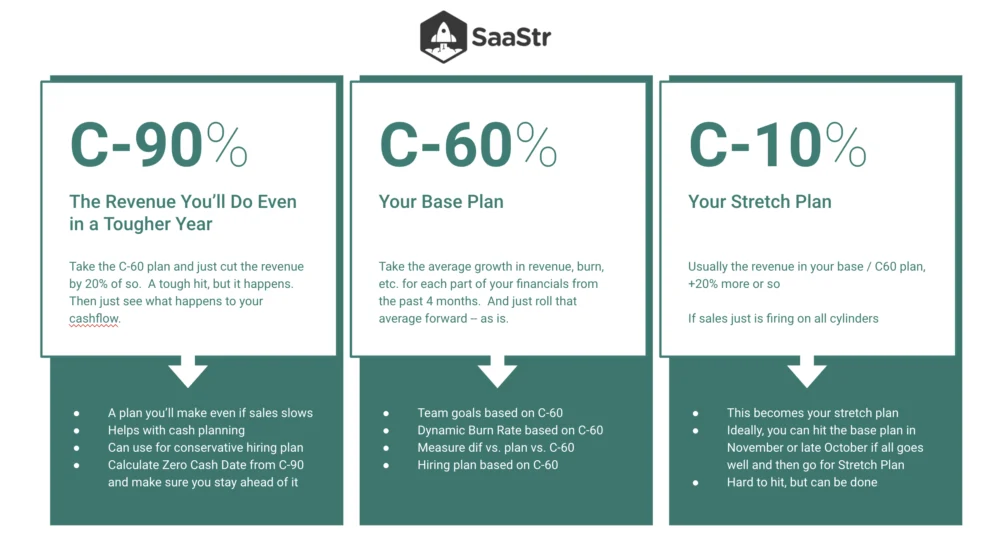
This baseline becomes the C-60 Plan—the scenario where you have a roughly 60% confidence level of hitting your targets. It represents the most objective, statistically probable path forward based on recent historical execution. It takes roughly 10 to 30 minutes to build and serves as an honest mirror of current business momentum.
The Danger of Ignoring the Baseline
Many founders discard their C-60 plans because the results are unpalatable. If the L4M model reveals that the company will run out of cash in nine months at current growth rates, leadership often panics, buries the data, or pressures finance teams to cook up an artificially inflated spreadsheet.
This is a critical mistake. Small, unaddressed deviations in burn rates compound exponentially over a 12-month period. A monthly overspend of just 5% can cascade into a catastrophic cash drain by Q3, severely eroding runway and forcing emergency down-rounds or painful layoffs.
Official Responses and Strategic Frameworks: The Three-Plan Architecture
To run a resilient SaaS business, leadership teams must abandon single-track forecasting and implement a triad of plans. Each plan serves a specific psychological and operational purpose within the organization.
1. The C-60 Plan (The Base Case)
- Definition: The objective reality of your business. Built using trailing 4-month (L4M) averages, this is the plan you know you can hit, but will have to work to achieve.
- Purpose: It establishes your realistic baseline burn rate, expected headcount growth, and dependable revenue projections. As business leaders note, aiming for a 50th to 60th percentile achievable deadline—similar to how engineering-driven organizations scale development velocity—prevents team burnout while maintaining steady momentum.
- Action Item: Do not let your VP of Finance or Operations bury this plan just because it looks unexciting. It is your anchor truth.
2. The C-10 Plan (The Stretch Case)
- Definition: The aggressive, highly optimistic growth scenario. There is roughly a 10% to 20% chance that the company will hit these numbers.
- Purpose: To incentivize the executive team, sales organizations, and go-to-market teams to push beyond their comfort zones.
- Mechanics: Take your finalized C-60 revenue model and aggressively scale the top line upward by 10% to 20%. Crucially, ensure you map out the corresponding variable costs required to support that growth (such as additional sales commissions, marketing spend, and customer success hires). This tells you how far you can stretch without breaking your financial foundation.
3. The C-90 Plan (The Downside Case)
- Definition: The defensive continuity plan. There is a 90% confidence level that you can hit these numbers—meaning you would have to actively try not to hit them.
- Purpose: To prepare the organization for market headwinds, missed sales targets, or delayed funding rounds.
- Mechanics: Take your C-60 cost structure, but discount the revenue growth by roughly 20%. Under this scenario, net burn will typically rise or efficiency will stall. Founders often dislike the C-90 plan because its implications—such as hiring freezes, discretionary spending cuts, or delayed product launches—are painful to contemplate. However, reviewing this plan with the board and finance team is mandatory. If market conditions sour, this is the operational roadmap you will have to execute overnight.
Implications for SaaS Founders and Operators
Implementing a multi-scenario financial planning framework carries profound operational implications for B2B startups navigating the current venture capital landscape.
1. Pinpointing the "Zero Cash Date"
By running the numbers across all three scenarios (C-10, C-60, and C90), founders establish distinct Zero Cash Dates—the exact calendar day the company’s bank account hits zero under each trajectory. Knowing these dates removes ambiguity. If the C-60 plan reveals a cash runway of less than 16 months, management has an early warning system to either optimize expenditures, cut unprofitable channels, or initiate fundraising discussions well before desperation sets in.
2. Leveraging Modern Automation Tools
Recognizing that many founders struggle with manual spreadsheet modeling, industry platforms have begun introducing automated solutions. For instance, modern AI benchmarking tools and ARR growth planners allow startups to upload pitch decks or historical financial summaries containing trailing revenue and burn data. These tools instantly synthesize the data to model out C-10, C-60, and C-90 trajectories, democratizing sophisticated financial planning for early-stage teams that lack dedicated CFOs.
3. Aligning Culture and Accountability
When a team understands the difference between their stretch goals (C-10) and their operational baseline (C-60), organizational clarity follows. Sales teams know what targets trigger accelerators, engineers understand the capital constraints governing infrastructure costs, and founders avoid the trap of magical thinking.
Conclusion
Financial planning is not a predictive crystal ball; it is a risk management framework. By abandoning wishful thinking, embracing the rapid insights of L4M modeling, and enforcing a disciplined C-10/C-60/C-90 architecture, SaaS startups can navigate market volatility with precision, protect their runway, and build enduring, capital-efficient businesses.