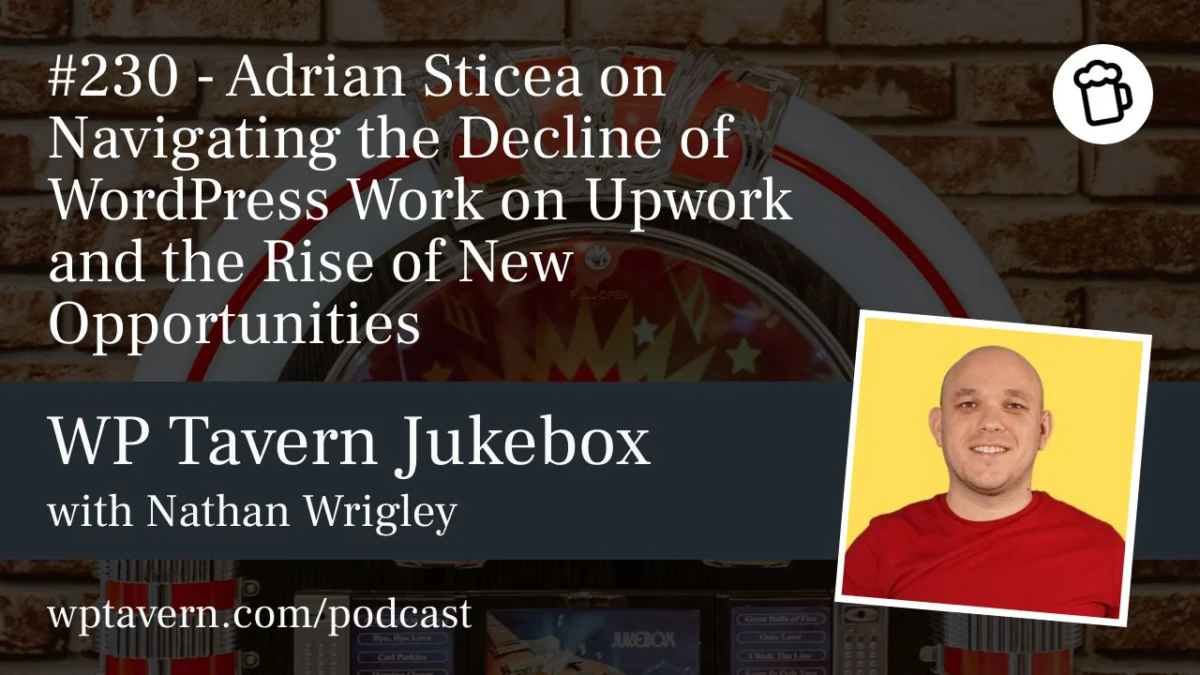
The digital freelance economy is undergoing a seismic shift, and nowhere is this more evident than in the WordPress development sector. For over a decade, major online platforms like Upwork served as a reliable, frictionless engine for independent web professionals seeking project leads. However, a recent viral LinkedIn post by veteran WordPress developer Adrian Sticea has brought a hard truth to light: the era of easy marketplace-driven leads may be coming to a close.
In a recent appearance on the Jukebox Podcast by WP Tavern, hosted by Nathan Wrigley, Sticea unpacked the data behind his dramatic drop-off in Upwork-sourced projects. His experience reflects a broader, industry-wide trend that has left many freelancers questioning the long-term sustainability of relying solely on digital gig platforms.
The Main Facts: A Paradigm Shift in Freelance WordPress Work
The core revelation centers around Sticea’s historical dependency on Upwork. Between 2015 and 2020, Upwork was the primary—and at times exclusive—fountain of project leads for Sticea, fueling a steady stream of enterprise-level development work, plugin creation, and code maintenance.
However, over the last few years, that volume has experienced a catastrophic nosedive. By 2022, his Upwork-derived workload had dropped by 20%. By 2023, it fell to 60%, continued plummeting through subsequent years, and has now effectively hit zero.
Despite this stark contraction on a single platform, Sticea’s overall business health remains robust. The crisis on Upwork did not result in a net loss of income; rather, it forced a strategic pivot away from automated marketplace bidding and back toward traditional, relational networking.
Chronology of an Industry Veteran
To understand the weight of Sticea’s observations, one must look at his trajectory within the WordPress ecosystem:
- 2013–2016: Sticea entered the WordPress space, working for small, local companies handling customer support and basic web development before transitioning into early freelance roles.
- 2016–2018: Relocating to the United States, he joined a digital marketing agency as a dedicated WordPress developer, significantly scaling his technical capabilities.
- 2018–2020: Sticea took on a monumental role at IBM, working on one of their largest WordPress installations—a sprawling learning platform focused on programming and technology.
- 2020–Early 2025: Following his tenure at IBM, he returned to full-time freelancing while also completing a stint as a web engineer in the marketing department at StellarWP. Throughout this period, he predominantly served enterprise clients on complex builds.
- Mid-2025–Present: Facing the complete drying up of enterprise and complex developer leads on Upwork, Sticea successfully pivoted to LinkedIn networking, direct agency partnerships, and temp agency recruitment pipelines.
Supporting Data and Underlying Causes
The graph shared by Sticea on LinkedIn—showing a healthy horizontal line abruptly sloping downward into a flatline at zero—sparked widespread panic and discussion among web professionals. When exploring why this is happening, Sticea and host Nathan Wrigley identified several converging factors:
1. The Rise of Artificial Intelligence (AI)
While AI is often blamed as a singular scapegoat for industry woes, Sticea argues its impact is more nuanced. AI has not necessarily replaced the client; rather, it has made developers significantly more efficient. By enabling engineers to ship code and build features faster, the overall demand for quantity of developer hours has decreased. Furthermore, the commoditization of programming via AI has steered newer tech projects away from legacy stacks like WordPress and toward modern JavaScript-based frameworks.
2. Post-Pandemic Economic Corrections and Tech Layoffs
The tech sector experienced a massive hiring boom during the pandemic to accommodate home-bound digital consumption. Once that demand normalized, massive layoffs rippled through the industry. AI acted as an accelerator in a market where engineering capacity already vastly outstripped client demand.
3. Market Saturation and Platform Competitors
Platforms like Upwork have become heavily saturated. For clients seeking simple brochure websites, alternative ecosystems like Wix, Squarespace, and Framer have siphoned away market share from out-of-the-box WordPress. Meanwhile, complex enterprise projects have increasingly migrated toward pre-vetted talent networks like Toptal, Codeable, or specialized tech temp agencies (such as Robert Half and Teksystems).
Industry Perspectives: Is Upwork Still Viable?
Sticea’s viral post struck a chord because his experience is far from isolated. Discussions in the wake of his post revealed that agency owners and senior developers alike are experiencing similar droughts on gig marketplaces, particularly when attempting to command fair, sustainable rates.
When freelancers attempt to raise their prices to match inflation and increased expertise, they are frequently met with silence on platforms heavily driven by race-to-the-bottom bidding wars.
Moreover, platforms like Upwork inherently create transactional, short-term relationships. As Sticea pointed out, completing a quick project via text-based chat boxes rarely fosters the kind of long-term professional rapport that generates recurring maintenance work or word-of-mouth referrals. For over a decade, Sticea received virtually zero downstream recommendations from clients acquired exclusively through Upwork—a stark contrast to traditional networking.
Implications for the Future of Freelancing
The decline of platform-dependent work serves as a cautionary tale for the broader WordPress and freelance community. While digital marketplaces offer an appealing comfort zone for introverted developers who prefer coding over cold-calling, they act as professional handcuffs.
Moving Away from Single-Source Dependency
The primary takeaway for independent developers is the danger of putting all their eggs in one digital basket. Relying solely on an algorithmic marketplace leaves a business vulnerable to platform policy changes, shifting macroeconomic tides, and sudden drops in lead quality.
Returning to Foundational Business Practices
Sticea’s successful pivot highlights a return to timeless business principles:
- Content and Thought Leadership: Utilizing platforms like LinkedIn to share insights, engage in discussions, and organically attract high-value clients.
- Direct Agency Partnerships: Collaborating directly with digital agencies that possess the client-facing infrastructure but occasionally lack in-house resources for complex plugin development or legacy code maintenance.
- Recruiter Networks: Partnering with tech-focused temp agencies and recruiters who pre-vet candidates, thereby insulating developers from low-budget tire-kickers and connecting them with serious enterprise buyers.
Ultimately, while the easy era of picking up high-paying enterprise projects via simple Upwork messages may be over, the underlying demand for skilled WordPress architecture has not vanished. It has simply returned to where it has always truly thrived: in human relationships, deep technical expertise, and long-term trust.