In the summer of 2025, Jeanne DeWitt Grosser, Chief Operating Officer at Vercel, made a move that would have been dismissed as corporate heresy just a year prior. Six weeks into her tenure—following a storied decade-long run leading go-to-market (GTM) strategies at tech giants Google and Stripe—Grosser established a “GTM engineering” team. Their singular, audacious mandate: bring AI agents to every corner of the company’s revenue engine.
At the time, the term “GTM engineering” was barely a whisper in the industry. Today, just ten months later, that mandate has evolved into a fully operational, production-scale reality. Vercel is not merely experimenting with AI; it has fundamentally restructured its core business operations to be run, in large part, by automated agents.
The Architecture of Automation: A Chronology of Change
The transformation did not happen overnight, nor did it occur through a series of impressive but ultimately hollow demos. Vercel’s approach was rooted in a rigid, disciplined methodology that mirrors software development lifecycles rather than traditional corporate process-mapping.
Phase 1: The Human-in-the-Loop Foundation
The Vercel method for building an agent relies on a "tripod" approach: a subject matter expert, a GTM engineer, and a QA lead working shoulder-to-shoulder. The first step is not writing code; it is extreme documentation. The team maps out the "best-in-class" way a human performs a task.
For their lead qualification agent, an engineer shadowed Vercel’s top-performing Sales Development Representative (SDR) for days, tracking every tab opened—LinkedIn, BuiltWith, CRM platforms, Slack history—and every heuristic used to qualify a lead.
Phase 2: The Shadow Period
Once the workflow was documented, it was encoded into a deterministic, tool-calling workflow. Critically, AI was not yet empowered to make decisions. The agent ran in "shadow mode" for six weeks, with the SDR reviewing every output and providing corrections. Only when the AI’s performance reached a point where the human expert could no longer find fault was the "human-in-the-loop" constraint removed.
Phase 3: Scaling to Production
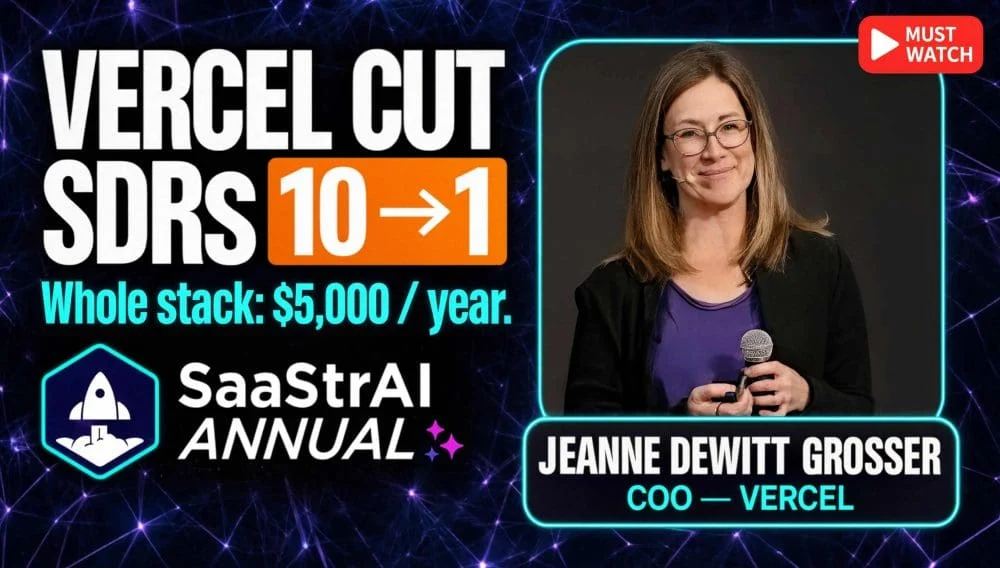
By August 2025, the lead qualification agent went live. What was previously a 10-person function was reduced to a single dedicated operator in the US, supplemented by just 20% of one person’s time to cover the APAC and EMEA regions. This transition allowed Vercel to move those 10 employees into higher-value, strategic roles, proving that the objective was not headcount reduction for the sake of austerity, but the elimination of rote, deterministic work to elevate human potential.
Supporting Data: The Economics of the Agentic Enterprise
The financial argument for Vercel’s transition is staggering. The lead qualification agent, which now handles lead routing and qualification 24/7 with human-equivalent quality, costs roughly $5,000 annually in infrastructure and token consumption.
Grosser calculates the ROI at 32x. When compared to the salary burden of 10 full-time employees, the efficiency gain is not just incremental—it is transformative.
The pattern repeats across the company’s infrastructure:
- Customer Support: An in-house agent now handles 93% of the total case load. Crucially, these are not password resets; they are complex, infrastructure-level technical support tickets.
- Content Production: An AI agent successfully executed 96% of all major content updates in the previous quarter.
- Developmental Efficiency: After the initial lead agent framework was established, the team applied the same logic to 30 different SDR workflows. The result was a 30% increase in SDR quotas within a single quarter.
The Three Pillars of Agentic Success
For organizations looking to replicate this, Grosser outlines three non-negotiable requirements for building an agentic organization.
1. Headless, Composable Architecture
Agents do not live in UIs; they live in APIs. If a product or internal tool does not offer developer-accessible surfaces—such as MCP (Model Context Protocol) servers, webhooks, or robust APIs—it is effectively invisible to an agentic workflow. Vercel’s internal "Deal One" meeting intelligence agent works specifically because it integrates seamlessly with Gong and Salesforce via accessible APIs. Tools that lacked these surfaces were systematically ripped out and replaced.
2. The Data Foundation
AI is only as good as the data it consumes. Vercel’s internal "D0" agent—a data analyst that answers complex questions via Slack—succeeds because it sits atop a meticulously structured semantic layer. By breaking revenue models into causal units and enriching them with first-party signals, Vercel prevents the common pitfalls of AI hallucination, grounding the agent’s output in the reality of the business.
3. The Shift in Build-vs-Buy Calculus
The era of buying enterprise software as a default procurement exercise is ending. Vercel’s internal support agent, Vertex, was built in-house in two months after off-the-shelf solutions failed to deliver results. It costs approximately $150,000 a year to run, including three engineers and high-volume token usage. When compared to external competitors who employ 150 engineers to manage similar workflows at significantly higher costs, Vercel’s "build" strategy proves that internal agility can outship legacy vendors.
Implications: The New Shape of the Company
The implications of this shift extend far beyond simple cost savings. Vercel is finding that its GTM team is increasingly functioning like a consulting firm. As other executives seek to emulate Vercel’s success, Grosser’s team is spending less time "selling" and more time educating peers on how to design agentic architectures and how to handle the inevitable "break points" that occur when processes scale from 1x to 1,000x.
The "agentic infrastructure" is the silent partner in this growth. Vercel’s reliance on "Fluid" compute—which optimizes resource usage by only triggering compute when necessary—has been instrumental. In a world where one-third of all customer deployments are now initiated by agents like Claude Code, the underlying infrastructure must be as dynamic as the software it supports.
The Five Traps of Agentic Implementation
Grosser cautions that the road to automation is littered with pitfalls. During their implementation, Vercel identified five primary mistakes that can derail even the most well-intentioned GTM engineering initiatives:
- Automating Bad Processes: If you encode a broken manual process, you are simply automating inefficiency. Always optimize the workflow before you turn it into an agent.
- Overlooking Infrastructure Scale: What works in a demo environment often fails when subjected to the high-concurrency demands of a production environment.
- Ignoring Data Hygiene: Building an agent on "dirty" data guarantees hallucinations. Invest in the semantic layer first.
- Static "Build-vs-Buy": The market moves too fast to commit to a tool forever. Re-evaluate your internal agents every quarter to see if a better, cheaper vendor solution has emerged.
- Failure to Empower Humans: Treating agents as "team replacements" rather than "team force-multipliers" destroys morale. The goal is to move humans up the stack to solve problems the agents cannot yet comprehend.
Conclusion: The Widening Gap
As Vercel continues to refine its "document, encode, QA, remove" methodology, the gap between traditional organizations and agentic enterprises is widening. For companies waiting for the "safe" time to begin, the prognosis is sobering. The delta between those currently carving out hours each week to build these agents and those watching from the sidelines is compounding.
In this new era, the most successful companies will not be those with the most employees, but those with the most efficient agents—shepherded by a lean, elite corps of engineers who treat the business itself as their primary product. The shift is not coming; it has arrived. The only question remaining is which organizations will possess the discipline to build the future, and which will be replaced by it.