
In the modern entrepreneurial landscape, the collective obsession leans heavily toward hyper-scalable software, AI-driven applications, and sleek direct-to-consumer digital brands. Yet, hidden in plain sight, a quieter class of founders is generating staggering generational wealth in industries most business school graduates wouldn’t touch with a ten-foot pole.
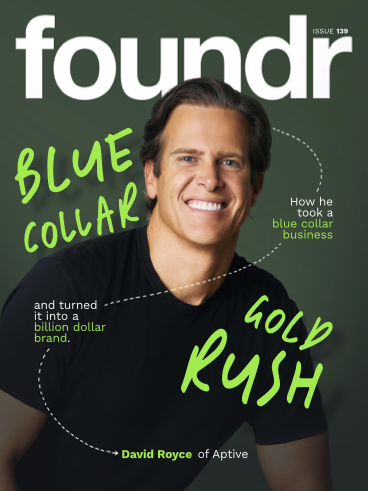
David Royce is the blueprint for this stealthy breed of wealth creation. As the founder and chairman of Aptive—currently the third-largest residential pest control service in North America—Royce has orchestrated multiple eight- and nine-figure business exits, culminating in a commercial juggernaut that generates over $500 million in annual revenue.
In a wide-ranging interview with Foundr CEO Nathan Chan, Royce broke down the counterintuitive philosophy that propelled him to the top 0.1% of U.S. earners: true success is rarely found in the sexiest industry or the most prestigious academic pedigree. Rather, it belongs to those willing to embrace unglamorous problems, master the work nobody else wants to do, and out-persist everyone else in the room.
Chronology: From Minimum Wage to Multi-Exits
The Formative Years and the Turning Point
Royce’s journey did not begin in an elite university incubator. Growing up, he struggled academically, unable to focus on subjects that failed to capture his interest. Without the vocabulary for undiagnosed ADHD, he internalized a damaging narrative: I guess I’m not smart.
That trajectory shifted in the sixth grade when an observant teacher, Mrs. Luft, recognized his potential and offered genuine encouragement. For the first time, Royce found an external reason to excel, cultivating a relentless work ethic. Years later, he would come to view his neurodivergence not as a liability, but as a double-edged sword—brutal in mundane settings, but a superpower when hyper-focused on areas of deep personal interest. Sales and entrepreneurship would eventually become the arenas where his brain felt entirely at home.

Before reaching the boardroom, Royce learned the foundational mechanics of labor and management through starkly ordinary jobs. Fired from a local pizza parlor at age fifteen, he landed at McDonald’s simply because they were willing to hire anyone. That humbling experience instilled a deep appreciation for operational standard operating procedures (SOPs)—lessons he would later apply to scale national workforces.
The Crucible of Door-to-Door Sales
Royce entered the pest control industry entirely by accident. Hearing that a friend had cleared $25,000 selling pest control door-to-door over a single college summer, Royce drove out to Sacramento to try his hand at the trade.
The reality check was brutal. Working entirely on commission, Royce failed to secure a single sale during his first five days. While his teammates comfortably closed one to four contracts daily, he found himself logging miles of unpaid cardio across suburban neighborhoods.
Instead of packing his bags and calling home, Royce leveraged his stubbornness. He spent the weekend at a local bookstore, purchased half a dozen foundational sales manuals, and locked in 90 minutes of daily study. By the end of his freshman summer, out of a cohort of 200 representatives, Royce finished as the top sales rookie in the company, netting a staggering $225,000 (roughly equivalent to half a million dollars today).
Over four college summers, he accumulated $300,000—capital initially earmarked for business school and an investment banking career path.
The Birth of an Empire and the Asset-Deal Strategy
As he approached college graduation, Royce planned to leverage his finance degree and sales acumen to enter investment banking. When he asked his boss for a letter of recommendation, the mentor challenged his assumptions: Why spend 80 to 100 hours a week building someone else’s enterprise when he could launch his own pest control venture?
Initially dismissive—believing success required a bespoke suit and an urban skyline—Royce eventually swallowed his ego, chose utility over image, and utilized his $300,000 savings to fund his first startup.
Rather than trying to reinvent the wheel, Royce mastered the mechanics of strategic exits. Over his career, he successfully built and sold three distinct companies to the exact same strategic buyer. His secret? The asset-deal structure.
Instead of selling entire corporate entities, Royce executed clean carve-outs. He sold only the customer databases and the frontline technicians servicing them—the exact assets strategic buyers desperately needed to fuel their own recurring revenue streams. Crucially, Royce retained his elite operational leadership teams, management infrastructure, and sales forces. Armed with fresh capital and an intact "golden goose" team, he immediately launched subsequent ventures in new territories completely free of outside investors or equity dilution.
Supporting Data & Economic Dynamics
The macroeconomic tailwinds supporting blue-collar businesses like Royce’s are both profound and largely misunderstood by mainstream investors.

- The "Stealthy Wealthy": According to data highlighted by The Wall Street Journal, roughly 43% of the top 0.1% of income earners in the United States—individuals pulling in $2.3 million or more annually—derive their fortunes from unglamorous, blue-collar industries.
- The Silver Tsunami: Millions of Baby Boomer owners of essential home-service businesses are currently reaching retirement age. The vast majority lack succession plans, creating an unprecedented window of opportunity for modern operators who understand recurring revenue models.
- The AI Proof Factor: While generative automation and artificial intelligence rapidly disrupt knowledge work, coding, and legal analysis, AI cannot unclog a main sewer line, scale a roof to treat termites, or physically service a residential property. Essential field services remain insulated from digital displacement.
Official Perspectives and Key Philosophies
Throughout his extensive dialogue with Foundr, Royce distilled decades of trial-by-fire experience into actionable frameworks for emerging founders.
1. The Trinity of High-Conversion Sales
Royce codified his door-to-door mastery into three pillars that formed the spine of a sales organization boasting over 3,000 representatives:
- Option Closes: Abandoning dead-end yes-or-no inquiries in favor of binary presumptions ("We will be in your area tomorrow at 3 PM or 5 PM, which works better?").
- RAC (Resolve, Ace, Close): Explicitly identifying customer doubt, dropping an undeniable value proposition they haven’t considered, and pivoting to a fresh close.
- Body Language as a Prerequisite: Acknowledging that non-verbal communication dictates conversion before a script is even uttered ("You aren’t losing because your script is bad; you’re losing because your face is saying, ‘Please don’t hurt me.’").
2. Cash Flow is Reality
Reflecting on his near-bankruptcy experience during his first year of operations in Los Angeles—where rapid growth forced him to pay agent commissions prior to collecting client revenue—Royce delivered a stark financial maxim:
"Revenues are vanity. Profits are sanity. But cash flow is reality."
3. Culture is Design, Not Vibes
Influenced by Tony Hsieh’s philosophies in Delivering Happiness, Royce recognized that corporate culture cannot be left to chance. While Aptive famously invested in high-end perks—including golf simulators, NCAA basketball courts, and international company retreats to Thailand and Egypt—Royce maintains that perks are merely "sugar, not protein." The true anchor for attracting elite talent was a world-class training ecosystem that consistently outperformed competitors.
Most significantly, Royce pioneered a radical wealth-sharing model, distributing 25% of the company’s equity value to his employees ahead of major exits. This decision injected life-changing capital directly into his team, allowing employees to clear mortgages, eliminate student debt, and fund generational milestones.
Business Implications: Lessons for the Next Generation of Founders
Royce’s trajectory offers several vital takeaways for modern entrepreneurs navigating volatile economic environments:
- Embrace the Unglamorous: Highly saturated, digitized markets often feature compressed margins and fierce competition. Conversely, overlooked, essential industries frequently boast robust pricing power and predictable recurring revenue.
- Beware of Resume Churn: Royce candidly recounted a costly misstep involving the hire of a high-profile CFO from a billion-dollar tech firm who lacked the nuanced, grassroots understanding of small-business cost structures. The lesson: Cultural and operational alignment supersedes pedigree.
- The Architecture of Delegation: Scaling past founder-dependency requires self-restraint. True executive leadership requires stepping out of the hero complex, empowering deputies, and accepting that capable leaders may execute tasks differently than the founder would.
- Redefining the Summit: Ultimately, Royce argues that entrepreneurship is not fundamentally about the destination, the valuation, or the financial exit. It is the discipline, character, and leadership forged during the climb. As Royce notes, if a founder does not genuinely enjoy the process of building, the summit will inevitably disappoint.