SAN FRANCISCO — In the high-stakes ecosystem of Silicon Valley, definitions of scale are being rewritten in real time. A decade ago, venture capitalists combed through portfolios hunting for "unicorns"—privately held startups valued at $1 billion or more. A few years later, the goalposts shifted to "decacorns" valued at $10 billion.
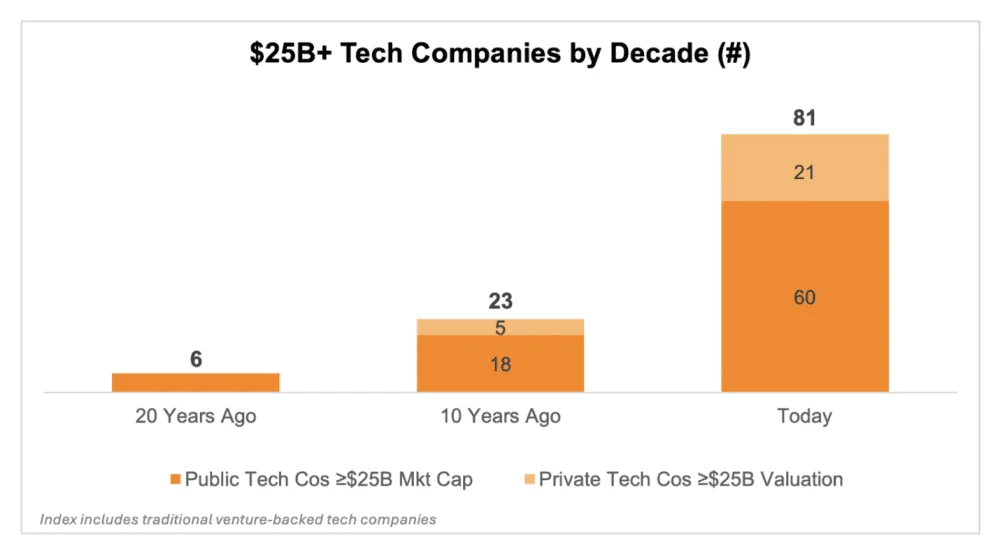
Today, according to industry data and a widely shared framework published by Menlo Ventures growth partner Alex Kurland, the baseline metric has leaped to an astonishing $25 billion.
Driven by an unprecedented wave of artificial intelligence breakthroughs, explosive revenue trajectories, and a massive influx of institutional dry powder, the venture capital industry in 2026 operates under a new reality. For mega-funds managing billions of dollars, a billion-dollar exit no longer moves the needle. Instead, the entire asset class has pivoted toward a singular objective: manufacturing and capturing $25B+ outcomes before companies ever touch the public markets.
Main Facts: The New Anatomy of Venture Capital
The transformation of the venture ecosystem is rooted in a fundamental shift in fund economics. As venture firms raised progressively larger pools of capital—culminating in milestones like Menlo Ventures closing a landmark $3,1 billion fund in mid-2026—the math required to return those funds to Limited Partners (LPs) fundamentally changed.
The Math of a Multi-Billion-Dollar Fund
Consider the arithmetic of a $3 billion venture fund. To deliver a standard 3x net return to its investors, a fund must generate roughly $9 billion to $10 billion in gross distributions.
Due to aggressive late-stage dilution, early investors rarely hold their initial stakes intact. According to Carta’s 2026 data, median founding team ownership drops from 56% at seed to roughly 36% after Series A, and down to 16.1% by Series C. Even top-performing early-stage leads who successfully defend their positions typically exit with 8% to 12% ownership.
At a 10% ownership stake, a single $1 billion acquisition returns $100 million—barely 1% of what a $3 billion fund needs to return itself once. To clear the hurdle, that fund requires roughly four $25 billion outcomes over a ten-year lifecycle.
When applied to growth funds entering at later stages, the constraint shifts from ownership percentage to entry multiples. Writing a $100 million check into a $5 billion round buys a mere 2% stake; to generate a 3x return on that position, the target company must scale well past the $25 billion threshold.
Consequently, $25 billion has evolved from an outlier milestone into the mandatory baseline for institutional underwriting.
Chronology: The Hyper-Acceleration of AI Valuations
The sheer velocity of the 2026 market has compressed timelines that once took decades into mere quarters. The tipping point is best illustrated by a historic sequence of events that unfolded across late summer.
- Mid-2021: PitchBook data records 26 active US decacorns. The $10 billion threshold is still widely viewed as the outer stratosphere of private company valuation.
- May 2026: AI coding startup Cognition announces a major funding round valuing the company at $26 billion, built upon a surging annual run rate of $492 million.
- June 2026: Menlo Ventures closes its historic $3 billion fund, signaling the widespread availability of mega-capital targeting high-growth category creators.
- August 14, 2026: In what is widely documented as the largest acquisition of a venture-backed startup in history, SpaceX completes an all-stock acquisition of Anysphere (the developer of AI coding tool Cursor) at a staggering $60 billion valuation. Having launched just four years prior, Cursor exited at roughly 15x its annualized revenue of ~$4 billion.
- September 8, 2026: Just weeks after the Cursor blockbuster, Cognition shatters expectations again. The company announces a Series E round of over $2 billion at a $48B valuation—nearly doubling its valuation in less than four months as its run rate approaches $900 million.
These milestones have solidified a new operational reality: elite AI startups are scaling from inception to tens of billions in valuation in under 48 months.
Supporting Data: The Rise of Private Giants
PitchBook’s mid-year 2026 data underscores a profound structural change in how capital formation occurs:

- Explosion of Decacorns: The count of active US decacorns reached 63 by mid-2026, up from 53 the previous year and just 26 in 2021.
- Pacing Records: Nineteen new companies crossed the $10 billion mark in the first half of 2026 alone, eclipsing the entire 2025 total of 18.
- The Dominance of Mega-Deals: Mega-rounds of $100 million or more accounted for an astonishing 87.5% of the $412.7 billion invested in US startups during H1 2026.
- The Private vs. Public Shift: Historically, achieving a $25 billion valuation required going public. Data compiled by Menlo Ventures shows that the private $25B+ cohort has grown from zero to 21 companies, accounting for roughly a quarter of all ultra-large enterprise outcomes. Capital that once arrived post-IPO is now aggressively deployed at Series D, E, and F stages.
Official Responses and Industry Perspectives
The rapid escalation of fund strategies and deployment models has sparked intense dialogue among prominent investors.
The shift is perhaps best encapsulated by Benchmark, a firm historically synonymous with classic, disciplined Series A rounds, which participated in Cognition’s massive $48 billion financing. Explaining the firm’s pivot toward dedicated growth vehicles, Benchmark general partner Everett Randle noted on social media:
"Cognition is the first investment in our first dedicated growth fund. When we discussed the fund’s strategy, we agreed that we wanted to focus solely on companies that were still only 1% of the way through their journey despite being at growth-stage scale, and had a shot at transforming global software capacity."
Echoing this sentiment, Cognition officially stated the core mission driving their hyper-growth:
"The world needs far more software than it can build. Cognition exists to change that."
Meanwhile, veteran investors and founders like SaaStr founder Jason Lemkin have emphasized the growing chasm between mega-fund economics and traditional B2B software targets. Lemkin noted that smaller, highly focused funds—such as solo-GP vehicles managing $60 million—enjoy a distinct strategic advantage. At that fund size, securing a 3% stake in a $2.0 billion outcome returns the entire fund, allowing smaller GPs to underwrite a vast universe of resilient, highly profitable companies that mega-funds must bypass.
Implications for Founders and the Broader Ecosystem
For early-stage entrepreneurs entering Series A pitch meetings in late 2026, the psychological and strategic framework of venture capital has fundamentally shifted.
1. The Death of the Probable $500M Pitch
When venture partners evaluate a pitch deck today, the primary question is no longer “Will this business succeed?” but rather, “If this succeeds, how massive is the ultimate ceiling?”
A startup with a highly probable, disciplined path to a $500 million acquisition is frequently screened out by large funds because it fails to move the needle on a multi-billion-dollar portfolio. Founders whose realistic addressable market caps out under $1 billion are increasingly cautioned against pursuing institutional venture capital, as the structural pressure to swing for impossible ceilings often compromises sustainable, profitable growth.
2. The AI-Driven Velocity Standard
Driven by lightning-fast monetization models—such as Cursor scaling from $1M to $100M ARR in 12 months, and Lovable reaching similar milestones with a tiny team of 45—the market expects hyper-acceleration. Founders must demonstrate not just product-market fit, but a structural capability to scale distribution and revenue at unprecedented speeds.
3. Alternative Paths are Flourishing
The silver lining of the 2026 market is that the alternatives to venture capital have never been stronger. Empowered by advanced AI agent workflows, leaner teams are generating millions in revenue with minimal headcounts. Founders can choose to bootstrap, raise smaller rounds from micro-VCs whose fund sizes align with realistic exits, or forgo outside capital altogether.
The Bottom Line
As the private $25B+ cohort continues to expand toward 100+ enterprises, the fault lines within the venture capital landscape are permanent. Mega-funds will continue their high-stakes pursuit of generational AI monopolies, while founders must carefully evaluate whether their business models are built to clear the daunting $25 billion hurdle—or whether they are better served by charting an independent, highly profitable course of their own.