
In the modern digital landscape, the maturity of User Experience (UX) practice is no longer measured solely by the quality of a design, but by the speed at which an organization can transform raw user feedback into actionable product iterations. As organizations scale, the demand for human-centered data often outpaces the capacity of traditional research teams. To bridge this gap, many industry leaders are turning to "Rapid Research"—a specialized, templatized, and high-velocity framework designed to keep pace with agile development without sacrificing the integrity of the insights.
The Evolution of Insight: Why Speed Matters
The expansion of UX research sub-disciplines—including content strategy, research operations, and data analytics—reflects a broader trend: companies are moving away from monolithic, slow-moving research cycles. Today, the goal is to provide actionable insights that fit seamlessly within two-week product sprints.
Rapid Research is not simply "doing research faster"; it is a systemic shift in operational philosophy. By standardizing the research lifecycle through templates and guardrails, organizations can maintain a consistent cadence of data collection. This approach effectively unblocks expert researchers, allowing them to pivot away from repetitive evaluative tasks and toward complex, generative discovery that drives long-term innovation.
The Core Pillars of Rapid Research
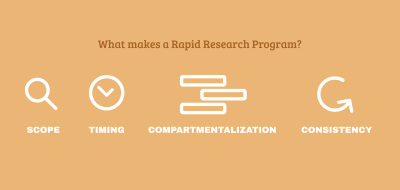
A successful Rapid Research program is built upon four foundational pillars: Scope, Timing, Compartmentalization, and Consistency.

1. Defining the Scope
Not all research is suited for a rapid cadence. Longitudinal diary studies or complex, long-form qualitative interviews often suffer when compressed into short timeframes. To build a sustainable program, teams must identify which methodologies can be templatized. The focus should be on evaluative research—usability testing, A/B testing support, and quick-turn surveys—that directly informs current sprint goals.
2. Calibrating Timing
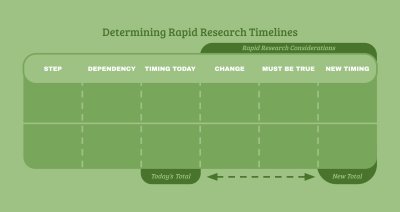
The value of this program lies in its efficiency. If the end-to-end timeline for a "rapid" study mirrors that of a standard study, the program fails to provide a competitive advantage. Success is measured by the ability to deliver insights within a specific, abbreviated window that stakeholders can rely on.
3. The Power of Compartmentalization
Efficiency is often throttled by interdependencies. By separating the research process into discrete, non-dependent blocks—such as separating project intake from study kick-off, or decoupling recruitment from guide development—teams can remove the friction that traditionally slows down research.
4. Ensuring Consistency
Consistency is the heartbeat of a Rapid Research program. If one week’s study takes five days and the next takes three weeks, stakeholders lose confidence in the process. A reliable, repeatable rhythm is essential for operationalizing the program and identifying further opportunities for automation.
Chronology of Implementation: A Four-Phase Roadmap
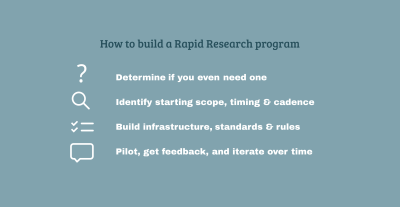
Building a Rapid Research program is a significant organizational undertaking. Drawing from industry case studies, we can outline a strategic four-phase approach.
Phase I: The Diagnostic Audit
Before launching, leadership must determine if a program is necessary. This involves:
- Need Assessment: Analyzing the current volume and type of research requests. Are teams waiting too long for validation? Are researchers burnt out from repetitive, tactical tasks?
- Gap Analysis: Identifying the "low-hanging fruit"—research requests that are recurring and follow a predictable pattern.
Phase II: Defining Parameters
Once the need is validated, the team must define the "rules of engagement." This involves setting clear boundaries for participant recruitment (e.g., using a consistent panel of users) and selecting the research methods that will be supported by the program.
Phase III: Building the Infrastructure
This phase is the heavy lifting. It includes:
- Templatization: Developing standardized discussion guides, recruitment screeners, and reporting templates.
- Staffing Models: Determining if the program requires dedicated junior researchers, a partnership with an external research vendor, or a "research-ops" support role to handle the administrative overhead.
- Buy-in: Securing executive support and budget, ensuring that cross-functional partners (legal, product, engineering) are aligned with the new, faster SLAs.
Phase IV: The Pilot and Iterate Cycle
No program is perfect at launch. The first three to six months should be viewed as a pilot. During this time, the team should solicit granular feedback from stakeholders, tracking what slows down the process and where the "rapid" promise is being met or missed.
Supporting Data: The ROI of Speed
The financial argument for Rapid Research is compelling. Research indicates that addressing usability issues in the early, iterative stages of development can be over 100 times cheaper than fixing those same issues post-launch.
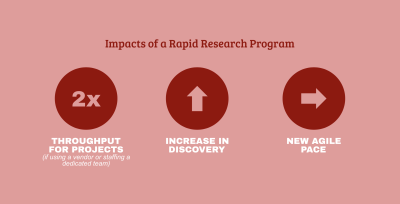
By increasing the throughput of a research team, organizations can effectively double the number of studies performed in a fiscal year. This increased frequency allows for a "fail-fast" mentality, where product teams can test multiple hypotheses per sprint. Furthermore, for organizations with large, dedicated UX teams, moving evaluative work to a Rapid Research track creates a talent development pipeline, offering junior researchers a structured environment to hone their moderation and analysis skills.
Official Perspectives and Organizational Realities
While the benefits are clear, organizational leaders caution against viewing Rapid Research as a panacea. A primary constraint is the "ramp-up" period, which can last anywhere from three months to a full year depending on the existing organizational culture and technical debt.
Industry experts emphasize that the most common failure point is the "Recruitment Bottleneck." Even with a perfect template, a program will stall if the organization lacks a reliable, recurring participant pool. "You can find as many users as you like by casting a wide net," notes one industry report, "but you won’t necessarily find the right participants." Therefore, investing in participant management tools is just as critical as the research templates themselves.
Strategic Implications: Looking Ahead
The adoption of a Rapid Research program has profound implications for a company’s long-term strategy.
- Generative vs. Evaluative Balance: As tactical research is moved into the Rapid Research track, the core research team is liberated. They can shift their focus toward long-term discovery—uncovering the "why" behind user behaviors that ultimately leads to market-disrupting innovation.
- Agile Integration: The program turns research into a first-class citizen of the development sprint, removing the "research as a blocker" stigma.
- Cultural Maturity: Successfully implementing such a program signals a shift toward a truly data-informed culture, where insights are not just an occasional check-point but a continuous, flowing stream of information.
The Trade-offs: A Balanced View
It is important to acknowledge the limitations. Rapid Research is not intended for high-stakes, highly sensitive, or foundational research where deep qualitative rigor is the primary requirement. Misusing the program for these types of studies can lead to shallow insights that may misguide product strategy.
Pros:
- Increased organizational speed and agility.
- Improved team morale by offloading repetitive tasks.
- Higher ROI on product development through early-stage validation.
Cons:
- Requires significant upfront time and resources to build.
- Risk of "shallow" data if the scope is not strictly managed.
- Requires a mature, stable participant recruitment mechanism.
Final Considerations
Ultimately, a Rapid Research program acts as the nervous system of an iterative product team. By standardizing the process, enforcing rigor through templates, and choosing the right moments for speed, organizations can transform their relationship with user data. Whether you are a small startup or a large enterprise, the ability to iterate based on immediate user feedback is the definitive competitive advantage of the next decade.
For those looking to begin, the advice is simple: start small, pilot the process with a trusted team, and remain committed to iterating on the program itself. In the world of modern product development, the only thing more dangerous than bad data is no data at all.