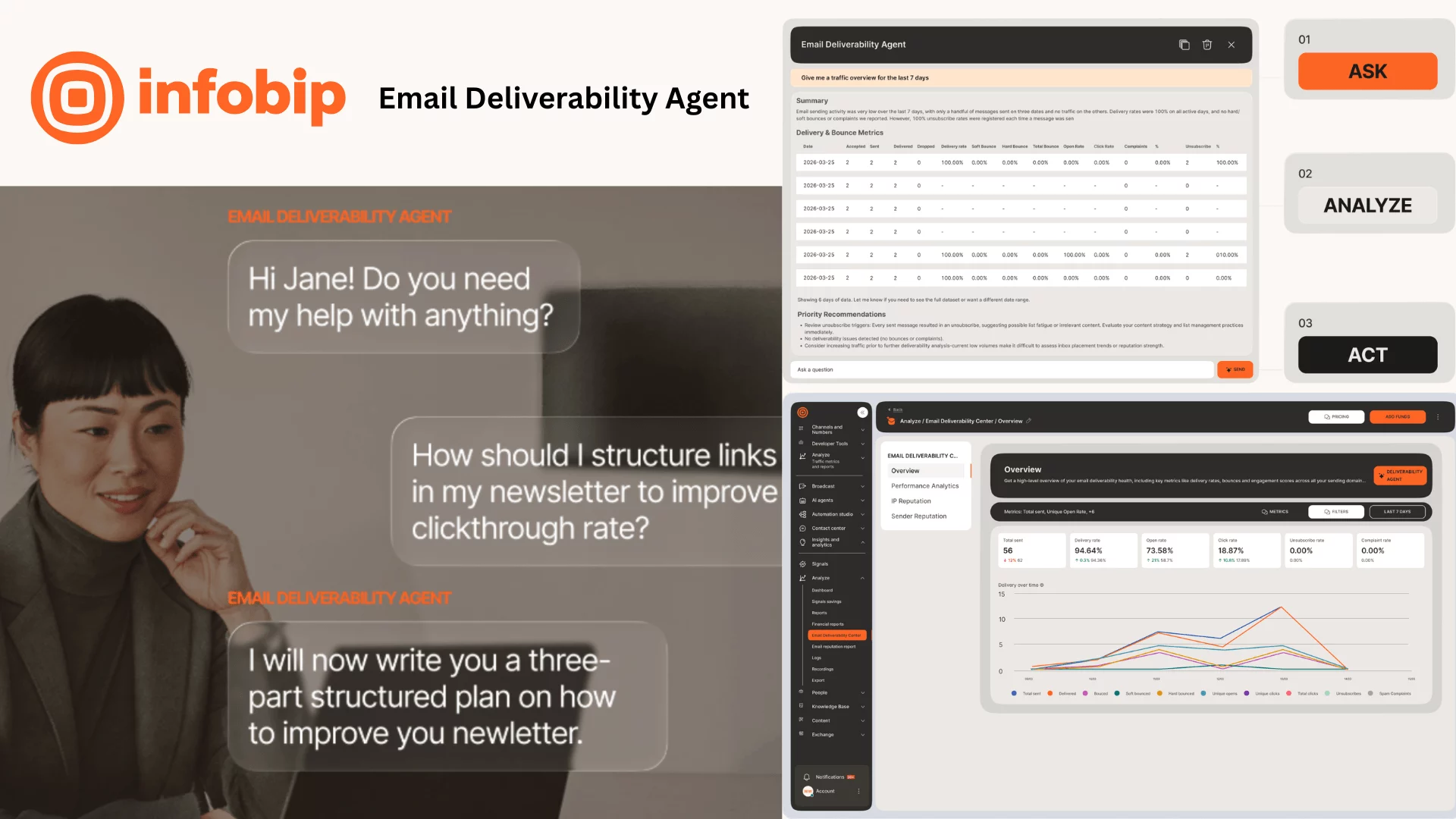
The landscape of digital communication is undergoing a seismic shift. For decades, the black art of email deliverability—the technical and strategic discipline of ensuring messages reach the inbox rather than the junk folder—has been the exclusive domain of highly specialized human experts. Today, that paradigm is being dismantled by a wave of automation, culminating in the launch of Infobip’s new AI-powered Email Deliverability Agent.
Integrated directly into its AgentOS platform, the new tool promises to bridge the gap between complex data analytics and actionable strategy. By "analyzing real-time sending data and telling you exactly what to fix," Infobip is positioning itself at the vanguard of a movement that seeks to democratize deliverability, removing the need for a dedicated specialist. However, as the industry moves toward autonomous systems, the implications for security, control, and the role of human judgment remain a subject of intense debate.
The Chronology of a Shift: Three Directions of Industrialization
To understand the significance of Infobip’s move, one must look at the broader context of the email ecosystem over the past several weeks. The deliverability discipline is currently being “industrialized” from three distinct directions simultaneously, forming a pincer movement that leaves little room for the traditional manual processes of the past.
1. Data from Above: The Platform Verdict
The first shift came from the mailbox providers themselves. Gmail’s recent updates to its Postmaster Tools have moved away from obscure metrics, instead opting for plain-language verdicts. By telling senders directly whether users actually want their mail, Google has effectively bypassed the need for third-party interpretation of complex engagement signals.
2. Tooling from Below: The Infrastructure Absorption
The second shift occurred as infrastructure providers began absorbing once-specialized services into their core offerings. Amazon SES recently made headlines by integrating inbox placement testing, cross-provider analytics, and blocklist monitoring directly into its console as a subscription service. This suggests that the baseline "hygiene" required for successful sending is becoming a commodity—a standard feature of the infrastructure itself.
3. Interpretation in the Middle: The Infobip Agent
This brings us to the third and most ambitious shift: the middle layer. Historically, this was the space occupied by the deliverability consultant—the professional who took the data from the mailbox providers, utilized the tools from the infrastructure providers, and synthesized it into a coherent strategy. By deploying an AI agent to handle this interpretive layer, Infobip is attempting to automate the "judgment" component of deliverability, which was previously considered the sole province of human expertise.
The "Send-Authority" Question: Agency vs. Recommendation
In the current gold rush of AI agent deployment—from Salesforce’s content-generating agents to the growing wave of MCP (Model Context Protocol) connectors—the fundamental question remains: What can the agent actually do, as opposed to recommend?
The distinction between an advisory agent and an empowered agent is not merely semantic; it is a critical security threshold. An advisory agent that misinterprets a reputation signal might lead a user to waste an afternoon adjusting settings. An empowered agent that misinterprets a signal and automatically acts on it at the massive volumes handled by a CPaaS (Communications Platform as a Service) provider could trigger a catastrophic deliverability collapse, resulting in domain blacklisting and significant revenue loss.
Official Response: The Infobip Stance
In an exclusive comment provided to emailexpert, Infobip clarified its current capabilities and future roadmap regarding automated decision-making.
“Our AI Deliverability Agent gives teams near real-time visibility into the issues affecting reputation and deliverability performance, then turns those findings into prioritized remediation steps,” an Infobip spokesperson stated. “The product roadmap moves from insights to selective automation for low-risk actions, with human approval, audit logs, and rollback built in. Each new agentic step is designed to improve performance without removing control from the sender.”
This response provides a vital level of transparency that is currently missing from many of the industry’s AI product launches. By confirming that the agent currently acts only in an advisory capacity, and that future automation will be constrained by "human-in-the-loop" safeguards—including audit logs and rollback mechanisms—Infobip has set a high standard for responsible AI implementation.
Implications: Literacy vs. Replacement
The rhetoric of "no specialist required" is powerful, but it requires a fair, nuanced reading. For the vast majority of businesses—particularly small-to-medium enterprises that have never had the budget for a dedicated deliverability consultant—this tool is not necessarily "replacing" a job. Rather, it is providing a form of technical literacy that was previously inaccessible.
By translating cryptic bounce codes, SNDS data, and Postmaster verdicts into plain English, Infobip is essentially acting as a force multiplier for non-specialists. It lowers the barrier to entry, ensuring that companies can maintain basic compliance with the increasingly stringent bulk-sender requirements enforced by Google and Yahoo.
However, the industry must be wary of the term "autonomous." While marketing departments are currently enamored with the word, the reality of deliverability remains deeply rooted in diagnostic complexity.
The Limits of the Checklist
We can anticipate that the Infobip agent will excel at what we might call "checklist deliverability":
- Authentication: Ensuring SPF, DKIM, and DMARC records are correctly configured.
- Monitoring: Identifying sudden spikes in bounce rates or blacklisting incidents.
- Hygiene: Flagging inactive segments or high-risk email addresses.
Yet, deliverability is often a "gnarly" discipline. It involves mystery throttling, shared-pool contamination, and edge-case reputation issues that defy simple algorithmic categorization. It is in these moments of diagnostic uncertainty that the human specialist proves their worth. The question remains: can an AI agent identify a complex, multi-variable issue that doesn’t follow a known pattern? Or will it merely offer generic "best practices" that fail to address the underlying root cause?
The Road Ahead for the Deliverability Discipline
As Infobip and other major players continue to iterate on their agentic platforms, the role of the deliverability specialist will likely evolve rather than disappear. We are moving toward a future where the specialist functions less like a "dashboard operator" and more like an "architect of automation."
The specialists who survive this transition will be those who can stress-test these agents, oversee the implementation of automated remediation, and handle the "black swan" events that occur when data and reality diverge.
A New Standard for Transparency
Infobip’s decision to answer the "send-authority" question on the record—before the automation has been fully deployed—is a significant data point for the industry. It establishes a benchmark for responsible AI development:
- Transparency: Clearly distinguish between advisory and autonomous actions.
- Safety: Implement audit trails and rollback mechanisms as a prerequisite, not an afterthought.
- Control: Ensure that the user, not the algorithm, maintains final decision-making power for high-risk actions.
As the industry watches for the first practitioner write-ups and case studies, the focus should remain on whether these tools actually empower the sender or simply shift the risk to a new, automated layer. Infobip has taken an ambitious step, and while the agent may meet its limits at the point of complex diagnosis, it is already performing a service by setting a clear, transparent standard for the rest of the category to follow.
For those looking to integrate these new tools, the advice remains the same as it has always been in the email world: trust the data, but always maintain a hand on the kill-switch.
Disclosure: Infobip is an Enterprise Member of Emailexpert. Coverage decisions and editorial judgments for this article were made independently of commercial relationships. Our commitment to accuracy and rigorous questioning remains the primary service we provide to the email community.