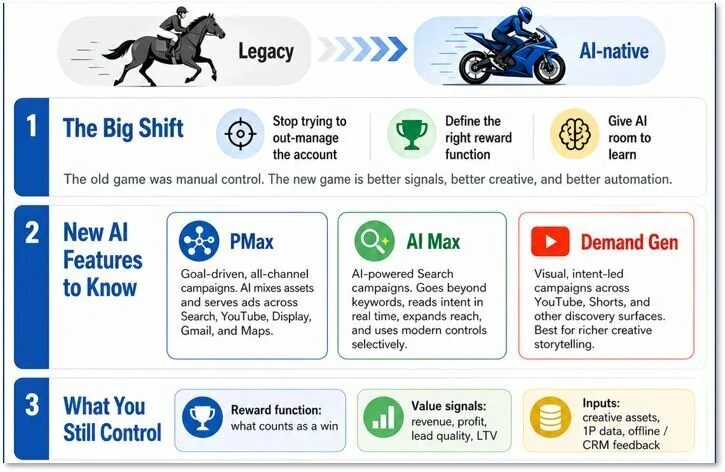
In the modern digital landscape, the question facing performance marketers is stark: In an age of high-performance motorcycles, why are you still riding a horse?
For decades, the bedrock of digital advertising was manual optimization—a world of granular keyword bidding, negative keyword lists, and daily micro-adjustments. However, platforms like Google Ads and Meta have fundamentally shifted, moving away from human-led micromanagement toward AI-driven automation. For the professional marketer, clinging to legacy tactics isn’t just inefficient; it is a direct obstacle to profitability.
The Shift: From Manual Manipulation to AI-Driven Outcomes
The transition toward "AIfying" advertising platforms is not a future event—it is the current reality. Google’s ecosystem has evolved beyond simple search queries to a holistic intent-matching engine.
For many, the transition is uncomfortable. In industry meetings and marketing forums, "Search Marketing" is still frequently categorized through the outdated lens of "brand vs. non-brand." Marketers continue to tinker with match types, geos, and bid modifiers, while agencies often justify their retainers by claiming credit for high-frequency daily changes. According to industry experts like Avinash Kaushik, a 16-year Google veteran and author, this behavior is "profit-pulverizing."
The core philosophy now must be "embrace and extend." AI systems, while not perfect, learn and iterate with a speed and depth that no human team can replicate. The choice to remain in the past is no longer a viable business strategy.
Chronology of the AI Evolution in Search
The trajectory of Google Ads over the last several years reveals a clear, calculated march toward automation:
- The Rise of Smart Bidding: The introduction of automated bidding strategies signaled the end of manual CPC (Cost-Per-Click) dominance.
- The Broad Match Revolution: Google moved away from the rigidity of "exact match" towards intent-based matching, allowing algorithms to capture demand beyond the specific keywords typed.
- The PMax (Performance Max) Era: Google consolidated various channels (Search, YouTube, Display, Gmail, Maps) into a single, goal-oriented campaign type. By feeding the AI assets—text, images, and video—the machine decides the optimal delivery path.
- The Advent of AI Max: A search-only evolution that removes the need for manual keyword management entirely, focusing instead on real-time intent signals.
- Demand Gen: The transformation of Discovery ads into a sophisticated visual-delivery engine that utilizes video and Shorts to drive performance.
Supporting Data and The Maturity Framework
To understand where a business stands in this transition, one must move past vanity metrics. The industry is currently divided between "Legacy Operators"—those clinging to the AdWords-era control mindset—and "AI-Native Advertisers."
The Maturity Assessment Model
To assist professionals in self-auditing their progress, a two-dimensional maturity model is essential:
- Capability Scoring: How sophisticated are the tools and methods being used? (Scaled 0–4, from "Legacy" to "AI-Native").
- Depth Scoring: How widespread is this sophistication across the account? (Scaled 0–4, based on the percentage of spend or conversions covered).
The Six Dimensions of Maturity:
- Measurement & Value Architecture (Weight: 30 pts): This is the foundation. If you are optimizing for pageviews or basic leads rather than business value (revenue, profit, or LTV), your AI is being fed the wrong signals.
- Search Operating Model (Weight: 20 pts): Moving from manual bid modifiers to Smart Bidding and broad matching.
- 1P Data & Audience Intelligence: Utilizing first-party data to inform the machine.
- Surface Breadth & Campaign Mix: Embracing the full range of Google’s inventory.
- Creative & Landing Page Adaptability: Allowing AI to test and iterate on creative assets.
- Operating Cadence & Governance: Managing the machine rather than micromanaging the auction.
The goal is to reach a maturity score of 85 or higher. Scoring below 30 identifies a "Legacy AdWords Operator," while those between 70 and 84 are classified as "Modern Advertisers."
The Logic of the "Reward Function"
A common misunderstanding among marketers is that AI removes all control. In reality, it changes the nature of that control. Marketers now manage the "Reward Function"—the definition of what a "win" looks like for the business.
When a marketer feeds the algorithm data on offline conversions, CRM feedback loops, or high-value customer segments, the AI optimizes for that specific outcome. The "Human-in-the-loop" role has shifted from being a button-pusher to a strategist who ensures the machine is fed high-quality, truthful data.
As noted in the industry, even if the AI makes the occasional error, the trade-off is mathematically superior. Losing on four small, irrelevant auctions is a negligible price to pay for winning on thirty or forty high-value conversions that a human would have missed due to the limitations of manual targeting.
Official Industry Perspectives
While some agencies struggle with the loss of "busy work" as a billable service, the consensus among forward-thinking practitioners is that AI liberation is the future. By outsourcing the mundane tasks—such as adjusting bids for specific hours or device types—marketers regain the time to focus on:
- Creative Strategy: Crafting the narrative and assets that resonate with the target audience.
- Data Integrity: Ensuring the signals sent to the AI are accurate and representative of real-world profit.
- Business Integration: Aligning marketing goals with organizational P&L.
Implications for the Future of Marketing Careers
The transition to an AI-first marketing stack has profound implications for professionals:
1. The Death of the "Account Tuner"
The role of the person who logs in daily to adjust bids by 5% is effectively obsolete. These tasks are now performed in milliseconds by algorithms processing millions of signals, including location, time of day, device, user behavior, and historical purchase patterns.
2. The Rise of the "Architect"
The modern marketer is an architect of systems. They build the measurement infrastructure, curate the creative assets, and define the value signals that drive the business. Their value lies in their ability to understand the business’s unit economics and ensure the machine is optimized for the right outcome.
3. The Cultural Shift
Perhaps the greatest hurdle is the cultural resistance to "giving up control." Many marketers feel that if they aren’t micromanaging, they aren’t working. This is a false narrative. True efficiency comes from trusting the machine to handle the heavy lifting, allowing the human to focus on the strategic "why" rather than the tactical "how."
Conclusion: Embracing the Present
The era of manual, keyword-obsessed, AdWords-style management is ending. For the serious marketer, the path forward is clear: perform an honest maturity assessment, discard the "horse and buggy" tactics, and pivot to a strategy that leverages the full power of modern machine learning.
The rewards for making this transition are not merely incremental. By moving from a Legacy operator to an AI-Native one, companies have seen potential revenue and profit gains of 3x, 5x, or even 20x. The choice is binary: either evolve to become a master of the machine, or continue to be outperformed by those who have already embraced the AI-first reality.
The tools of the future are here. The only question remains: are you ready to use them?