In the modern media landscape, where fragmentation has turned audience attention into a scarce commodity, sports remains the final frontier of mass-scale, synchronized viewership. Last year, nearly every one of the top 50 most-watched telecasts in the United States was tied to sports. From the Super Bowl to the NBA playoffs, live athletics provide a rare "campfire moment" that advertisers are desperate to occupy.
Even the exceptions—the 97th Oscars, the SNL 50th anniversary special, and the 67th Grammys—only underscore the rule: when people watch, they watch together. As streaming giants like Amazon, Apple, and Netflix aggressively pivot toward acquiring live sports rights, the message to the market is clear. For global brands, sports marketing is no longer just a luxury; it is a primary vehicle for survival in a distracted world.
The Gold Rush: Sponsorships and the Visibility Trap
The rush into sports advertising has been nothing short of a frenzy. Corporations are pouring capital into every available touchpoint: team sponsorships, athlete endorsements, stadium naming rights, and high-visibility placements on jerseys, equipment, and interview backdrops.
Yet, this influx of capital often masks a lack of strategic depth. At the executive level, the conversation often shifts from business impact to vanity. A CEO might enjoy the prestige of a hospitality suite at Augusta National or the thrill of shaking hands with a legendary quarterback, but eventually, the question arises: "For $38 million in marketing spend, is this actually moving the needle for our business?"
When that question lands, it is often met with silence. The challenge lies in the fact that many brands treat sports marketing as a "set it and forget it" expense, failing to apply the same rigorous analytical standards they use for their digital performance channels.
The Laws of Marketing in the Sports Arena
It is a fundamental error to assume that the rules of marketing change simply because a logo is displayed on a jumbotron. On the contrary, the laws of marketing become more rigid in the sports context.
If a brand’s creative story is too weak to capture attention in the 1.2-second window of a TikTok scroll, placing that same logo on a race car or a stadium banner will yield even poorer results. In fact, because the audience is hyper-focused on the game itself, the brand’s message faces even higher barriers to entry.
Consider the Seattle Seahawks: they have featured only one corporate logo on their uniforms for decades. It is a "slam dunk" of brand recognition, yet most marketers struggle to identify it—or why it works. The takeaway is clear: sports marketing requires the same "spike and sustain" strategy as any other channel. A single, fleeting placement is the "kiss of death." To derive value, brands must ensure a frequency of at least three impressions per user per week, typically supported by paid media that leans heavily into the athlete or the sport’s narrative.
The Measurement Playbook: Moving Beyond Vanity
The measurement of sports marketing often descends into "vanity metrics." Agencies frequently tout "Impressions" or "Earned Media Value" (EMV)—the idea that if you had to pay for the seconds your logo was on screen, it would have cost $72 million.
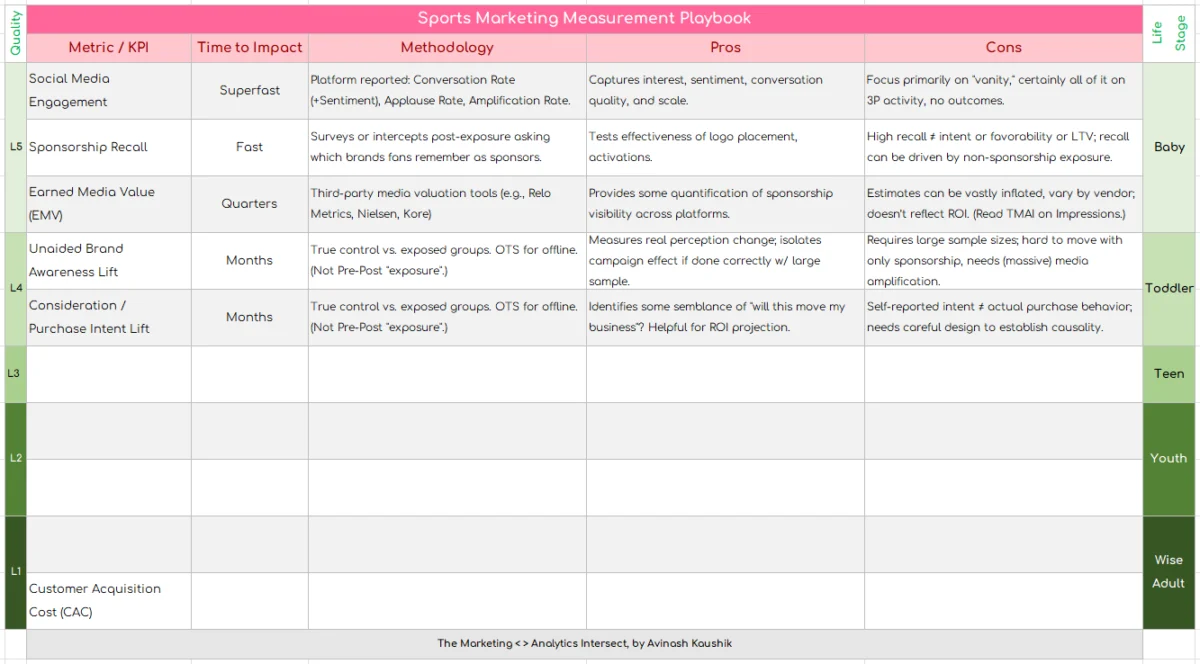
This is widely considered a "con" by top-tier analysts. EMV ignores the quality of the audience, the lack of a distinct brand message, and the hyper-cluttered nature of the environment. To truly understand the impact, companies must move from Level 5 (Vanity) toward Level 1 (Incrementality).
Level 5: The Opening Gambit (Vanity Metrics)
At this entry level, brands focus on social media engagement and Ad Recall. While helpful for establishing a baseline, these metrics measure noise, not outcomes. They tell you if you are visible, but not if you are profitable.
Level 4: The Quest for Brand Impact
This is the first step toward genuine accountability. Here, companies employ test-versus-control methodologies to measure "Unaided Brand Awareness" and "Purchase Intent."
- The Methodology: By using propensity score matching, marketers can compare exposed audiences (those who watched the broadcast or highlights) against a control group.
- The Goal: To see if the sponsorship actually shifts what people think and feel about the brand over a period of six to nine months.
Levels 3, 2, and 1: The Road to Financial Accountability
Moving beyond awareness, the higher levels of the "Impact Intelligence Score" (IIS) demand that marketing teams link sponsorships to actual financial outcomes.
- Level 3 (Heart & Mind): Focuses on compounding brand advantage.
- Level 2 (The First Digital Trace): Identifies specific financial outcomes directly driven by the exposure.
- Level 1 (Show Me The Money): The gold standard, where Marketing Mix Modeling (MMM) is used to prove the incrementality of the investment—proving that the business grew specifically because of the sports sponsorship, not in spite of it.
The Strategic Imperative: Why Creative Still Reigns Supreme
Even with the best measurement tools, sports marketing remains a creative challenge. Data suggests that creative execution is responsible for 60% to 70% of all brand marketing success.
There is a significant opportunity for brands that are willing to outsource their storytelling to the sport itself. By aligning with the values of an athlete or a team, a brand can "inherit" those qualities. However, this must be a conscious decision. If a brand lacks a strong, cohesive narrative, it will be swallowed by the spectacle of the event.
Implications for the C-Suite
For the modern CMO, the mandate is simple: stop sponsoring in the dark. The era of writing checks for "hospitality suites" and "impressions" without data-backed verification is coming to an end.
The transition to rigorous measurement does not happen overnight. It requires:
- Long-term Commitment: Short-term sports marketing is, in almost every instance, a waste of capital. The lag between exposure and business impact necessitates a minimum of a multi-year investment.
- Integration: Treating sports marketing as a siloed activity is a strategic failure. It must be woven into the broader marketing mix, with paid media amplification that mirrors the brand’s core objectives.
- Audacity in Measurement: If the internal analytics team cannot report on "incrementality," the sponsorship is effectively a blind bet.
Conclusion: Turning on the Lights
Sports marketing can be a transformative force—think of the enduring, ironclad association between Rolex and tennis. But such power is earned through consistent, measured, and creative application.
As we look toward the future, the companies that will thrive are those that reject the comfort of vanity metrics and embrace the friction of true measurement. By turning on the lights, CFOs and CMOs can finally see whether their multimillion-dollar bets are building a business or simply paying for a seat in the clubhouse. The data exists to prove the value; the only remaining question is whether leadership is brave enough to ask for it.