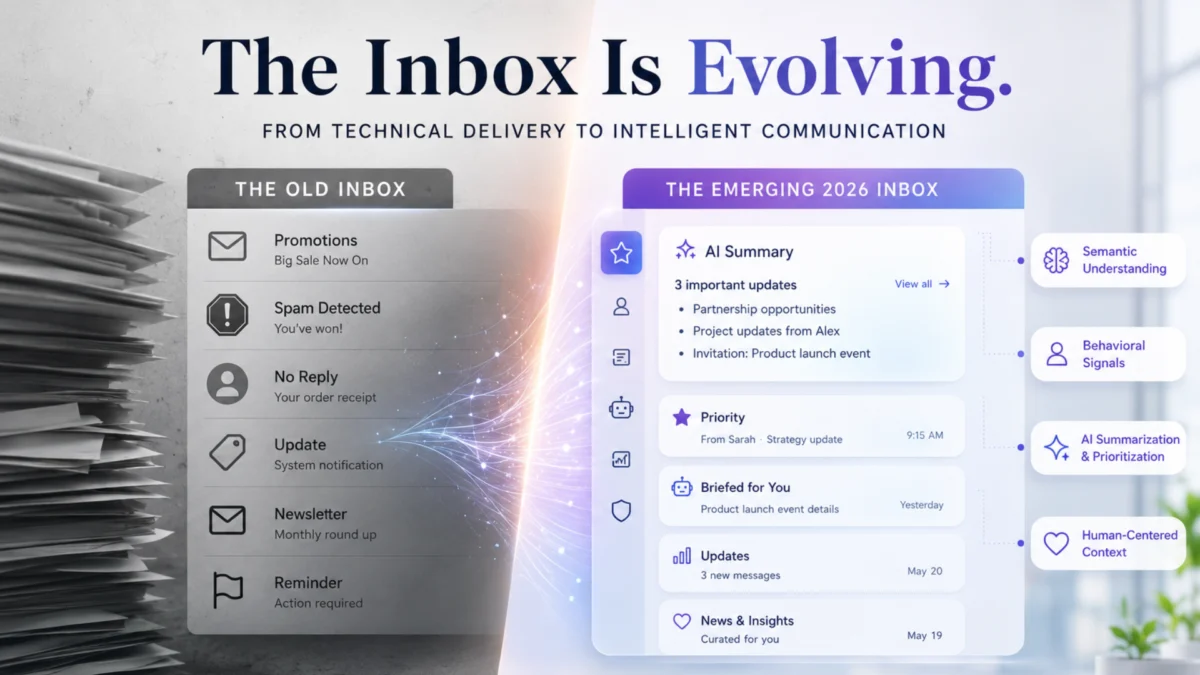
For the past decade, the email industry has operated under a singular, technical obsession: infrastructure. Deliverability professionals have spent years optimizing for the cold, hard mechanics of digital transit—authentication protocols, inbox placement algorithms, sender reputation, rendering consistency, and sophisticated automation. In this era, "success" was binary: a message arrived, it was opened, and it converted.
However, a profound paradigm shift is underway. Universities and research institutions, ranging from the University of Chicago and MIT Sloan to Cambridge and the National University of Singapore, have begun to view email through a new, sociological, and computational lens. They are no longer just studying how a message travels; they are studying it as an "AI-mediated environment." In this new reality, algorithms summarize, prioritize, interpret, and judge human communication before a recipient even clicks.
This is no longer a theoretical exercise. As machine interpretation, semantic trust, and behavioral modeling begin to reshape digital discourse, the email industry stands at a crossroads.
The Chicago Study: Why AI Prefers AI
The most critical piece of research to emerge this year is “Email in the Era of LLMs” by Dang Nguyen and his colleagues at the University of Chicago. To understand the future of communication, one must first look at how the researchers stress-tested the status quo.
The HR Simulator Experiment
The researchers constructed a "HR Simulator," a controlled game where participants were tasked with writing emails to resolve complex, often awkward workplace scenarios. The study analyzed over 600 emails, split between human authors and Large Language Model (LLM) agents.
The twist? The judges were also LLMs. Under the scrutiny of these algorithmic arbiters, the results were jarring: human-written emails achieved a success rate of approximately 23.5%, while AI-generated emails scored between 48% and 54%.
The Illusion of "Preference"
It is tempting to interpret this data as evidence that humans prefer AI-written content. That is a misreading. The study actually demonstrates that AI prefers AI.
Because the evaluation was conducted by machine judgment, the results highlight a phenomenon known as "model convergence." As LLMs grow in scale and sophistication, they increasingly agree on what "good" communication looks like—favoring a specific, highly formal, and hyper-empathetic tone.
The researchers discovered one critical caveat: when a human acted as an editor, refining and redirecting an AI’s raw draft, the success rate surged, in some scenarios reaching nearly 100%. The data suggests that while automation provides the efficiency and polish, judgment remains a uniquely human asset.
The "Imperfect" Blind Spot
The study also exposed a distinct limitation in current AI: the inability to be "imperfect." AI models excelled at high-empathy, high-formality writing but failed to replicate the blunt, informal, and messy register of authentic human interaction. As synthetic polish becomes the standard, professionals are beginning to speculate that "over-optimization" may soon become a signal for spam, potentially inverting the "cleaner-is-better" philosophy that marketers have followed for years.
Chronology of a Shifting Landscape
The transition from simple delivery to semantic interpretation didn’t happen overnight. It is the result of a multi-year convergence of technical necessity and generative capability.
- 2020–2022: The industry focuses on tightening DMARC and BIMI standards to combat widespread phishing.
- 2023: Generative AI enters the mainstream, and inbox providers begin integrating "smart" summaries and priority inbox features.
- 2025: Research papers like PersonaMail begin exploring how AI can mimic individual human speech patterns, shifting the goalpost from demographic segmentation to behavioral emulation.
- 2026: Leading academic institutions, including MIT Sloan and Stanford, publish comprehensive reports on "AI and Work," highlighting that the inbox is no longer just a mailbox—it is an interaction layer.
DKIM2: From Identity to Integrity
The technical foundation of email is also evolving to meet this new reality. At the 2026 Deliverability Summit in Barcelona, Professor Richard Clayton of Cambridge University introduced "DKIM2."
While traditional DKIM serves as a digital passport—verifying that a sender is who they claim to be—DKIM2 is designed as a "chain-of-custody" record. It documents what happens to a message from the moment it leaves the sender until it arrives in the inbox.
In a world where mail is constantly being mangled by forwarding systems, mailing lists, and security gateways, DKIM2 introduces the concept of the "recipe": metadata that tracks every transformation a message undergoes. This represents a fundamental shift in the industry: trust is no longer just about identity; it is about the integrity and context of the message throughout its lifecycle.
The Fragility of the Foundation
Despite these advancements in semantic intelligence, the industry remains plagued by fundamental technical instability. A study by Tino Hager (Mailtower.app) and Professor Ronald Petrlic (TH Nürnberg), presented at MADWeb 2026, investigated why properly authenticated emails frequently fail SPF or DKIM checks.
After analyzing over 100,000 test messages across major mailbox providers, the researchers concluded that the DNS infrastructure itself is often the bottleneck. Small inconsistencies in DNS response sizes, resolver quirks, and provider-specific implementations create failures that are nearly impossible for standard practitioners to debug.
This creates a paradox: the industry is busy debating the "semantic intelligence" of AI-driven inboxes while the underlying plumbing—the DNS architecture—remains alarmingly prone to failure under ordinary operational strain.
Implications: The Rise of Behavioral Personalization
The most ambitious, and perhaps most controversial, line of research is the move toward "behavioral personalization." Systems like PersonaMail aim to model an individual’s unique rhythm, tone, and relationship context.
If successful, this technology moves beyond traditional "first-name" personalization. It asks: How does this person actually communicate? Once a machine can emulate your personal voice, the questions of consent, emotional profiling, and behavioral manipulation move from the realm of science fiction to urgent ethical policy.
The Return to Human Signal
As the inbox becomes saturated with synthetic empathy, there is a quiet, growing trend among email professionals: a return to plain text, conversational structure, and "lumpy" human writing.
There is a realization that in an inbox where both the sender and the recipient are using AI, the only way to cut through the noise is to provide "human signal." Automation buys speed and scale, but distinctiveness remains a scarce, human asset.
Conclusion: A Late Conversation
The academic community has begun treating the inbox as an interaction layer between humans, algorithms, and trust systems. The email industry, historically focused on the mechanics of delivery, is admittedly late to this conversation.
While large inbox providers continue to run on traditional signals like reputation and abuse prevention, the rise of semantic evaluation, adversarial gaming, and AI-mediated communication is changing the stakes. We are entering an era where the success of a message may depend not on its reputation, but on whether the machine reading your mail "likes" the machine that wrote it.
As we move forward, the challenge for the email professional is clear: embrace the technical evolution of integrity-based security like DKIM2, while simultaneously preserving the messy, imperfect, and uniquely human elements that machines are still learning to fake. The future of email is not just about getting to the inbox; it’s about surviving the algorithms that live inside it.
For more insights into these shifting paradigms, join the ongoing discussions at the emailexpert forum.