The modern executive stands at a precarious crossroads. Every day, business leaders attempt to navigate an environment where artificial intelligence is evolving at a velocity that far outstrips the pace of our traditional institutions, corporate policies, and economic frameworks. As the lines between human labor and machine capability blur, the central challenge is no longer just "how do we implement this technology," but "how do we adapt our society and our organizations to survive the transition?"
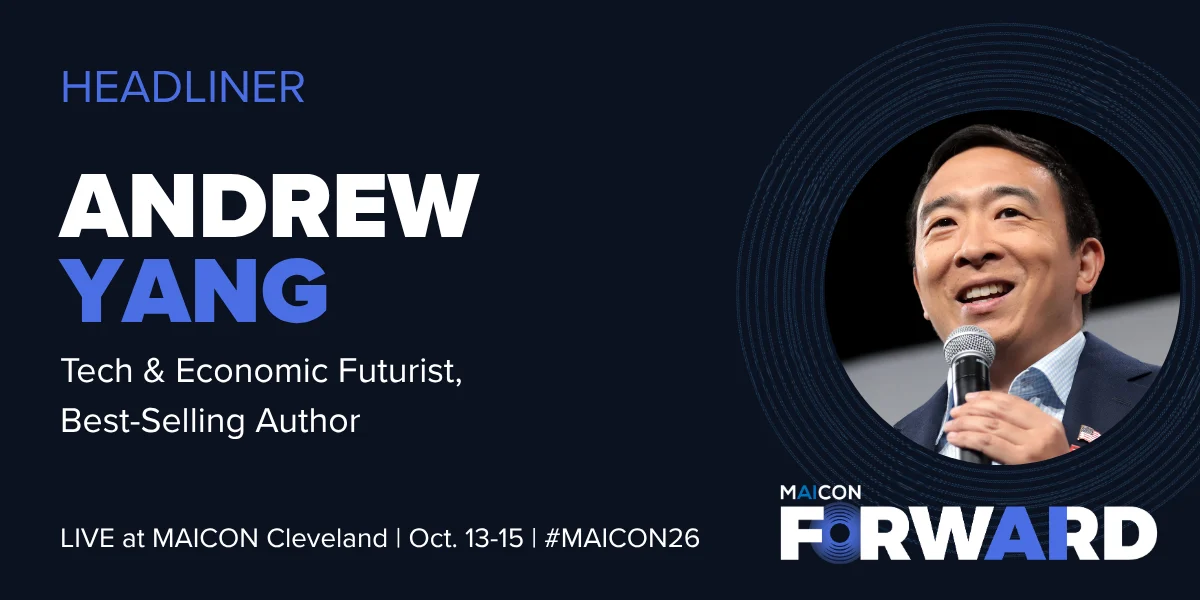
It is a question that entrepreneur, former presidential candidate, and best-selling author Andrew Yang has been asking for years—long before AI became the central topic of every boardroom discussion. As the featured keynote speaker for the Marketing Artificial Intelligence Conference (MAICON) 2026, Yang will bring a seasoned perspective to the stage, one that has been sharpened by years of intense public debate, policy research, and technological analysis.
The Man Who Saw It Coming: A Chronology of Prescience
To understand why Yang’s voice carries such weight in 2026, one must look back to his 2020 presidential campaign. At the time, his platform was viewed by many political observers as alarmist. While the American economy appeared robust and the concept of "automation-driven job displacement" felt like a distant, abstract threat relegated to science fiction, Yang was sounding the alarm.
The 2020 Campaign: The Early Warning System
Yang’s primary argument was that AI and robotics were on the verge of fundamentally dismantling the American labor market. He introduced Universal Basic Income (UBI) not merely as a populist policy, but as a necessary economic shock absorber for a workforce facing unprecedented structural shifts. While mainstream media often reduced his platform to a $1,000-a-month proposal, the deeper context was a warning: the current institutional architecture of the United States was woefully unprepared for the AI revolution.
The Shift from Hypothetical to Immediate
The dismissal of Yang’s early warnings has given way to a stark, modern reality. In a 2024 post titled AI and the Rest of Us, Yang provided a tangible example of the disruption he predicted: "Just the other day I spoke to someone who said they used to have 15 designers suggesting various ideas for graphics and clothing. They recently fired them all because now they use AI for the same task. A lot of creative work is being changed to utilize AI, which often means fewer workers. What four years ago was hypothetical is now immediate."
This shift marks a critical inflection point. The discussion has evolved from "will AI change our jobs?" to "how many jobs are being fundamentally redefined or eliminated this quarter?"
Supporting Data: The Economic Reality of the AI Era
The implications of Yang’s thesis are backed by mounting data regarding productivity and labor displacement. According to various labor market studies, the integration of generative AI is not merely supplementing roles—it is consolidating them.
- The Creative Contraction: As Yang noted, sectors once thought to be "safe" from automation—such as graphic design, copywriting, and middle-management analysis—are experiencing the highest rates of workforce reduction as firms lean into automated efficiency.
- The Productivity Paradox: While corporate output remains high, the correlation between growth and headcount is decoupling. AI allows firms to achieve the same or better results with significantly smaller teams, a trend that is creating a "hollowed-out" middle class in the white-collar sector.
- Institutional Lag: Current federal policies regarding workforce retraining and education remain tethered to an industrial-age model, failing to address the rapid cycle of skill obsolescence driven by Large Language Models (LLMs) and autonomous agents.
Official Responses and the Philosophical Shift
Yang has spent the years since his campaign interviewing leading technologists, policy architects, and economic thinkers to refine his strategy. His approach has moved beyond simple warnings; it is now a framework for action.
In his 2025 TED Talk, he reiterated the urgency: "I went around the U.S. making the case that AI was going to come and change everything and that we needed to evolve our economy, adopting measures like universal basic income, to prepare for the future."
The "official" response from the business community, however, has been fragmented. Many corporations are focused on short-term ROI, prioritizing AI adoption to reduce operational costs. Conversely, forward-thinking leaders are starting to align with Yang’s perspective, acknowledging that a sustainable business model requires a sustainable consumer base. If companies systematically replace their employees with AI, they ultimately erode the purchasing power of the very people meant to buy their products and services.
![Andrew Yang: How AI Can Build a Future that Works for Everyone [MAICON 2026]](https://www.marketingaiinstitute.com/hubfs/Andrew%20Yang.png)
Implications: The Human-Centered Economy
For leaders attending MAICON 2026, the stakes are not merely academic. They are operational. Decisions made today regarding AI strategy—such as vendor evaluation, long-term workforce planning, and the ethical governance of algorithms—will define the success of their organizations over the next decade.
Navigating the "Black Box" of Strategy
Yang’s message is not anti-technology. He acknowledges the immense potential for AI to revolutionize healthcare, accelerate scientific discovery, and solve previously intractable problems. However, he offers a cautionary framework: "Left to its own devices, there will be some major downsides. If we want more of the good and less of the bad, it will be up to us and our leaders."
The Roadmap for Modern Leadership
For those in the C-suite, the implications are three-fold:
- Workforce Resilience: How do we transition our human talent to roles that AI cannot easily replicate?
- Governance and Ethics: How do we ensure that our AI tools are not reinforcing systemic bias or creating catastrophic points of failure?
- Economic Integration: How do we ensure our business models contribute to the broader stability of the economy, rather than participating in a race to the bottom that diminishes our consumer base?
What to Expect at MAICON 2026
Andrew Yang’s keynote, titled "The Human-Centered Economy: Building a Future That Works for Everyone," will serve as a cornerstone of the MAICON 2026 experience. Unlike technical deep-dives into LLM fine-tuning or prompt engineering, Yang’s presentation will zoom out. It is designed for leaders who are tasked with steering their organizations through the turbulent waters of the Fourth Industrial Revolution.
Attendees can expect a rigorous, honest examination of the economic forces that are shaping the workplace of tomorrow. Yang will challenge participants to think beyond the immediate technical deployment and consider the long-term societal role of their organizations. Whether you are a technologist, a policymaker, or a business executive, his message acts as a strategic compass for navigating a world where the only constant is accelerated change.
Conclusion: Preparing for the Future
The challenge of the AI era is one of leadership. It requires the courage to acknowledge that our current systems are insufficient and the foresight to build something better. As the host of The Andrew Yang Podcast and a prominent figure in the Forward Party, Yang continues to press for the structural reforms necessary to ensure that human beings remain the primary beneficiaries of technological progress.
At MAICON 2026, joined by over 50 other top AI and business leaders, the goal is clear: to move from being passive observers of the AI revolution to active architects of a human-centered future.
If you are responsible for how your organization prepares for, adopts, and governs AI, this keynote is more than a presentation—it is a mandatory checkpoint. It is an opportunity to gain a grounded, honest framework for understanding the forces that are shaping your business decisions today and to ensure that you are positioned to thrive in the years to come.
Join us at MAICON 2026 to hear Andrew Yang and over 50 other visionaries define the future of business in the age of AI. Secure your place at the table and ensure your organization is ready for what comes next.