In the rapidly evolving landscape of digital marketing, the integration of Artificial Intelligence (AI) has moved beyond simple copy generation into the complex world of data analysis and reporting. One of the most significant technological shifts in recent months is the emergence of the Model Context Protocol (MCP). While many agencies and in-house marketers are hailing MCP as a "reporting revolution," a critical distinction is being lost in the hype.
The following analysis explores the technical architecture of modern Pay-Per-Click (PPC) reporting, examining why MCP—while transformative for ad-hoc investigation—cannot serve as a standalone client reporting system, and why BigQuery remains the essential "memory" for any professional marketing operation.
1. Main Facts: Defining the MCP and the Reporting Dilemma
To understand the current friction in marketing analytics, one must first define the Model Context Protocol (MCP). In technical terms, MCP is an open standard that enables AI assistants, such as Anthropic’s Claude, to establish a secure, standardized connection with external data sources and tools.
For a PPC specialist, an MCP server acts as a sophisticated translator. Instead of a human downloading a CSV from Google Ads, opening a spreadsheet, and manually uploading that data into an AI chat, the AI assistant uses MCP to "talk" directly to the platform. By utilizing connectors like GoMarble, marketers can ask Claude questions about Google Ads, GA4, or BigQuery in plain English.
The Misconception of "Solved" Reporting
The primary fact confronting the industry is a growing category error: many practitioners assume that because they can query a platform via MCP, they have built a reporting system. This is incorrect. MCP provides accessibility, not governance.
- MCP’s Strength: High-speed, natural language investigation of "messy" questions (e.g., "Why did my conversion rate dip last Tuesday?").
- MCP’s Weakness: Lack of persistence, high token costs, and the risk of inconsistent definitions across different chat sessions.
The reality is that professional client reporting requires three distinct layers: native platform tools for internal hygiene, MCP for exploratory "detective work," and a data warehouse (BigQuery) for the final, authoritative record.

2. Chronology: The Evolution of the PPC Data Stack
The journey to our current technological crossroads has moved through four distinct eras, each attempting to solve the problem of data visibility.
The Era of Manual Tabulation (2000s – 2010s)
In the early days of AdWords, reporting was a labor-intensive process of exporting .csv files and building complex pivot tables in Excel. This era was defined by "static truth"—by the time a report was formatted, the data was often 48 hours old.
The Dashboard Proliferation (2015 – 2023)
The rise of Looker Studio (formerly Data Studio) and Tableau allowed for live API connections. This solved the "freshness" problem but created "dashboard fatigue." Clients were given access to live data but lacked the context to understand why the numbers were moving.
The Generative AI Explosion (2023 – Early 2024)
Marketers began copy-pasting data into ChatGPT or Claude. This provided the "why" (commentary) but was plagued by "hallucinations" and the manual friction of data movement. It was a step forward in insight, but a step backward in workflow efficiency.
The MCP and Governed Data Era (Late 2024 – Present)
We have now entered an era where the AI can fetch its own data. However, as the industry is currently discovering, an AI with a direct connection to an API is only as smart as the prompt it is given. This has led to the current push for a "Combined Stack" that uses MCP for agility and BigQuery for structural integrity.
3. Supporting Data: The Technical and Economic Reality
The argument for a multi-tiered reporting system isn’t just theoretical; it is driven by the technical constraints of Large Language Models (LLMs) and the economic realities of API usage.

The Token Cost Argument
When an AI assistant queries a platform like Google Ads via a direct MCP connection, it often pulls a massive amount of raw data into its "context window."
- Direct MCP Query: Claude might ingest every campaign ID, ad group setting, and daily metric for a 30-day period to answer one question. This consumes a significant number of tokens, increasing the cost of the session and eventually hitting the model’s context limit.
- BigQuery Query: When the AI queries a pre-aggregated BigQuery "View," it only receives the summarized answer (e.g., "Brand Spend: $5,000, Non-Brand Spend: $12,000"). This reduces token consumption by as much as 90%, making the process faster and more cost-effective.
The Attribution Gap
Supporting data from various platforms often conflicts. Google Ads uses its own attribution models, while GA4 uses another.
- Native Reporting: Google Ads’ internal Gemini-powered reporting is excellent for account-level checks. It allows users to build reports using plain English within the interface.
- The Client Need: However, a client report often requires joining data from Google Ads, Meta, and a CRM like Salesforce. MCP connections to single platforms cannot "join" this data reliably on the fly without a central warehouse.
4. Expert Perspectives: When to Use Which Tool
Industry experts suggest a "Rule of Three" for determining where a reporting task should live. This framework ensures that the tool matches the intent of the query.
Tier 1: The Native Interface (For Internal Hygiene)
If the question is an internal account check—such as "Which search terms are driving the most spend today?"—the native Google Ads interface is the most efficient tool. With the integration of Gemini, Google Ads can now generate these reports via natural language without the data ever leaving the platform.
- Expert Verdict: "If Google Ads can answer it cleanly, stay in Google Ads. Don’t build a complex stack for a simple question."
Tier 2: Direct MCP (For Ad-Hoc Investigation)
MCP shines when the question is "disposable." These are one-off, exploratory threads where the marketer doesn’t know the next question until they see the answer to the first one.
- Use Case: "I see a spike in CPA last Wednesday. Claude, look at the change history via MCP—did we increase bids on a specific keyword, or did our landing page conversion rate drop simultaneously?"
- Expert Verdict: "MCP is your detective. It follows threads and pulls context that isn’t worth building a permanent table for."
Tier 3: BigQuery Views (For Everything That Matters Twice)
The moment a metric becomes a "Key Performance Indicator" (KPI) or enters a client-facing report, it must be moved to BigQuery.

- The Concept of "Views": A BigQuery View is a saved piece of logic. For example, instead of asking Claude to "find all campaigns with ‘Brand’ in the name" every time, you create a View in BigQuery that defines Brand vs. Non-Brand.
- Expert Verdict: "Client reporting needs a memory. If you ask a question twice, or if a budget decision depends on the answer, it belongs in a BigQuery View. This ensures the definition of ‘Success’ doesn’t change based on how you phrase a prompt that day."
5. Implications: The Future of the PPC Professional
The shift toward an MCP-BigQuery combined stack has profound implications for the role of the digital marketer and the expectations of the client.
The Death of the Manual Dashboard
For years, agencies billed hours for "reporting." As AI assistants become more adept at querying BigQuery views and generating natural language commentary, the static, 20-page PDF report is becoming obsolete. The future is "On-Demand Reporting," where a client can ask an AI-powered interface for a status update, and the AI generates a response based on governed data.
The Rise of the Data Governor
The PPC specialist’s value is shifting from building reports to governing the logic behind them. The "BigQuery for Everything That Matters Twice" rule means the marketer must be able to define business logic in a way that an AI can consistently retrieve. This requires a deeper understanding of data structures than previous generations of marketers needed.
Trust and Reliability
The most significant implication is the restoration of trust. By using BigQuery as the source of truth and MCP as the interface, agencies can provide the speed of AI with the reliability of a traditional database.
Final Decision Framework: The Simple Rule
To navigate this new landscape, professionals are adopting a straightforward decision flow:
- One-off question? Use direct MCP (Claude + GoMarble).
- Asked it twice? Create a BigQuery View.
- Client-facing? It must come from governed data in BigQuery.
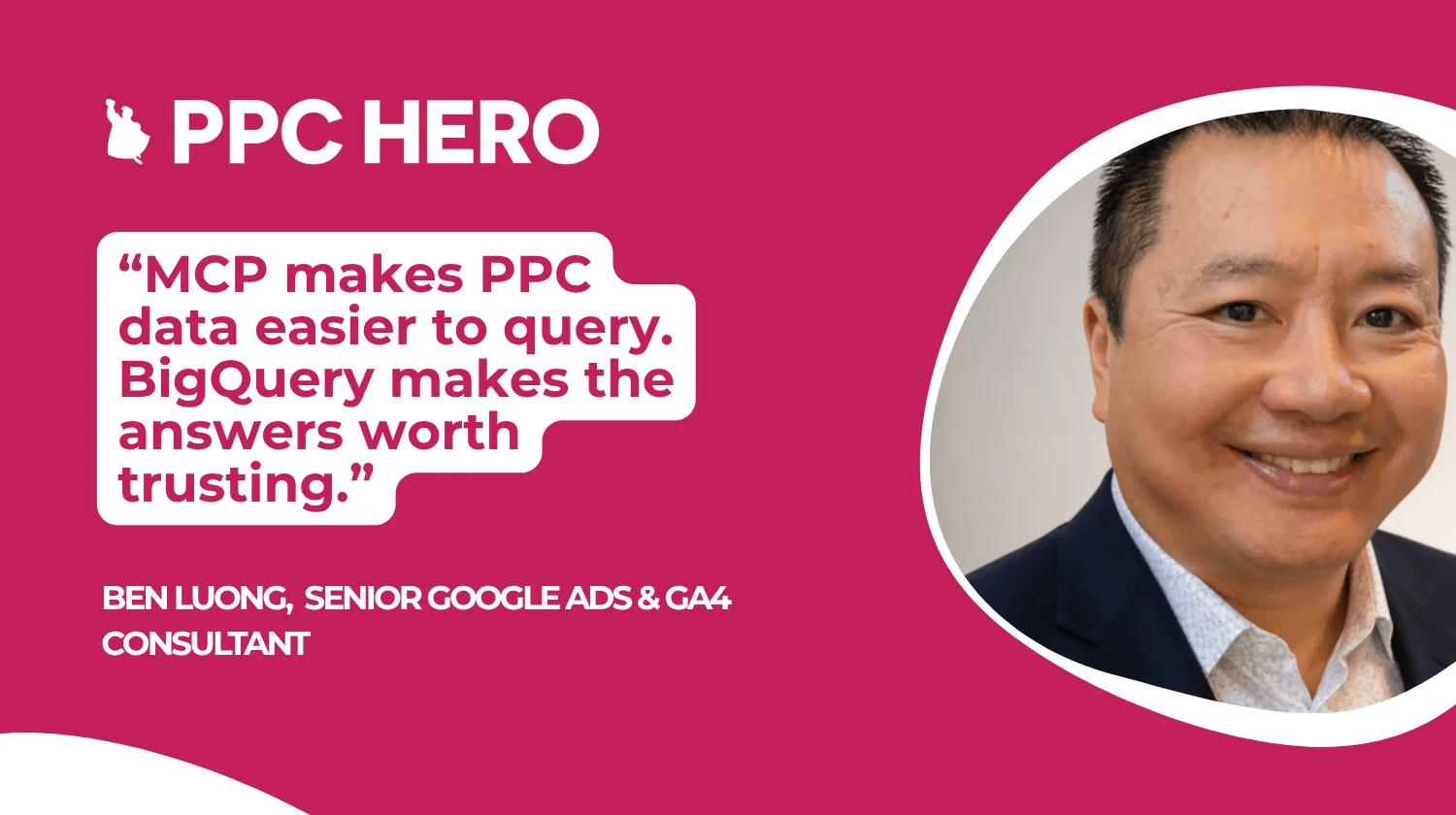
In conclusion, MCP makes PPC data easier to query, but BigQuery makes the answers worth trusting. The agencies that thrive in the coming years will be those that don’t just "connect" their AI to their data, but those that "anchor" their AI in a governed data environment.