The Outlier Video Method: How AI is Revolutionizing Content Research and Production
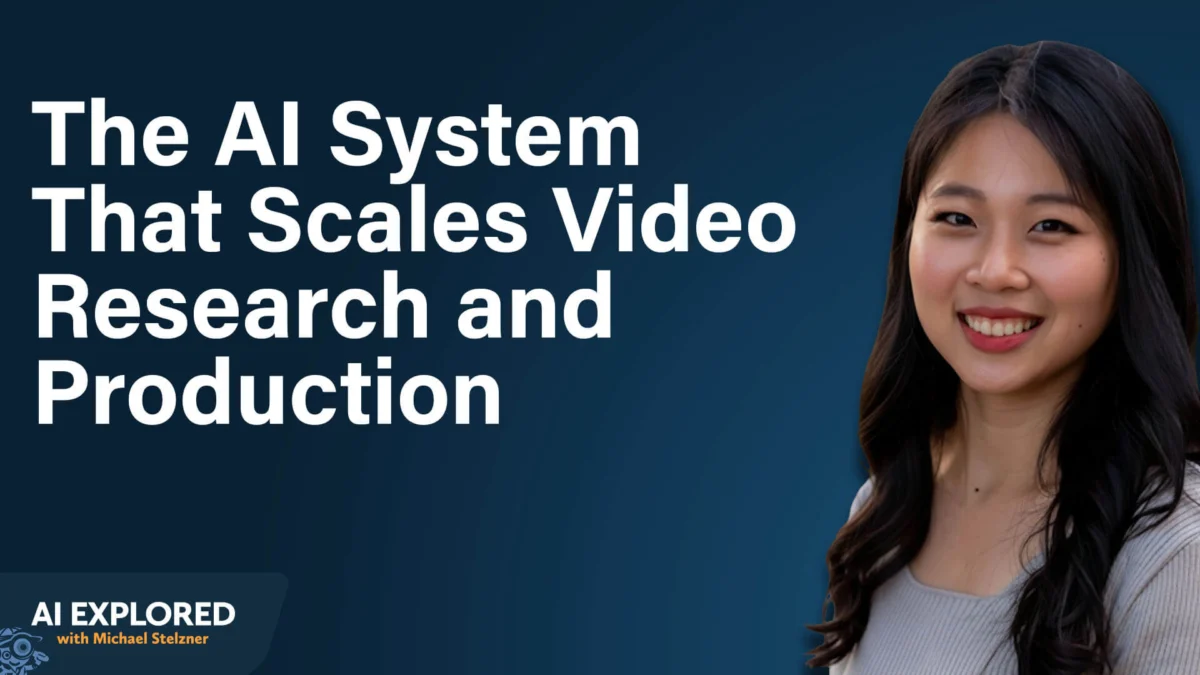
For many creators, the life cycle of content production is a relentless, exhausting treadmill. The process—ideating, filming, editing, scripting, and publishing—creates a loop that often leads to burnout. Sandy Lee, a veteran digital educator who scaled a language-learning channel to over 550,000 subscribers, knows this struggle better than most. However, in late 2025, she pivoted from manual labor to an automated, AI-driven framework that transformed her workflow, helping her build a new channel from 200 to 11,000 subscribers in less than 30 days while generating significant revenue.
This new approach, which she calls the "Outlier Video Method," leverages Claude Code to automate the most time-consuming parts of the creative process. By utilizing a system of AI agents, creators can now identify what truly works in their niche and produce high-performing content without sacrificing their unique voice.
The Core Concept: Moving Beyond Manual Labor
The traditional creator economy model relies on the creator doing everything. For someone balancing a full-time job, client work, and parenting, this model is unsustainable. Lee’s solution was to treat her content business like a software engineering project. She designed a system consisting of seven distinct AI agents—functioning like a team of senior and junior developers—to handle the heavy lifting.
The system is designed to remove the "grind" while maintaining the creator’s creative integrity. It acts as an automated research assistant, a copywriter, and a strategist, leaving the creator to focus on the one thing AI cannot replicate: showing up on camera with authentic human connection.
Establishing Foundations: The Ikigai Framework
Before integrating AI, Lee emphasizes that the creator must define their "reason for being." Drawing on the Japanese concept of Ikigai, she encourages creators to map out four pillars: what you love, what you are good at, what the world needs, and what people will pay for.
This foundational work must be done manually, away from screens and algorithms, to ensure the output is genuine. Once the four pillars are defined, they are fed into an AI tool to generate two vital assets:
The Ideal Customer Profile (ICP): A detailed breakdown of the target audience, including their pain points, search habits, and purchasing intent.
Content Pillars: A set of 3–5 recurring topics that sit at the intersection of the creator’s expertise and the audience’s needs.
By defining these parameters, the AI system gains the context necessary to distinguish between "noise" and "signal" when researching the broader market.
The Engineering of Research: The Outlier Score
The most innovative aspect of Lee’s system is how it defines success. Rather than chasing generic viral trends, the system uses a mathematical formula to identify "outlier" videos—content that performs significantly better than a channel’s typical output.
The formula for the Outlier Score is:
(Video Views in First 48 Hours ÷ Channel’s Average Views in First 48 Hours) × 100
A score exceeding 100 indicates that a video has struck a nerve, regardless of the creator’s pre-existing subscriber count. This allows the AI to ignore "vanity metrics" (views based on large follower bases) and focus on "signal metrics" (content that is objectively resonating with viewers). Lee’s system, powered by Claude Code and connected to the YouTube API, automatically monitors a curated list of competitors and sends a daily digest of these high-performing outliers directly to her inbox.
Chronology: From Analysis to Execution
The workflow operates in a structured, four-phase cycle:
Phase 1: Identification. Every 48 hours, the system scans target channels and calculates the Outlier Score for recent uploads.
Phase 2: Automated Analysis. Once a video is flagged as an outlier, the system breaks down its success. It evaluates the thumbnail layout, the curiosity-inducing title, and the specific hook used in the first 30 seconds.
Phase 3: Scripting. The AI generates a draft script that mirrors the successful structure and "flow" of the outlier video but adapts it to the creator’s specific voice, ICP, and content pillars.
Phase 4: Execution. The creator reviews the script, makes minor adjustments, and films the content.
This process ensures that the creator is not starting from a blank page but is instead iterating on a proven, high-performing framework.
The Hook Framework: Capturing Attention in a Crowded Market
The most critical part of any video is the opening 30 seconds. Lee’s system utilizes a specific seven-part hook formula designed to trigger immediate engagement:
The Promise: Stating exactly what the viewer will get.
The Stakes: Why this matters right now.
The Proof: Establishing credibility or authority.
The Bridge: Connecting the viewer’s current struggle to the solution.
The Curiosity Gap: Hinting at a non-obvious secret or insight.
The Call to Action (Soft): Inviting engagement early.
The Transition: Moving smoothly into the meat of the video.
By applying this structure through AI, the system ensures that every video has the structural integrity required to retain viewers in an age of decreasing attention spans.
Implications for the Creator Economy
The Outlier Video Method represents a significant shift in how personal brands are built. It suggests that the future of content creation is not "AI-generated" in the sense of replacing the human, but "AI-supported" in the sense of removing administrative and analytical friction.
Economic Impact
For Sandy Lee, the results speak for themselves: $10,000 in revenue in just one month and a rapidly growing audience. By automating the research phase, she reclaimed hours of her day, which she reinvested into higher-value activities like community management and client services. This model demonstrates that creators can scale their output without necessarily scaling their workload, provided they have a robust AI infrastructure in place.
The Human Element
Critics of AI in content creation often argue that it leads to generic, "soulless" content. However, the Outlier Video Method argues the opposite: by using AI to handle the mundane tasks of trend spotting and structural formatting, creators are freed to inject more of their personality, unique stories, and genuine insights into the camera. The AI acts as the skeleton; the creator provides the muscle and the soul.
Conclusion: The Future of Production
As tools like Claude Code continue to evolve, the barrier to entry for professional-grade content research is collapsing. Creators who refuse to integrate AI into their research and scripting workflows may soon find themselves at a structural disadvantage compared to those who can produce high-quality, data-backed content at scale.
The lesson from Sandy Lee’s success is clear: AI is not a replacement for creativity; it is a force multiplier for it. By leveraging technology to identify what works, and using that data to inform a human-led creative process, creators can build sustainable, profitable, and meaningful businesses that survive the volatility of the digital age.
For more on building scalable content systems, followers of this methodology can explore Sandy Lee’s community, where she shares further insights into the specific AI agents and workflows that underpin this approach.